How Much Power Does Bitcoin Really Use? Key Bitcoin Energy Consumption Statistics
Key Takeaways
- •Bitcoin's network consumes an estimated 204.44 TWh of electricity per year—more than double Finland's annual usage—with total power demand estimated at 18.35 gigawatts.
- •A single Bitcoin transaction generates about 465.63 kg of CO2, a carbon footprint equivalent to more than one million Visa transactions.
- •Renewables now supply over 52% of Bitcoin mining energy, though the share fell from 41.6% to 25.1% after China's 2021 mining ban pushed miners toward coal- and gas-based power in the United States and Kazakhstan.
- •Beyond carbon, Bitcoin mining produces an estimated 22.16 kilotonnes of e-waste annually and consumes 3,222 gigaliters of freshwater, comparable to Switzerland's total annual water use.
- •Bitcoin has no realistic path to transition from Proof of Work to Proof of Stake, unlike Ethereum, because mining underpins the scarcity and security that most developers and stakeholders view as central to its value.
Bitcoin is the world's largest cryptocurrency by market value—and one of the most energy-intensive computing networks on the planet. Its appetite for electricity stems from Proof of Work, the mining process that secures the network. Miners run powerful computers around the clock to validate transactions and earn newly created coins, and that relentless computation draws enormous amounts of power.
This article compiles the latest available data on Bitcoin's environmental footprint, spanning electricity use, carbon emissions, water consumption, and electronic waste, along with comparisons to traditional payment systems and other industries.
Bitcoin's Energy Use at a Glance
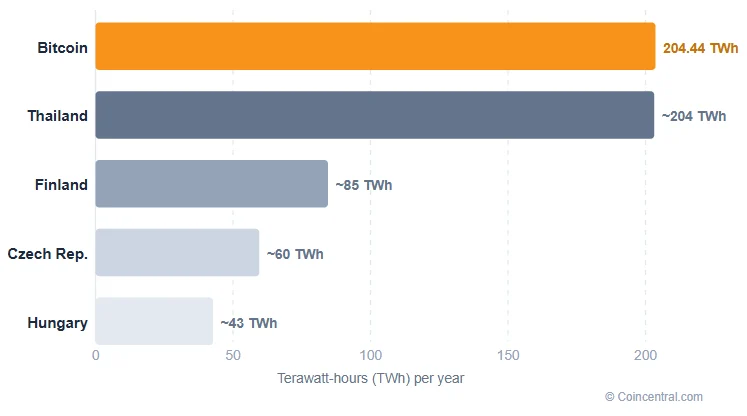
Bitcoin's network consumes an estimated 204.44 terawatt-hours (TWh) of electricity per year—roughly the annual power consumption of Thailand, a nation of 72 million people. For context, Finland uses about 85 TWh annually and Hungary around 43 TWh. Bitcoin's estimated consumption is more than double Finland's and nearly five times Hungary's, despite the network not powering a single home, factory, or city.
The figures come from the Bitcoin Energy Consumption Index (BECI), which tracks the network's energy use through an economic model. The index assumes miner income and electricity costs move in lockstep: when miners earn more, they can afford to run more powerful machines, pushing total consumption upward.
Rather than a single figure, the model produces a range. The lower bound is 82.45 TWh, based on best-case hardware efficiency, while the upper bound reaches 309.35 TWh assuming older, less efficient machines. The mid-range estimate of roughly 160 to 204 TWh is treated as the most credible daily figure.
Bitcoin's energy use first drew broad public attention around 2017, when its price surged and mining expanded rapidly. At its peak in early 2022, the network's consumption briefly exceeded Finland's on some estimates. Since then, figures have fluctuated with Bitcoin's price, underscoring the direct link between the two.
Mining hardware efficiency currently stands at an estimated 17.01 joules per terahash (J/TH). The most efficient machines operate at around 9.50 J/TH, while older units can reach 30 J/TH or more. Total network power demand is estimated at 18.35 gigawatts (GW).
That demand is not fixed. When prices rise, mining becomes more profitable, attracting more miners and lifting consumption; when prices fall, less efficient miners shut down and energy use drops.
The Carbon Footprint of Bitcoin
Bitcoin's total carbon footprint is estimated at 114.03 million tonnes of CO2 (Mt CO2) per year, roughly equal to the annual emissions of the Czech Republic as a country.
A single Bitcoin transaction generates an estimated 465.63 kilograms of CO2. By comparison, a single Visa transaction produces about 0.45 grams. One Bitcoin transaction therefore generates the same carbon as roughly 1,031,993 Visa transactions—or 77,605 hours of watching YouTube.
The carbon intensity of Bitcoin's electricity mix has been rising. A 2022 study published in the journal Joule found that average carbon intensity climbed from 478.27 grams of CO2 per kilowatt-hour (gCO2/kWh) in 2020 to 557.76 gCO2/kWh by August 2021.
The shift followed China's crackdown on Bitcoin mining in spring 2021. Before the ban, Chinese miners on a meaningful share of hydroelectric power during wet seasons. After relocating to the United States and Kazakhstan, they switched to coal- and gas-based electricity, pushing the network's overall carbon intensity higher. The renewables share of the mining mix fell from 41.6% before the ban to 25.1% shortly afterward—one of the clearest examples of how a policy decision in one country can rapidly reshape the global environmental cost of mining.
Bitcoin vs. Traditional Payment Systems
A single Bitcoin transaction uses an estimated 834.82 kilowatt-hours (kWh) of electricity—enough to power an average U.S. household for 28.61 days.
Visa processed 138.3 billion transactions in 2019 while consuming 740,000 gigajoules of energy across all of its global operations, which works out to roughly 0.00149 kWh per transaction. One Bitcoin transaction uses the energy equivalent of 561,675 Visa transactions.
The carbon gap is even wider. Bitcoin emits about 465.63 kg of CO2 per transaction versus 0.45 grams for Visa. Adjusting for Visa's cleaner energy mix, one Bitcoin transaction carries a carbon footprint equal to more than 1 million Visa transactions.
The comparison, however, is not straightforward. Bitcoin's energy use is not determined by how many transactions it processes but by how profitable mining is. Even if nobody used Bitcoin for payments, miners would consume roughly the same amount of electricity. The per-transaction cost is high largely because the transaction count is so low.
Bitcoin's blockchain is capped at roughly seven transactions per second—about 220 million per year under ideal conditions. The global financial system handles more than 700 billion digital payments annually, and Visa alone can process over 65,000 transactions per second at peak capacity. Bitcoin's total theoretical annual capacity represents just 0.03% of global digital payment volume. Countries with modest payment systems exceed it: Hungary, for example, processes more than 300 million electronic payments per year, meaning Bitcoin would need its entire annual capacity just to serve Hungary, leaving nothing for the rest of the world.
The Renewables Question
Not all Bitcoin mining runs on fossil fuels. Research by ESG analyst Daniel Batten found that more than 52% of Bitcoin mining now uses renewable energy.
Hydropower is the single largest source, accounting for 23.12% of the energy mix, followed by wind at 13.98%. Solar provides 4.98% and other renewable sources 2.40%, bringing the combined renewable share to 52.40%. Nuclear and non-renewable sources account for 7.94%. The remaining roughly 47.6% comes from fossil fuels—primarily coal and natural gas in the United States and Kazakhstan, which became the largest Bitcoin mining regions after China's 2021 crackdown pushed miners out.
The renewable share dropped sharply after that ban. Before it, renewables made up an estimated 41.6% of the mix, aided partly by cheap Chinese hydropower during the wet season. The figure fell to 25.1% immediately after, then recovered over time as miners adopted cleaner options.
A structural barrier limits how far renewables can go. Bitcoin miners need constant power, 24 hours a day, 365 days a year, while renewable sources like wind and solar are intermittent and do not always generate electricity when demand exists. When renewable output drops, miners draw on whatever backup power is available—and in most regions that backup is fossil fuel. A peer-reviewed paper in the journal Joule titled "Renewable Energy Will Not Solve Bitcoin's Sustainability Problem" argues this mismatch makes Bitcoin and renewables a poor fit at scale: renewables reduce baseload fossil fuel use, but Bitcoin miners increase baseload demand and cannot pause during low-generation periods.
Electronic Waste and Water Consumption
Bitcoin's environmental impact extends beyond electricity and carbon. Mining also generates substantial electronic waste (e-waste) and consumes freshwater for equipment cooling.
The Bitcoin network produces an estimated 22.16 kilotonnes (kt) of e-waste per year, comparable to the volume of small IT equipment waste generated annually by the Netherlands. A single transaction accounts for approximately 90.50 grams—roughly the weight of half an iPhone 12.
Mining hardware has a short useful life because newer, more efficient machines continually displace older models, and once a rig becomes unprofitable to run it is typically discarded. Unlike consumer electronics, old mining rigs rarely have a secondary market or practical reuse case, as they are highly specialized devices built for a single purpose.
Freshwater is another cost. The network's estimated annual water consumption is 3,222 gigaliters (GL), comparable to Switzerland's total annual water use. A single transaction consumes an estimated 13,157 liters of water—roughly the amount held in a backyard swimming pool.
Bitcoin Mining vs. Gold Mining
Bitcoin is often called "digital gold," and the comparison rests on real similarities: both assets have a fixed maximum supply and require sustained effort to produce. It also extends to environmental cost, where Bitcoin does not come out well.
Around 3,531 tonnes of physical gold are mined globally each year, and the gold mining industry's total CO2 emissions run to approximately 81 million metric tonnes annually. Producing one Bitcoin's worth of gold generates roughly 33 tonnes of CO2. Mining one Bitcoin through the Bitcoin network produces an estimated 690 tonnes, including transaction fees—more than 20 times the per-coin carbon cost of gold.
The comparison has important limits, though. Physical gold, once mined, holds its value indefinitely without anyone maintaining it. Bitcoin mining must continue non-stop for the network to function at all; if miners stopped, the network would cease to operate and existing coins could not be transferred. That creates a permanent, ongoing energy commitment with no off switch. Gold mining could theoretically stop tomorrow and existing reserves would remain intact—Bitcoin mining has no equivalent safety net.
Miner Economics and Energy Costs
Mining is a business driven by profit margins, and the energy consumed by the Bitcoin network is directly tied to how profitable mining is at any given moment.
The Bitcoin Energy Consumption Index estimates annual miner income at approximately $13.8 billion, combining newly created Bitcoin and transaction fees. Electricity accounts for an estimated $10.2 billion of that—roughly 74% of total income—assuming an average electricity rate of $0.05 per kilowatt-hour.
When Bitcoin's price rises, mining revenue increases and miners invest in more machines, drawing more power. When prices fall, the least efficient miners switch off their hardware and total network energy use drops. The result is a direct feedback loop between Bitcoin's market price and its environmental footprint.
Bitcoin's built-in supply limit of 21 million coins reinforces this dynamic. More than 90% have already been mined, and as the cap approaches over the coming decades, mining difficulty will increase, meaning more computation is required per coin. As long as Bitcoin has value, this scarcity mechanism ensures mining remains energy-intensive.
The $0.05 per kWh assumption is conservative. Many large mining operations negotiate lower rates—sometimes as low as 2 to 3 cents—which would make mining even more profitable and could sustain higher energy consumption than the index estimates.
What Could Change?
Bitcoin's Proof of Work system is written into its software at a fundamental level. Unlike Ethereum, which switched from Proof of Work to Proof of Stake in 2022, Bitcoin has no realistic path to a similar transition.
Proof of Stake uses far less energy: validators create new blocks based on how much cryptocurrency they hold, rather than racing to solve computational puzzles. Switching is estimated to cut energy use by at least 99.85%, reducing a single transaction's footprint from 834.82 kWh to roughly 1.25 kWh or less.
But Proof of Work is part of what gives Bitcoin its specific properties. Mining creates the scarcity and security that many users and investors see as central to Bitcoin's value, and changing the consensus mechanism would alter the network's risk profile in ways that most Bitcoin developers and stakeholders strongly oppose.
Some argue that the Lightning Network, a second-layer payment system built on top of Bitcoin, could reduce per-transaction energy costs by processing many payments off-chain. Yet moving any funds into the Lightning Network still requires a transaction on the main Bitcoin blockchain—if every person alive today needed just one such transaction, it take Bitcoin's main chain 35 years to process them all.
Carbon offsetting offers a partial answer. Planting trees, purchasing carbon credits, or investing in carbon capture can compensate for some emissions, and the crypto industry has started exploring tokenized carbon credits as one approach. But there is no reliable data on how much Bitcoin mining is currently being offset.
The most practical trend has been to locate mines near cheap renewable energy sources. Operations in Iceland use geothermal power, while some facilities in the Pacific Northwest and parts of South America access surplus hydroelectric generation. These moves reduce carbon intensity without changing Bitcoin's underlying design—but they do not remove the structural demand for constant power.
Conclusion
Bitcoin's energy footprint is large, well-documented, and closely tied to the currency's price. The network uses over 200 TWh of electricity per year, produces more than 114 million tonnes of CO2, generates tens of thousands of tonnes of e-waste, and consumes billions of liters of water. Its per-transaction energy and carbon costs are hundreds of thousands of times higher than those of traditional payment systems.
That gap exists not because Bitcoin is wasteful by accident, but because its design prioritizes security and decentralization over efficiency. The energy cost is a deliberate product of Proof of Work.
Over half of Bitcoin mining now runs on renewable energy, and that share is growing. Still, structural limits on renewable power availability mean a full transition to clean energy is unlikely under the current setup, and some fossil fuel backup will almost always be needed to maintain constant mining output.
Whether Bitcoin's environmental cost is justified depends on one's view of its other qualities: decentralization, censorship resistance, and fixed supply. The data above offers a factual picture of what that cost currently looks like in numbers.
Sources
- Digiconomist: Bitcoin Energy Consumption Index (BECI)
- Cambridge Centre for Alternative Finance: Cambridge Bitcoin Electricity Consumption Index (CBECI)
- de Vries, A. & Stoll, C. (2022). "Bitcoin's Growing e-Waste Problem." Joule.00086-3)
- de Vries, A. et al. (2022). "Revisiting Bitcoin's carbon footprint." Joule.00140-6)
- de Vries, A. (2021). "Renewable Energy Will Not Solve Bitcoin's Sustainability Problem." Joule.00586-7)
- Stoll, C. et al. (2019). "The Carbon Footprint of Bitcoin." Joule.30087-X)
- Statista: Bitcoin energy consumption worldwide, 2017–2025 (K. Scholle, Dec 2025)
- Visa Inc.: ESG Report — energy and transaction data
- Daniel Batten: Bitcoin Mining Sustainable Energy Research (ESG)
- Crypto.com: How Much Energy Does Bitcoin Consume?
Source: CoinCentral

