Bitcoin Faces CPI Week Between $63,000 On-Chain Demand Zone and $69,000 Holder Resistance
Key Takeaways
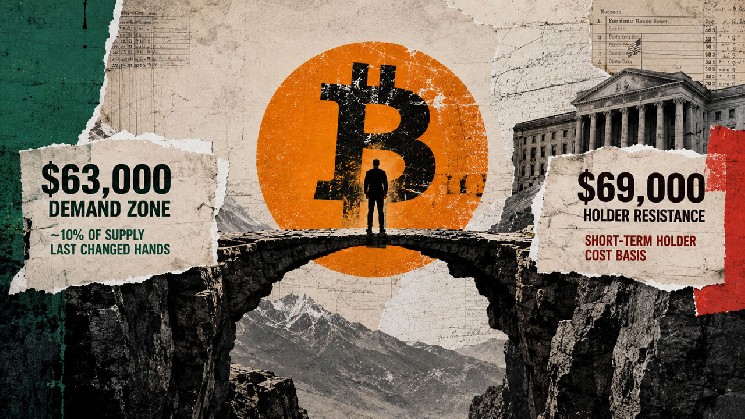
- •Glassnode identifies roughly $63,000 as Bitcoin's largest nearby demand shelf, where about a tenth of circulating supply last changed hands.
- •The short-term holder cost basis is near $69,000, making that level a key resistance point if Bitcoin rises.
- •Economists expect the August 12 CPI report to show headline inflation at 3.4% and core inflation at 2.5%, both below June's readings.
- •Bitcoin has stabilized around $65,000 after falling to about $58,000 in late June, while institutional inflows and taker buying have picked up.
- •Treasury auctions and upcoming US data releases could affect yields and the dollar, which in turn may shape Bitcoin's next move.
Bitcoin Faces CPI Week Between $63,000 On-Chain Demand Zone and $69,000 Holder Resistance
Bitcoin is trading near $64,000 as it heads into what shapes up as the most consequential US macroeconomic week of August, with price sitting almost directly on top of the market's largest nearby demand concentration. The cryptocurrency has been sensitive to Federal Reserve policy signals throughout 2024, having rallied to a March all-time high near $73,000 before pulling back as rate-cut expectations shifted.
The August 12 inflation report, due in under 48 hours, will help determine whether that demand floor holds or comes under pressure.
According to Glassnode's latest on-chain map, that demand shelf sits at roughly $63,000—a zone holding close to a tenth of Bitcoin's circulating supply. Meanwhile, the market's key repair test lies near $69,000, the level at which recent buyers would reach breakeven on their positions.
Why the August 12 CPI Report Matters
July's jobs report revealed that payrolls fell by 23,000, sharply missing expectations for an 80,000 gain. Additionally, May and June figures were revised down by a combined 103,000. In response, traders repriced September rate hike odds down into the mid-to-high 40% range.
For the August 12 Consumer Price Index (CPI) release, economists polled by Reuters expect headline inflation at 3.4% year-over-year and core inflation at 2.5%—both down from June's readings of 3.5% and 2.6%, respectively.
A cooler-than-expected print would validate the case for the Federal Reserve to pause rate hikes. Conversely, a hotter reading would reopen the debate over whether inflation remains sticky even as hiring decelerates—a combination that typically prevents a central bank from stepping back.
Glassnode's July report identified the $63,000 shelf as the price level where approximately a tenth of Bitcoin's supply last changed hands, representing the heaviest concentration of buyers anywhere near the current market price. The short-term holder cost basis—the average price recent buyers paid—stands near $69,000.
Buyers who purchased near the peak of a prior rally and remain underwater tend to sell as soon as price allows them to exit at cost, effectively turning their breakeven point into resistance. Glassnode notes that clearing this level would thin Bitcoin's supply profile into what the firm describes as an "air pocket," with the next structural reference point near $84,000.
Bitcoin's Recovery Remains Narrow
Glassnode's August 10 update indicates that Bitcoin has stabilized near $65,000, recovering from late-June lows around $58,000. Taker buying has accelerated, and perpetual taker activity is running above its typical statistical range.
Institutional net flows are reported as unusually strong, and the options skew has compressed—meaning traders are paying less for downside protection than they previously were. The institutional flow picture has been a recurring theme since the January 2024 launch of US spot Bitcoin ETFs, which brought sustained participation from traditional finance channels.
However, centralized exchange turnover remains subdued. Active addresses, transfer volume, and fees all sit near the lower end of their statistical range, and realized losses across the network continue to outweigh realized profits—a sign that coins acquired at higher prices are still being spent at a loss rather than held in anticipation of recovery.
On the macro calendar, the US Treasury sold $58 billion in 3-year notes on August 11. August 12 brings both the CPI release and a $42 billion 10-year note auction at 1 p.m. EDT, scheduled just hours apart.
August 13 pairs the Producer Price Index (PPI) with a $25 billion 30-year bond auction, bringing the week's total Treasury supply to $125 billion.
Weak demand at either long-duration auction could keep yields elevated even if CPI itself lands close to consensus. A soft inflation print paired with a poorly received 10-year auction would partially offset each other, while a hot print combined with weak auction demand would push yields and risk sentiment in the same negative direction.
A Liquidity-Driven Narrative
Glassnode's mid-July macro analysis tied Bitcoin's recent weakness specifically to real yields, with the 10-year real yield near a 2026 high of 2.4%. Over the same period, Bitcoin's inverse relationship with the dollar has deepened, while its correlation with equities has eased.
Ahead of the August 12 CPI print, the dollar index climbed to 99.76, and the 10-year Treasury yield sits in the 4.66%–4.70% range. Both metrics feed directly into Bitcoin's market setup this week.
August 14 brings July retail sales data. By that point, CPI and Thursday's PPI will have already shaped the market's assessment of inflation and the Federal Reserve's likely policy path.
Strong retail sales alongside a hot CPI would reinforce concerns about a resilient consumer keeping prices elevated. Conversely, weak retail sales paired with a soft CPI would strengthen the argument for a Fed pause.
Scenarios for Bitcoin This Week
In the bullish scenario, CPI lands at or below consensus while the 10-year and 30-year auctions clear without a tail. Yields ease, the dollar softens, and Bitcoin uses that room to test $66,000 first. A decisive break through the $69,000 cost basis—supported by genuine spot buying alongside existing derivatives strength—would open the thinner supply profile above it, with the next structural reference near $84,000.
In the bearish scenario, CPI comes in hot, or the Treasury auctions land poorly enough to keep long yields firm regardless of the inflation reading. September hike odds climb back up, the dollar strengthens, and Bitcoin's tentative recovery loses the macroeconomic tailwind it has been riding.
Under that scenario, a retest of the $63,000 demand shelf would follow, and a clean break below it risks a slide back toward the $58,000–$60,000 zone that Bitcoin left behind in late June.
Bitcoin has spent weeks establishing a floor near its largest demand concentration. The August 12 CPI release will determine whether that floor holds—or whether the shelf beneath it faces a genuine test.
Source: CryptoSlate via CryptoNews

