Bitcoin BIP-110 Fork Splits Chain as Main BTC Network Pulls Ahead
Key Takeaways
- •A minority fork occurred on August 9 when BIP-110 enforcing nodes rejected an AntPool block that lacked the required version bit 4 signal at height 961,632.
- •Only approximately 2.53% of miners signaled support for BIP-110 in the preceding difficulty period, well short of the 55% threshold needed for early lock-in.
- •BIP-110 is officially titled the Reduced Data Temporary Softfork and proposes temporary restrictions on arbitrary data in Bitcoin transactions rather than quantum-computing security upgrades.
- •Bitcoin Core has not adopted the BIP-110 implementation, and the majority of network hash power continues extending the non-enforcing chain under existing consensus rules.
- •The minority fork does not currently provide automatic replay protection, meaning transactions on one branch could potentially affect the same coins on the other branch.
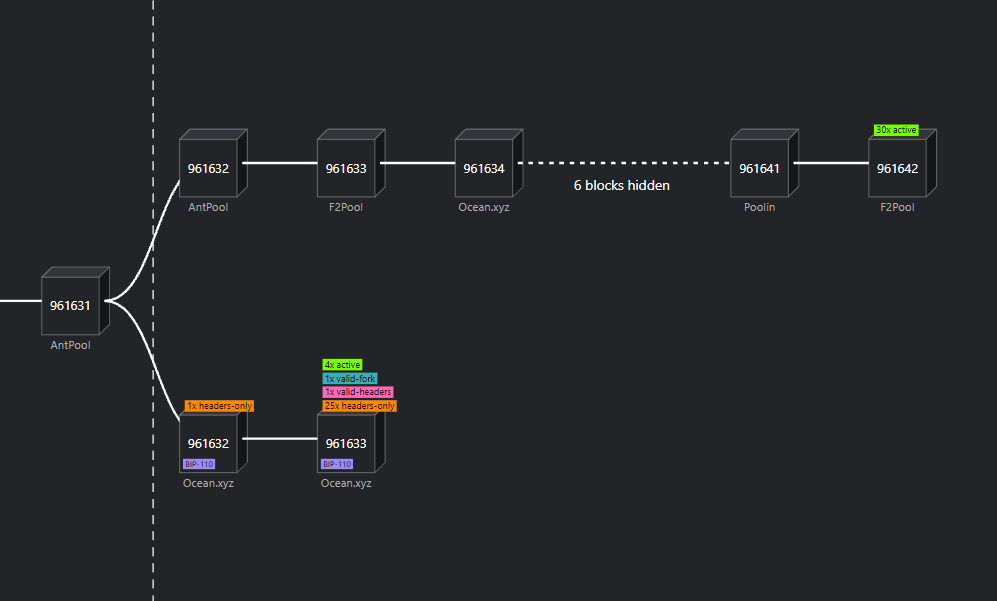
Bitcoin's BIP-110 activation attempt has produced a live minority fork after enforcing nodes rejected a non-signaling block at height 961,632 early on August 9. Most miners continued extending the existing network under current consensus rules, rapidly widening the gap between the two competing branches.
According to BIP110Monitor, by approximately 01:00 UTC on August 9, the main chain had reached block 961,654 while the enforcing branch stood at block 961,633 — a deficit of 21 blocks. Zero of the first 23 blocks in the new difficulty period signaled support for the proposal.
How the Split Occurred
The fork originated at block 961,632, which marked the start of BIP-110's mandatory-signaling window. AntPool mined a block that did not include the required version bit 4 signal, while Roughnecks produced a competing compliant block via OCEAN. Nodes enforcing BIP-110 rejected AntPool's block and followed the alternative branch. The larger non-enforcing network continued extending Bitcoin under existing consensus rules.
Support for the proposal was already minimal before the split. During the preceding 2,016-block retarget period, only 51 blocks signaled support — approximately 2.53% of the total.
Activation Mechanism and Timeline
BIP-110 employs a modified BIP9 activation process. Under its early lock-in rules, 1,109 of 2,016 blocks (55%) needed to signal support, but miner participation fell well short of that threshold. Consequently, the proposal entered mandatory signaling at block 961,632.
From that point forward, enforcing nodes began rejecting any block that failed to set version bit 4. The mandatory-signaling requirement remains in effect through block 963,647. Under the proposal's rules, the minority branch would force lock-in at block 963,648.
The proposal's transaction restrictions would not activate immediately. Those rules are scheduled to take effect at block 965,664 and would remain active for 52,416 blocks before expiring. The current fork therefore centers on signaling requirements and chain selection, not yet on transactions that would violate BIP-110's proposed temporary data restrictions.
What BIP-110 Actually Proposes
Despite some social-media characterizations, BIP-110 is not a quantum-computing security upgrade. Its official title is "Reduced Data Temporary Softfork," reflecting a narrower purpose: temporarily restricting arbitrary data embedded in Bitcoin transactions. The proposal introduces seven consensus rules covering scriptPubKeys, OP_RETURN data, witness payloads, and several Taproot-related structures.
The proposal emerged amid an ongoing debate within the Bitcoin community over the volume of non-financial data being inscribed onto the blockchain — a practice that accelerated after the launch of Ordinals inscriptions and BRC-20 tokens in 2023. Proponents of data restrictions argue that excessive on-chain data inflates block sizes and raises node-operating costs, while opponents contend that valid transactions should not be censored and that the fee market naturally manages block space allocation. BIP-110 represents one of several proposed approaches to this tension, though it has not attracted broad miner or developer support.
The proposal's "Complete" status in the BIPs repository indicates only that the specification itself is considered finished — not that Bitcoin has adopted it. Actual adoption depends on miners, users, exchanges, custodians, and other economic participants deciding which software and consensus rules they recognize.
Replay Risk and Operational Concerns
Bitcoin Core has not adopted the BIP-110 implementation, and most hash power continues extending the non-enforcing chain. Because only limited hash power supports the enforcing fork, block production on the minority branch can take significantly longer than Bitcoin's standard target of approximately one block every 10 minutes.
The most immediate concern for BTC holders is operational. The minority fork does not provide automatic replay protection before its later activation stage, meaning a transaction made on one branch could potentially affect the same coins on the other branch. Developers have cautioned holders against treating the split as a risk-free airdrop opportunity.

