Bitcoin Rose 84.2% as 10-Year Treasury Yields Climbed, CryptoSlate Reports
Key Takeaways
- •Bitcoin delivered an 84.2% gain over a period of rising 10-year U.S. Treasury yields, according to CryptoSlate's reporting.
- •The report identifies a 5.3% 10-year Treasury yield as a potential headwind level for Bitcoin, even as its post-ETF performance record complicates that view.
- •Spot Bitcoin ETFs introduced new buyers, including institutional investors and retirement funds, who were absent from earlier rate cycles.
- •Corporate treasury buyers such as Strive, holding 25,000 BTC, and H100 Group, with 3,506 BTC, tend to keep their holdings through volatility, shrinking the liquid supply available for rate-driven selling.
- •The article stresses that the observed co-movement shows correlation rather than proven causation, and the exact time window behind the 84.2% figure could not be independently verified.
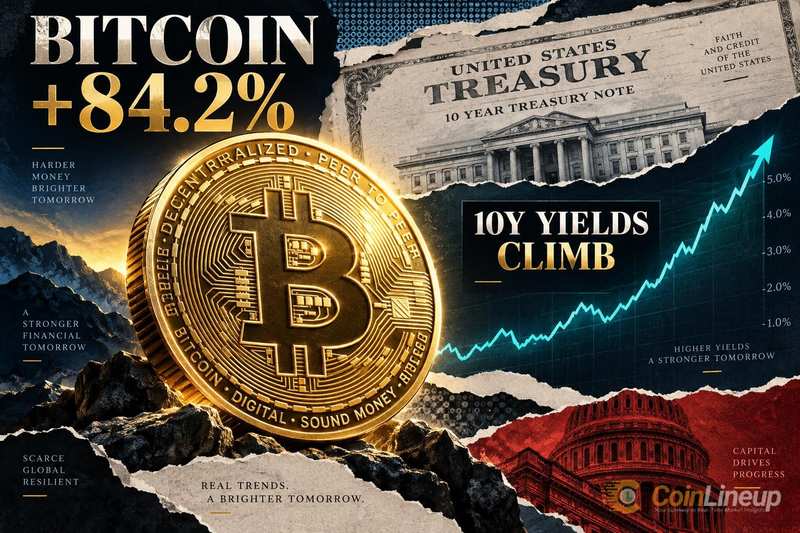
Bitcoin gained 84.2% during a period in which 10-year U.S. Treasury yields were rising, according to reporting by CryptoSlate. The finding challenges a widely held assumption that higher government bond yields are inherently bad for Bitcoin.
The 84.2% Gain at a Glance
CryptoSlate reported that Bitcoin posted an 84.2% gain across a stretch when 10-year U.S. Treasury yields were climbing. The 10-year Treasury yield — the annual return the U.S. government pays investors who lend it money for a decade — is one of the most closely watched numbers in global finance, in part because it is widely used as a proxy for the risk-free rate against which riskier assets are measured.
The same report frames a yield level of 5.3% as a potential headwind for Bitcoin, while noting that the asset's performance record since the approval of spot ETFs complicates that simple narrative. Even at elevated yield levels, Bitcoin has shown it can still move higher. That 5.3% level also gives readers a concrete reference point in this debate: it is the threshold the report flags as a potential headwind, which makes future 10-year yield readings worth checking alongside Bitcoin's own price.
The research underlying the article was unable to independently verify the exact time window for the 84.2% figure or retrieve the underlying dataset from the U.S. Treasury's official yield curve data. Readers should therefore treat the 84.2% figure as CryptoSlate's reported finding and consult the original article for its full methodology.
Why Rising 10-Year Treasury Yields Matter for Bitcoin
Rising Treasury yields typically pull capital toward safer assets. When the U.S. government pays higher interest, bonds become more attractive compared with riskier investments such as stocks or crypto. That logic has often been used to explain Bitcoin sell-offs in the past.
The 84.2% gain recorded during a rising-yield period, however, suggests the relationship is not that simple. The launch of spot Bitcoin ETFs in the United States introduced new buyers — institutional investors and retirement funds among them — who were not present in earlier rate cycles. Spot ETFs hold Bitcoin directly and trade on standard exchanges, a structure that gives traditional investors exposure to the asset without handling it themselves. Bitcoin also reclaimed the $80,000 level after a Federal Reserve rate decision earlier this year, another example of the asset behaving differently than the traditional "risk-off" playbook predicts.
It is equally important to distinguish correlation from causation. The CryptoSlate report describes an observed co-movement over a specific period, not a proven cause-and-effect relationship. Other forces, including ETF inflows, corporate treasury buying, and broader market sentiment, were active during the same window.
What the Report Means for Crypto Market Watchers
Corporate and institutional buyers have changed the supply picture. Companies that purchase Bitcoin directly for their balance sheets tend to hold through volatility rather than sell when yields move. Strive, for instance, has accumulated 25,000 BTC under a long-term treasury strategy, and similar accumulation by firms such as H100 Group, which raised its holdings to 3,506 BTC, reduces the liquid supply available for rate-driven selling.
For Bitcoin holders who worry every time yields rise, the report is worth knowing about. It does not guarantee that Bitcoin will always climb when rates go up, but it does suggest that the old rule of "rates up, Bitcoin down" is no longer reliable on its own.
Before drawing conclusions from the 84.2% figure, verify the time period it covers by reading CryptoSlate's full analysis. A single data point, however striking, should inform research rather than drive a decision on its own.
Disclaimer: This article is for informational purposes only and does not constitute financial or investment advice. Cryptocurrency and digital asset markets carry significant risk. Always research thoroughly before making decisions.

