Bitcoin (BTC) Consolidates Near $83,000 After Best Quarter Since 2024
Key Takeaways
- •Bitcoin has gained 43.1% so far in the third quarter of 2026, marking its strongest quarterly performance since Q4 2024 and its third-best quarterly gain since US spot Bitcoin ETFs began trading in January 2024.
- •The recent rally was supported by $2.4 billion in spot Bitcoin ETF inflows during the week ending September 25, according to The Kobeissi Letter.
- •Treasury yields hit multi-decade highs, with the 10-year yield reaching its highest level since April 2002, before the selloff eased after New York Fed President John Williams said the Fed faces no urgency on its next policy move.
- •Analysts identified $85,000 as a critical resistance zone, where Glassnode data shows long-term holder positions concentrated, with support near $82,000 and a potential move toward $90,000 on a breakout.
- •Diplomatic tensions between the United States and Iran over the Strait of Hormuz persisted, with President Trump rejecting an Iranian proposal to reopen the strait and Reuters sources indicating a deal before the midterm elections appears improbable.
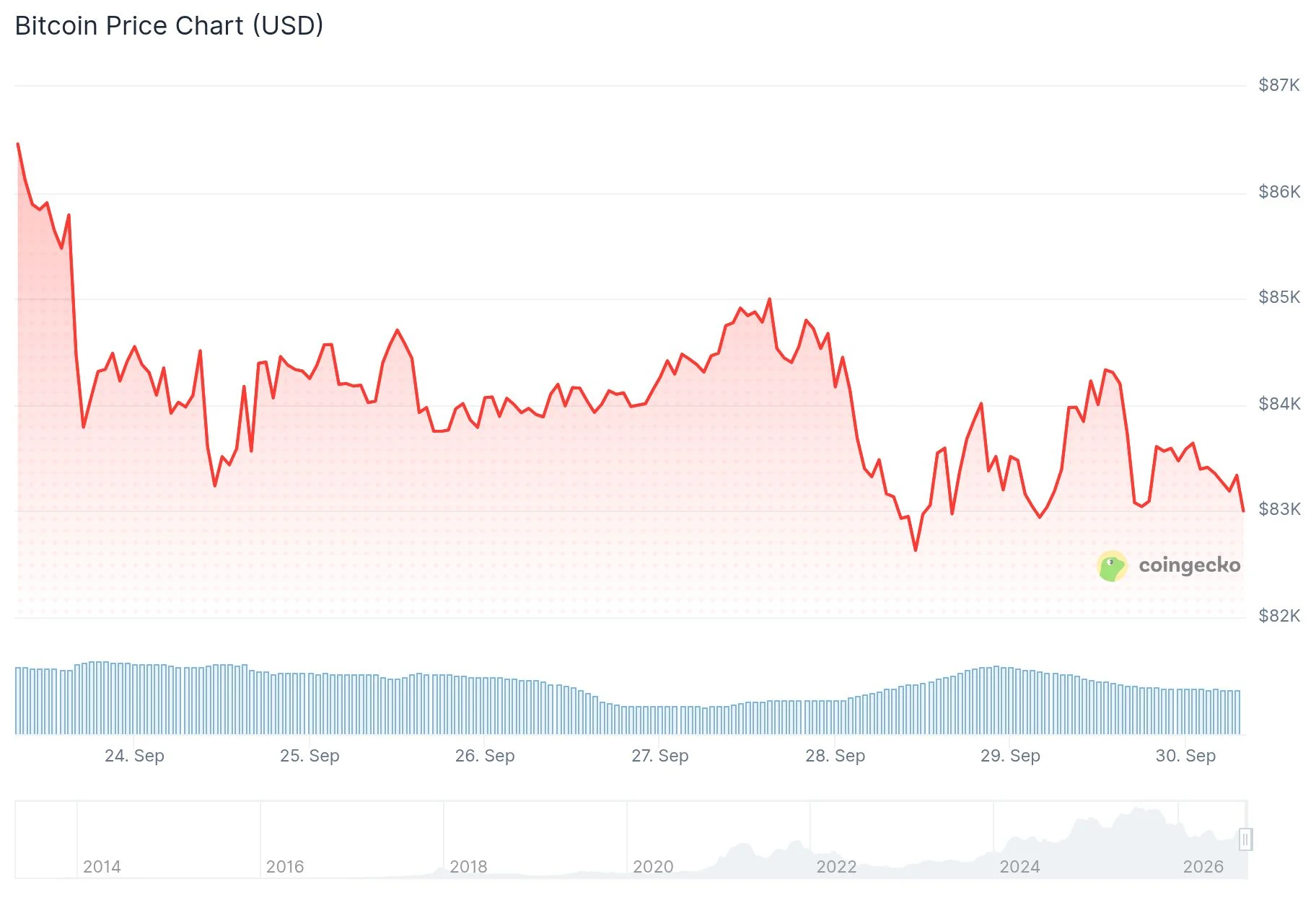
Bitcoin (BTC) held steady near $83,453 on Tuesday, registering a modest 0.3% daily gain as crude oil prices softened and volatility in the Treasury bond market showed signs of subsiding. The cryptocurrency peaked at $85,128 over the weekend before retreating below the $83,000 threshold on Monday, subsequently finding its footing. Sentiment remained under pressure from geopolitical friction between Washington and Tehran over the Strait of Hormuz — a chokepoint for a substantial share of global oil shipments — compounded by elevated Treasury yields.
Bitcoin's Strongest Quarter Since 2024
The asset has surged 43.1% during the third quarter of 2026, marking its strongest quarterly performance since the final quarter of 2024, according to analysis from The Kobeissi Letter. The financial commentary firm reported via X that the rally has been supported by $2.4 billion in spot ETF inflows during the week concluding September 25, and that the quarterly gain would rank as bitcoin's third-best since US spot Bitcoin ETFs officially began trading in January 2024. Spot ETFs hold the asset directly and trade on regulated exchanges, giving traditional investors a familiar route to exposure through standard brokerage accounts.
BREAKING: Bitcoin is +43.1% so far in Q3 2026, on track for its best quarterly performance since Q4 2024. This would also mark their 3rd-best quarterly gain since US spot Bitcoin ETFs officially began trading in January 2024. Since August 19th alone, Bitcoin prices have… pic.twitter.com/lfZ3a8vHGp
— The Kobeissi Letter (@KobeissiLetter) September 29, 2026
Analysts Frame Key Levels
According to Iliya Kalchev of Nexo Dispatch, the $82,000 zone represents a probable floor for support. In his assessment, a breach of $80,000 would indicate diminishing bullish momentum, whereas a successful breakout could propel the asset toward $90,000.
Kalchev also highlighted a disconnect in market psychology: digital asset markets are approaching “extreme greed” territory, he noted, while traditional equity markets have maintained a fearful stance for three consecutive weeks.
Adding a positive note to the broader landscape, Citi — one of the largest US banks — announced the extension of its cryptocurrency services into the Japanese and UAE markets.
Crude Prices and Treasury Yields Drive Market Dynamics
Brent crude dropped to its weakest point in almost seven days, while Middle Eastern exports climbed to 12.8 million barrels per day in September — the strongest flow since February.
BREAKING: WTI crude oil falls below $90 for the first time in 3 weeks. pic.twitter.com/XqrdYc0PxS
— Bull Theory (@BullTheoryio) September 29, 2026
Diplomatic tensions between the United States and Iran persisted. President Trump dismissed an Iranian proposal to reopen the Strait of Hormuz and refuted reports suggesting a willingness to relax economic sanctions. Qatari intermediaries remained engaged in facilitating dialogue between the parties, although Reuters sources indicated that reaching an agreement before the upcoming midterm elections appears improbable.
Government bond yields experienced dramatic movements. The 10-year Treasury note yield reached its highest level since April 2002, while the 30-year bond touched levels not witnessed since June 2002 — benchmarks that serve as a reference point for pricing risk across financial markets. The Treasury selloff then moderated following comments from New York Federal Reserve President John Williams, who indicated the central bank faces no urgency in implementing its next policy adjustment.
Against this backdrop, BTC oscillated between $82,807 and $84,545 throughout the session before stabilizing around $83,150. Total liquidations approached $78 million — the forced closure of leveraged positions — with short positions accounting for $44 million of that volume.
Utkarsh Ahuja of Moon Pursuit Capital attributed the decline below $83,000 to factors extending beyond cryptocurrency markets, identifying elevated yields, dollar strength, and geopolitical uncertainty as contributing forces. Excessive leverage, he, can amplify broader market movements into sharper corrections within crypto markets, though he anticipates swift repricing once external pressures diminish.
Kyle Rodda, senior analyst at Capital.com, suggested that escalating oil prices are constraining bitcoin's upward trajectory. Nevertheless, he maintains that technical indicators continue to support a near-term bullish structure.
Critical Barrier Emerges Around $85,000
Exchange order book data from CoinGlass revealed substantial resistance forming near $85,000, mirroring patterns observed earlier in the week. Glassnode analysts posted on X that long-term holder positions are concentrated between $84,000 and $85,000, emphasizing that prices must decisively break through this zone for the rally to maintain momentum.
Elsewhere in traditional markets, gold experienced a 3.6% decline to $4,115 per ounce before rebounding to $4,166. The Kobeissi Letter characterized the movement as “highly unusual” in a separate X post, attributing the disruption to yield-driven pressures affecting precious metals broadly.
Mosaic Asset Company observed that equity markets are displaying oversold conditions unprecedented since late March, and suggested that robust August employment figures could underpin gains despite expectations for an October rate increase by the Federal Reserve.
This article is based on reporting originally published by Blockonomi.

