Arthur Hayes Predicts Ethereum Could Hit $10,000 by the End of 2026
Key Takeaways
- •Arthur Hayes forecast that Ethereum reach $10,000 by the end of 2026 during an interview at Korea Blockchain Week in Seoul.
- •With ETH trading near $2,660, achieving Hayes's target would require a price increase of roughly 276% before December 31.
- •Hayes based his prediction on Ethereum's ability to absorb large institutional allocations and his view that it is the most secure Layer 1 blockchain by scale and market capitalization.
- •Other prominent forecasts, such as Tom Lee's $6,000 tied to a $150,000 Bitcoin scenario and Standard Chartered's $4,000 based on network activity and tokenized-finance demand, rely on different conditions than Hayes's institutional-allocation thesis.
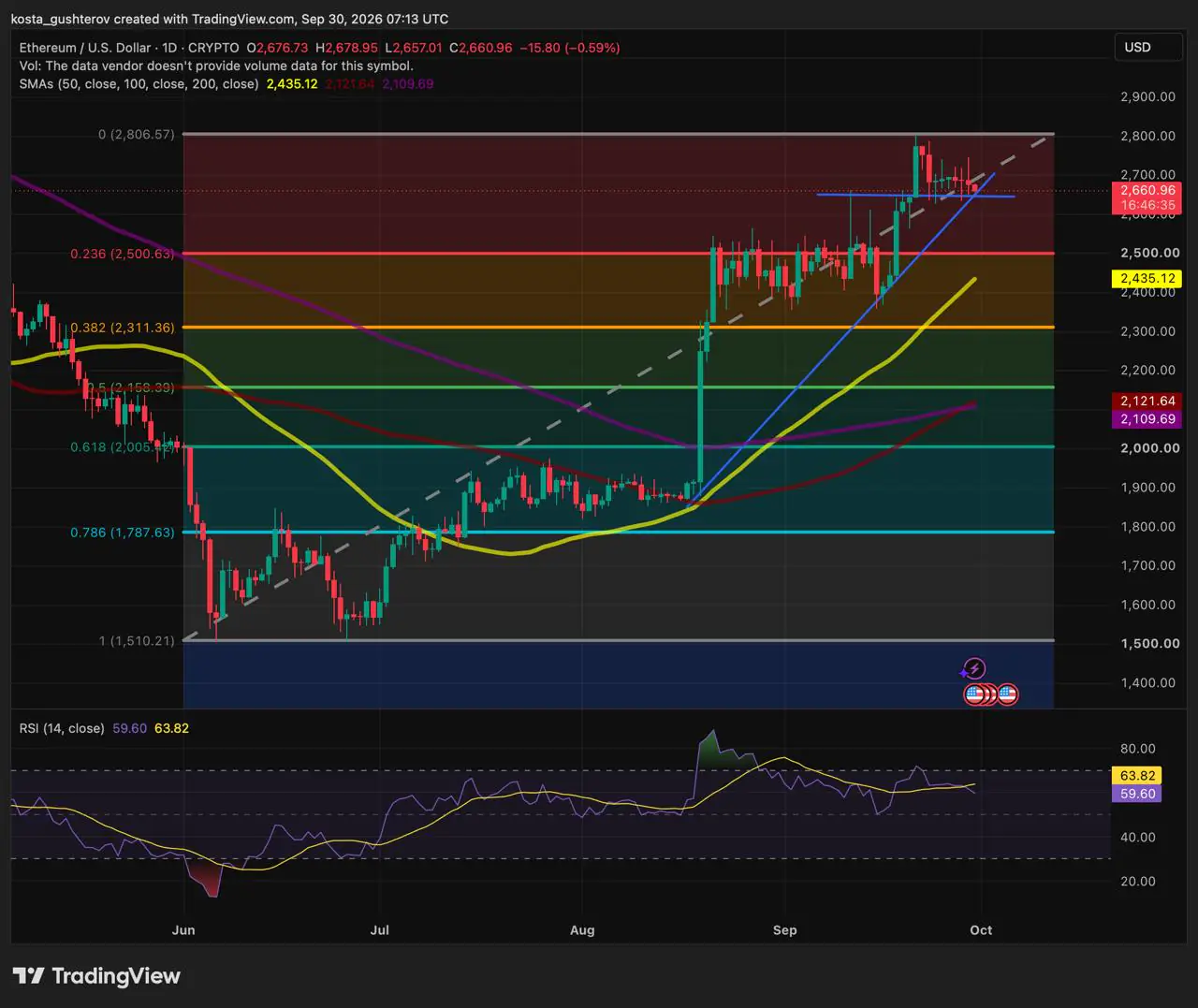
- •Technically, ETH is defending a $2,640-$2,660 support zone, and a breakdown would shift attention to $2,500, where the 23.6% Fibonacci retracement overlaps with prior heavy trading from late August through mid-September.
BitMEX co-founder and Maelstrom Chief Investment Officer Arthur Hayes has predicted that Ethereum (ETH) could reach $10,000 by the end of 2026, a call grounded in his view of the network's institutional role. He made the prediction during an interview at Korea Blockchain Week, an annual industry conference held in Seoul, and his year-end target stands well above other prominent forecasts for the asset, which remain materially lower.
At the time of writing, ETH traded near $2,660, according to CoinMarketCap data. A move to $10,000 from that area would require an advance of roughly 276% before December 31.
📈 @CryptoHayes calls $10,000 $ETH by the end of the year. His bullish take at the desk from @kbwofficial pic.twitter.com/6bVhc2lS0X
— CoinDesk (@CoinDesk) September 30, 2026
Why Hayes sees room for $10,000
Hayes bases the call on Ethereum's institutional role. In the CoinDesk clip, he said Ethereum appeals to him because it can absorb a large allocation, adding that he is less concerned about an exploit suddenly cutting the value of such a position by 75%.
Hayes described Ethereum as the most secure Layer 1 in his view and linked that confidence to its scale and market capitalization. Layer 1 is the term for base blockchain networks that process and finalize transactions on their own, as opposed to protocols built on top of an existing chain. That is an investment judgment, rather than a security measurement established by market value alone.
He also argued that Ethereum underperformed while rivals such as Solana captured faster-moving market narratives, including meme-coin trading. Ethereum's size has brought trade-offs of its own: a slower path to upgrades, more complex coordination and stronger competition for activity.
Hayes' argument fits the longer-term debate over whether Ethereum can grow without giving up the qualities that make it attractive to institutions. Coindoo recently examined the ideas behind Ethereum's Lean roadmap, where scaling, verification and security are treated as connected problems.
Other prominent forecasts rely on different conditions
Hayes is not alone in expecting higher ETH prices, though the range of estimates shows there is no clear consensus around a year-end number. Tom Lee's $6,000 view was reported in connection with a $150,000 Bitcoin scenario, while Standard Chartered's May note placed more weight on network activity and tokenized-finance demand.
The forecasts start from different assumptions. Hayes focuses on Ethereum's ability to attract large allocations; Lee's scenario requires a stronger Bitcoin market; Standard Chartered expects activity and adoption to translate into demand for ETH. Their price figures should therefore be read as conditional views, rather than competing measurements of the same outcome.
ETH is testing a former resistance area near $2,650
The daily chart shows ETH trading just above a $2,640-$2,660 support zone. A horizontal line in that region held price back during the earlier September advance, and over the past eight to ten days ETH has begun returning to the same area from above. The rising blueline now reaches that range as well, and the two references create the closest support area below the market during the current consolidation. The zone combines former resistance and trendline support.
A brief move below the range followed by a recovery would leave the rising structure largely intact. Continued daily trading beneath it could put the next support area near $2,500 back in focus.
The $2,500 Fibonacci level has recent price history
The 23.6% Fibonacci retracement sits near $2,500, drawn from the visible daily swing between the June low around $1,500 and the latest high near $2,800. Fibonacci retracements are a widely used charting method that projects potential support and resistance levels from ratios of a prior price move. It is the next major Fibonacci area below the market.
Its importance does not come only from the Fibonacci tool. ETH met repeated resistance and support around $2,500 from late August through mid-September before moving into the current range, and that trading history gives the level more context than a Fibonacci line alone.
A return to $2,500 would test whether that earlier trading range can absorb another pullback. Holding and recovering from the area could keep the decline within the broader advance. Continued daily trading below it could bring the rising 50-day simple moving average — an average of the past 50 daily closes often used as a medium-term trend reference — near $2,435 into view, followed by the 38.2% Fibonacci retracement near $2,310.
The support map beneath the $10,000 call
Hayes' forecast asks readers to consider how Ethereum could be valued if it becomes a larger destination for institutional capital. The daily chart cannot settle that longer-term argument, but it can show whether buyers are still defending the structure behind the latest recovery.
For now, the first evidence sits around $2,650. If that area gives way, $2,500 becomes the more important test because it combines the 23.6% retracement with a recent stretch of heavy price interaction. How ETH behaves across those levels may offer a clearer reading of the recovery than any year-end prediction alone.
This article is provided for informational purposes only and does not constitute financial or investment advice. Price forecasts and technical levels are interpretive tools, not guarantees of future market performance.
This article first appeared on Coindoo.

