Treasury Secretary Bessent's Notepad Reveals Yen Purchase Plan at Camp David Meeting, Drawing Critics' Mockery
Key Takeaways
- •A photograph taken during a Camp David Cabinet meeting captured Treasury Secretary Scott Bessent's notepad with a handwritten instruction to purchase $5-10 billion worth of Japanese yen.
- •The U.S. Treasury participated in a coordinated yen-buying intervention with Japan on Friday, marking Washington's first such joint effort since 2011.
- •The yen's prolonged weakening has been driven largely by the wide interest-rate gap between the United States and Japan, as the Bank of Japan kept rates near zero while the Federal Reserve raised rates aggressively.
- •The intervention combined direct currency purchases, official calls to trading banks, and public statements from both U.S. Treasury Secretary Bessent and Japanese Finance Minister Satsuki Katayama.
- •This is not the first time Bessent has used visible notepad messages during Cabinet meetings, having previously displayed notes including the word 'resilience' at a May gathering.
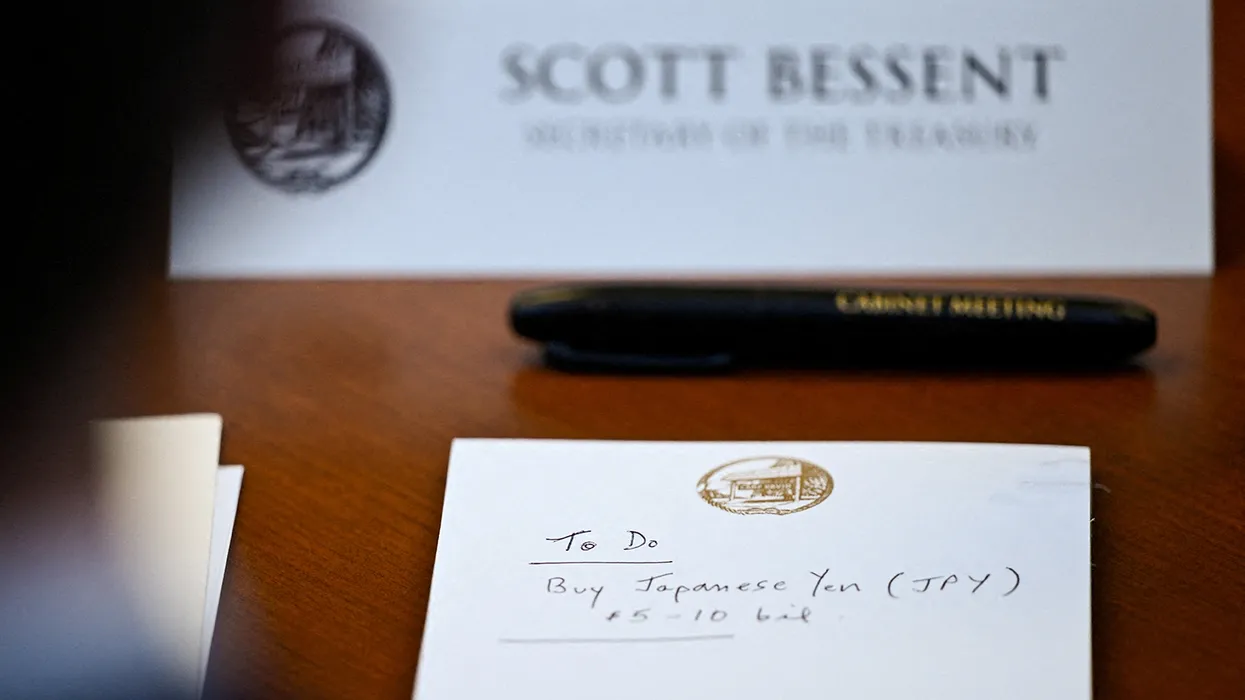
A notepad visible in front of Treasury Secretary Scott Bessent during a Camp David Cabinet meeting on Friday drew sharp scrutiny after a photograph captured a handwritten reminder to "buy Japanese Yen $5-10 bil" — a note that critics and market observers said was deliberately positioned for press coverage.
According to Reuters, the image was "taken over Bessent's shoulder during an on-the-record portion of the meeting" and "showed no other words" apart from the instruction to purchase Japanese yen. The U.S. Treasury did in fact buy yen on Friday as part of a coordinated effort to support the Japanese currency, Bloomberg reported.
"The U.S. joined Japan in engineering one of the most notable rebounds in the yen since the currency began its years-long slide, a decline that's stoked inflation in the Asian nation and rippled through global markets," Bloomberg stated. The yen's extended weakening has been driven in significant part by a wide interest-rate gap between the United States and Japan, as the Bank of Japan held rates near zero for years while the Federal Reserve raised rates aggressively. The outlet attributed the rebound to "a combination of direct purchases of the yen, calls by officials to banks that trade the currency and jawboning from US Treasury Secretary Scott Bessent and Japanese Finance Minister Satsuki Katayama."
Bloomberg noted that Bessent, drawing on extensive knowledge of Japan's role in global markets from his hedge fund career, signaled that he considers the yen too weak.
This intervention marked a significant milestone. Per Reuters, it represented "Washington's first yen-buying intervention with Tokyo in more than a decade as it languishes near 40-year lows." The news agency further reported that "the U.S. Treasury has not intervened to prop up the yen since 2011." That earlier intervention came in the aftermath of the Tohoku earthquake and nuclear disaster, when global powers moved jointly to stabilize currency markets during a period of acute crisis.
The visible notepad quickly drew reactions from commentators and market professionals.
Bloomberg opinion columnist Gearoid Reidy responded on X, calling Bessent "a joker":
https://x.com/GearoidReidy/status/2083379090221138028?s=20
Reidy wrote: "This is the most on-purpose thing ever."
Japanese politics and international relations expert Jeffrey J. Hall similarly observed that Bessent "left [the note] out for the media to photograph":
https://x.com/mrjeffu/status/2083433238924841083?s=20
Corpay Chief Market Strategist Karl Schamotta described the note as "the funniest thing I've ever seen in [financial] markets":
https://x.com/Karl_Schamotta/status/2083330385849577497?s=20
"Seriously folks," Schamotta remarked. "Bessent wrote himself a reminder to intervene in currency markets—complete with the amount to be purchased — as if he didn't want to forget anything at the grocery store, and then left that note in plain sight so reporters could see it. Amazing!"
This was not the first instance of Bessent using a notepad to communicate with the press. During a Cabinet meeting in May, the Treasury Secretary wrote and underlined the word "resilience," as documented by The New Republic. That notepad also listed "Operation Economic Fury," the phrase "Just in Time, Just in Case" in parentheses, and the word "resilience" a second time.
https://x.com/Acyn/status/2059698200198754463/photo/1
When asked at a press conference why he wrote those messages on his notepad, Bessent replied to laughter: "So people could look over my shoulder, photograph them and think they got a scoop."

