Base Lending Reaches Record $2.75 Billion as Morpho and Aave Drive Growth
Key Takeaways
- •Base’s outstanding loans reached $2.75 billion on September 10, according to Artemis.
- •Morpho holds approximately $3.94 billion of Base’s $4.56 billion lending TVL and has about $1.93 billion in active loans.
- •Aave V3 has roughly $513 million in Base lending TVL and $354 million in active loans.
- •Coinbase lets eligible U.S. customers borrow up to $5 million in USDC against Bitcoin through a product powered by Morpho.
- •About half of Base’s adjusted January USDC volume, totaling $5.3 trillion, came from a small group of DeFi contracts, including activity involving flash loans.
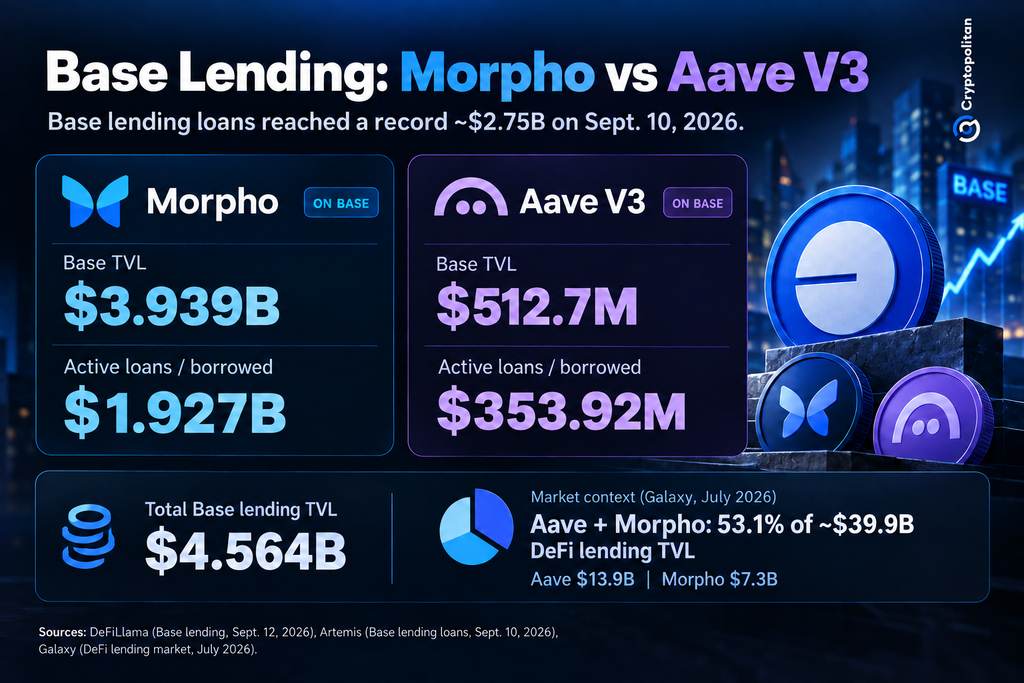
Outstanding loans on Base reached a record $2.75 billion on September 10, according to Artemis reports, following a rise in lending activity in late August. The milestone reflects the rapid expansion of credit on Coinbase’s Layer 2 network and the growing contribution of Morpho and Aave.
Artemis wrote on September 11 in a post on X: “Lending on @base is accelerating.”
The firm’s earlier research said lending is gradually becoming more modular, with specialized enterprises handling different parts of origination, distribution, risk management, and the infrastructure required for lending. Base is beginning to show what that transformation can look like at scale.
Morpho and Aave account for most of Base’s lending
Base’s lending total value locked (TVL) stands at approximately $4.56 billion, according to DeFiLlama. Morpho accounts for about $3.94 billion of that amount and has issued approximately $1.93 billion in active loans. Aave V3 follows with roughly $513 million in TVL and $354 million in active loans.
The concentration is consistent with the wider DeFi lending market. Galaxy estimated that total DeFi lending TVL was approximately $39.9 billion in July, with Aave and Morpho together representing 53.1% of the market. Galaxy’s figures placed Aave’s total TVL at about $13.9 billion and Morpho’s at $7.3 billion. Galaxy also reported that Standard Chartered had initiated coverage of both Morpho and Aave.
Coinbase brings DeFi lending to its platform
Coinbase is making decentralized-finance lending available to customers who may not otherwise interact directly with a lending protocol. Through its crypto-backed loan product, qualifying customers can borrow USDC against crypto assets on Coinbase’s platform. Coinbase describes the product as “powered by Morpho.”
Under the arrangement, Coinbase manages the customer relationship while Morpho supplies the on-chain infrastructure. Although the loan uses decentralized technology, the borrowing experience is designed to resemble a conventional financial transaction.
In the United States, Coinbase allows customers to borrow up to $5 million in USDC against Bitcoin. Limits are lower for some other crypto assets, and the product has an 86% liquidation threshold. Coinbase advertises U.S. rates as low as 5%. The product is described on Coinbase’s borrowing page.
The arrangement may be contributing to Base’s lending growth. Rather than requiring users to interact with DeFi protocols themselves, Coinbase can route lending requests to Morpho. Base’s 2026 strategy similarly emphasizes deeper stablecoin liquidity through trading, borrowing, and lending.
USDC activity extends beyond Base
The increase in lending also makes USDC more important to Base’s financial infrastructure. A February analysis found that Base was a major contributor to record stablecoin transfer activity, with Morpho among the contracts generating large USDC flows.
However, the same analysis found that roughly 50% of Base’s adjusted USDC volume in January—$5.3 trillion—was driven by a small number of DeFi contracts. Some Morpho transactions involved flash loans, in which funds are borrowed and repaid within the same transaction. As a result, high transaction volume does not necessarily represent a comparable level of current economic activity.
Morpho raised $175 million in June. Cryptopolitan also reported earlier this month that outstanding loans on Morpho had reached an all-time high of $5 billion, showing how quickly the protocol was approaching Aave’s scale.
Concentration remains a consideration
The record also underscores Base lending’s growing dependence on a small number of protocols and collateral markets, with Coinbase becoming an important distribution channel for Morpho. That structure can improve liquidity and capital efficiency, but it also increases the importance of controls covering smart-contract, oracle, curator, and collateral risks.
Base lending has continued to expand. Its development will show whether that growth can continue into the fourth quarter without becoming overly dependent on a single protocol, collateral type, or major distribution channel.

