Chemical By-Products of Ballast Water Treatment Go Untracked at Most Ports Worldwide
Key Takeaways
- •The IMO's Ballast Water Management Convention, in force since 2017, regulates organism kill rates and residual chlorine limits but does not track cumulative disinfection by-products in actual port waters.
- •Electrochlorination systems, preferred for large vessels, generate bromoform at average concentrations of approximately 247 micrograms per litre, roughly ten times higher than levels measured in cooling water or desalination effluent.
- •A 2022 review estimated that global ballast water treatment releases about 860 tonnes of bromoform into the sea each year, yet no standardized port-level monitoring system exists.
- •Australia's ABARES applied risk assessment to real ports in 2019 and found multiple disinfection by-products exceeding safe environmental thresholds at Port Hedland and Melbourne, but no physical sampling has since been carried out.
- •IMO guidance documents contain inconsistent global ballast water transfer estimates, ranging from 3 to 5 billion tonnes up to 10 billion tonnes per year within the same document.
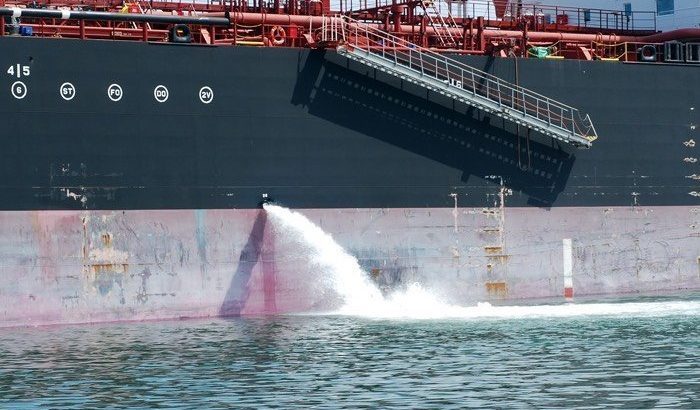
Ballast water treatment systems are evaluated primarily on their ability to kill invasive organisms, not on the chemical residues their oxidant processes leave behind. With billions of tonnes of ballast water discharged into the world's ports each year, authorities have little understanding of how much bromoform and other disinfection by-products are accumulating in harbour waters. Captain Alex Byelyavtsev reports.
Ballast water treatment was designed to address a specific ecological threat: the transfer of live organisms between seas, where some species establish themselves in non-native environments. The International Maritime Organization's Ballast Water Management Convention tackles this directly — a treatment system is approved if it kills organisms in the tank, and a discharge is deemed legal if it meets a concentration limit on exit. The Convention entered into force in 2017, and its phased implementation schedule has meant that a growing share of the global fleet is now required to fit treatment systems each year. What remains unaddressed is the fate of the active chemistry once it enters the harbour.
Not all treatment systems introduce chemicals. Ultraviolet (UV) treatment adds no chemical agents to the water. Oxidant-based systems, primarily electrochlorination, generate chlorine inside the ballast tank from seawater itself. Electrochlorination has been widely favoured for larger vessels because UV systems require substantial power and space to achieve the required organism kill rates. While chlorine effectively kills organisms, in seawater it does not remain chlorine for long. It reacts with bromide and organic matter to produce bromoform, bromate, chlorate, and a range of brominated acids — compounds collectively known as disinfection by-products.
The IMO is aware of these by-products. Its scientific advisory body, GESAMP (Joint Group of Experts on the Scientific Aspects of Marine Environmental Protection), maintains a list of them. Manufacturers are required to test for them under the IMO's Procedure (G9) before a system receives approval. However, that risk assessment is not conducted against real-world port conditions. Instead, it uses what GESAMP calls a "Model Harbour" — a standardised, hypothetical reference environment. Discharge limits apply only to residual chlorine. No mechanism tracks the cumulative chemical load once treatment systems enter widespread commercial operation. By contrast, municipal drinking water and wastewater treatment have long been subject to regulated by-product monitoring regimes; ballast water discharge carries no comparable port-level surveillance.
The problem becomes apparent at scale. Discharge concentrations are measured in micrograms per litre to determine whether an individual ship's output crosses a regulatory threshold. Ballast water volumes, by contrast, are measured in tonnes, and only a handful of jurisdictions track them. Around Singapore, cargo-based modelling has estimated annual ballast discharge at approximately 190 million cubic metres. Ships are not required to report where they deballast. The IMO's own guidance documents offer inconsistent figures, placing the global ballast water transfer at 3 to 5 billion tonnes per year in one section and 10 billion tonnes in another, within the same document. There is no standardised method for measuring ballast volumes, let alone the disinfection by-products they contain.
When concentration data is paired with actual annual discharge estimates, the implications shift. A 2022 review published in Water Research measured disinfection by-products directly in treated ballast water. It found bromoform concentrations averaging approximately 247 micrograms per litre — roughly 10 times higher than the levels the same researchers recorded in cooling water or desalination effluent. A ballast tank retains its chlorine dose longer and with less dilution than either of those systems. Based on these findings, the review estimated that global ballast water treatment releases approximately 860 tonnes of bromoform into the sea annually. Separate modelling for Singapore and the Pearl River Delta, published in Ocean Science and drawing on ocean-current data from the EU's Copernicus Marine Service, estimated the regional bromine input from ballast-derived bromoform at roughly 8 to 63 tonnes per year.
Bromoform evaporates, and in open water much of it transfers from the sea surface to the atmosphere. The Singapore modelling confirmed that most of the bromoform produced there follows this path. In slow-exchange harbours, water circulation is the primary removal mechanism. Evidence from the Gulf of Fos and the Persian Gulf — where the same chemistry enters semi-enclosed waters via industrial outfalls — demonstrates the consequences: bromoform concentrates near discharge points, and related compounds accumulate in marine tissue at concentrations many thousands of times higher than in the surrounding water. Ballast water discharge has not been incorporated into those regional assessments, nor in most of the world.
In 2019, Australia's Bureau of Agricultural and Resource Economics and Sciences (ABARES) applied the same risk-assessment methodology to real ports rather than the hypothetical Model Harbour. At Port Hedland, dibromoacetonitrile exceeded its safe environmental threshold even under a plausible discharge scenario. In Melbourne, monochloroacetic acid exceeded its threshold at every dock modelled, and dibromoacetic acid did so at Appleton Dock. The report recommended physical sampling to verify the findings. As far as the public record indicates, no such sampling has been carried out.
This is not an argument against oxidant-based treatment. The Ballast Water Management Convention solved the problem it was designed to address. GESAMP reviews the chemistry during the approval process, and discharge limits on residual oxidants are enforced. What remains unknown for most ports is the other side of the equation: the volume of oxidant-treated ballast water they receive each year, the rate at which their waters exchange with the open sea, and the cumulative chemical load after a decade or more of continuous discharges. Singapore has developed a model. Australia has developed one. Most harbours have not.
Source: Splash247

