Axis Robotics Raises $12 Million Seed Round Led by Hack VC
Key Takeaways
- •Axis Robotics secured $12 million in seed funding led by Hack VC to build data infrastructure for Physical AI.
- •The company says its platform addresses data scarcity, generalization challenges and hardware fragmentation in robotics training.
- •Axis reports a global contributor network of more than 100,000 active users submitting data multiple times per day on average.
- •Its Sim Dataset V1 showed performance gains on LIBERO-Plus compared with a volume-matched RoboCasa365 baseline, according to the company.
- •Axis is commercializing customized Task Packages for robotics hardware makers, Physical AI model developers and industrial automation firms.
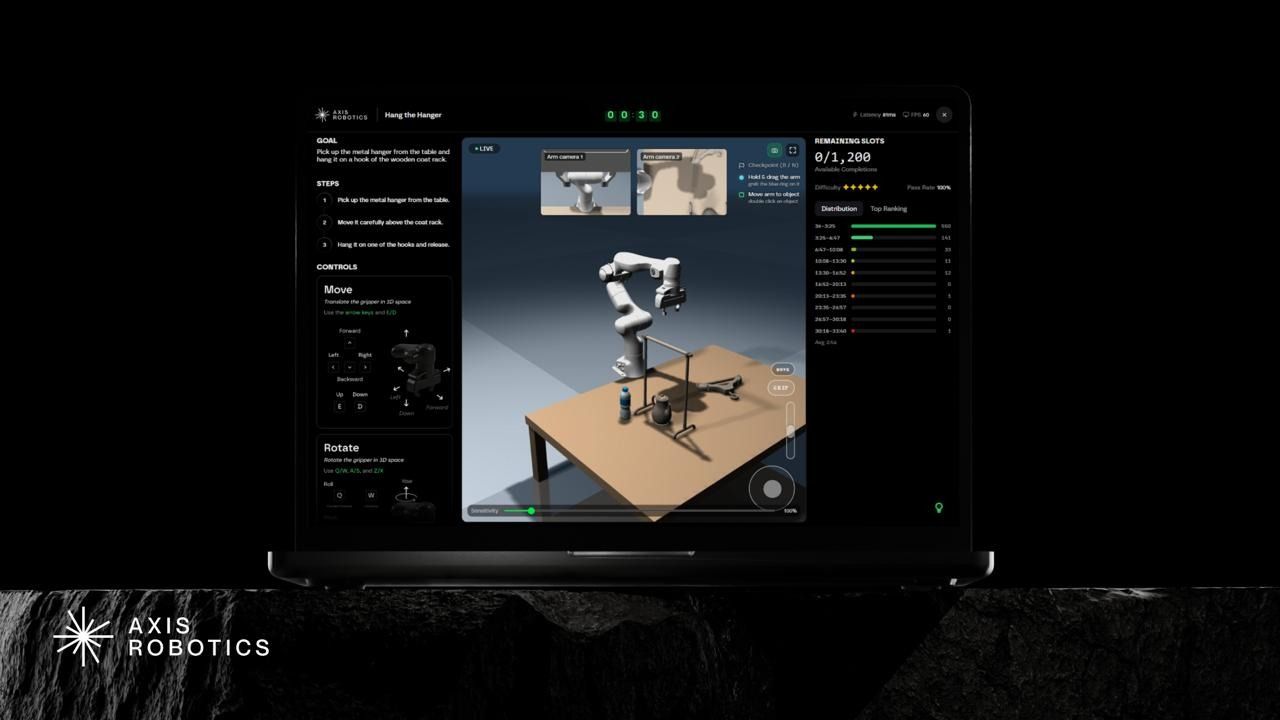
Axis Robotics, a company building what it calls a compounding data engine for Physical AI, said it raised $12 million in a seed funding round led by Hack VC. Nomad Capital, Pi Network Ventures, 10K Ventures and several angel investors also participated in the round.
The company said the capital will support its effort to build a massively parallel, human-in-the-loop global data engine designed to address what it describes as a key bottleneck for Physical AI: generating structured, highly diverse robotic training data at scale. For robotics systems, that data must capture not only what a model sees, but also how physical actions unfold across objects, environments, sensors and robot bodies.
Addressing the Physical AI Data Bottleneck
Axis Robotics said Physical AI faces three major barriers that differ from the data environment used to train Large Language Models. While Large Language Models can scale using trillions of tokens of pre-existing internet data, Physical AI must contend with severe data scarcity, a generalization gap and embodiment fragmentation across different types of robot hardware.
“Physical AI demands billions of human-physical interaction motion trajectories,” said Chris, Founder of Axis Robotics. “For years the industry lacked an efficient, infinitely scalable hybrid data production system which can help models iterate effortlessly – and that’s exactly what we built with Axis, a compounding data engine.”
Axis’s Approach to General Robotics Intelligence
Axis said its proprietary Compounding Data Engine provides an end-to-end workflow that combines task generation, data capture, continuous model training and optimization.
The company’s Task Gen Engine generates diverse atomic robotic tasks through randomization across objects, spatial layouts, visuals, robot embodiments and semantics. Axis said this approach embeds diversity into each data trajectory.
Its Browser-Based Sim Teleoperation Platform is described by the company as the world’s first web-based interface that enables users to generate high-quality robotic motion trajectories remotely. Axis said the platform delivers 10x higher throughput than lab-based collection and integrates human-gated DAgger, or Dataset Aggregation, intervention loops to refine and correct robot policies continuously.
The Ego Data Mobile Capture App is designed to move real-world data capture away from costly, hardware-heavy setups and into a zero-barrier mobile application. Axis said the app pairs state-of-the-art, or SOTA, real-time hand pose tracking with a global workforce, translating human vision and dexterity into robotic motion at global scale.
Axis’s Data Processing Pipeline automates trajectory cleaning, domain randomization and dense language annotation, producing model-ready multimodal datasets with more than 10x improved data quality, according to the company.
Axis said the unified architecture creates a self-reinforcing flywheel. Failed robot trajectories from real-world or simulation deployment trigger human corrective intervention, which then feeds back into training to expand edge-case coverage. The company said this process creates compounding intelligence as data volume increases.
Vertically Integrated Data Infrastructure
Axis said its core advantage is a unified platform that spans the full lifecycle of Physical AI. In contrast with what it described as traditional fragmented approaches, the company said it has built a vertically integrated engine that combines large-scale distributed pre-training data collection with real-time human-gated Dataset Aggregation after training.
Built for data diversity, Axis’s proprietary Task Generation Engine randomizes object layouts, lighting, camera poses, physical properties and robot morphologies. The company said this creates continuously unique scenes and manipulation tasks and produces training data designed for generalization.
To support foundation-model-scale diversified data, Axis said it has established a global robotic data infrastructure with more than 100,000 active contributors. These contributors submit data an average of 3 to 4 times daily, according to the company, increasing both production efficiency and diversity coverage.
Axis said it can currently generate more than 1,200 hours of simulation data and over 20,000 hours of real-world ego-centric data across diverse scenarios each month.
The company recently launched Sim Dataset V1 and said benchmark results show that engineered diversity produces measurable performance gains. On LIBERO-Plus, pretraining π0.5 on Axis’s fully diversified dataset improved overall success by 4.9 points and outperformed a volume-matched RoboCasa365 baseline by 31.3 points. Axis said the gains included layout generalization, sensor-noise resilience and robot-pose robustness. The company said the results indicate that its edge comes from its proprietary diversity pipeline rather than larger data scale alone.
Commercialization and Partnerships
Axis Robotics said it is commercializing its training data for real-world deployment through customized “Task Packages” tailored to robotics hardware manufacturers, Physical AI model companies and industrial automation firms.
The company said it has already established initial commercial partnerships with Booster Robotics, Manycore Tech, Feagine Robotics, Dexmal, Lotus Car, Geely Auto, SomaStacks and other companies. Axis said these collaborations demonstrate market demand for scalable, high-fidelity robotic training data.
Building General Physical Intelligence
“The future of Physical AI hinges on deep symbiosis between models and data,” said Chris. “Static datasets cannot power general robotic intelligence. The winning solution is a compounding data engine: a vertically integrated system linking a global contributor network with constant model iteration. Every diverse trajectory and human correction fuels faster model improvement, forming a self-reinforcing intelligence flywheel.”
Axis said its team includes AI and robotics researchers from institutions including UC Berkeley, Carnegie Mellon University, Georgia Tech, NTU and SJTU, as well as growth specialists who previously scaled consumer products to more than 30 million global users.
With the $12 million seed round led by Hack VC, Axis Robotics said it plans to expand its procedural generation capabilities, scale its distributed contributor network and strengthen its role as a data engine for Physical AI. The next test for the company will be whether its data infrastructure can continue translating simulated and ego-centric human motion data into deployment-ready training assets for customers working across different robot embodiments and industrial use cases.

