Surprise Jump in Australian Unemployment Not Yet Enough to Trigger Sahm Rule Recession Call
Key Takeaways
- •Australia's Sahm-rule indicator remains below the Reserve Bank of Australia's preferred 0.75 percentage-point recession threshold despite a surprise rise in unemployment.
- •The Australian recession trigger is set higher than the 0.50 percentage-point bar used in the rule's original United States formulation.
- •The index, calculated by Econbrowser using Australian Bureau of Statistics data and a 2024 RBA methodology by Hartigan and Rosewall, approximates the real-time rule by using the latest revised unemployment series rather than initial release values.
- •Economist Claudia Sahm told the ABC that the pace of unemployment increases, not the level of the jobless rate, is the key recession warning, since even modest rises can snowball.
- •Dr Sahm said it is possible Australia could cross the recession threshold within six to 12 months, with upcoming ABS labour force releases and index updates set to show whether the reading moves closer to the trigger.
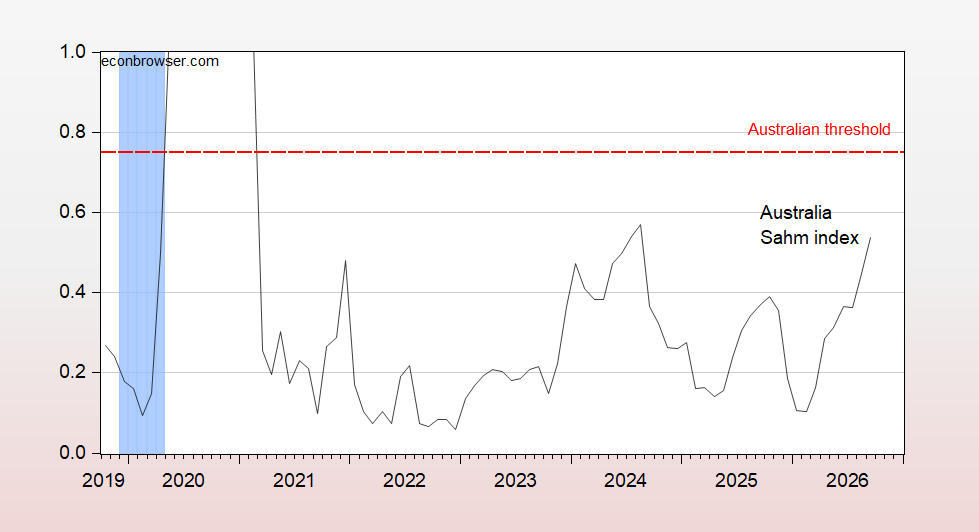
Australia's unemployment rate posted a surprise jump in the latest labour market data, but the country's version of the Sahm rule has not yet triggered a recession call under the threshold preferred by the Reserve Bank of Australia (RBA), according to an analysis published by Econbrowser.
The analysis plots an Australia Sahm Index against the 0.75 percentage-point threshold used as the recession signal — a higher trigger than the 0.50-point bar in the rule's original United States formulation — alongside peak-to-trough recession dates as defined by ECRI. The underlying data draw on unemployment figures from the Australian Bureau of Statistics (ABS) and an Australian Sahm-rule methodology developed by Hartigan and Rosewall (2024) at the RBA, with the index calculation performed by the Econbrowser author.
The author notes that the calculation is an approximation of the “real time” Sahm rule, insofar as it uses the latest vintage of the unemployment series rather than the initial release values. The distinction matters because official monthly figures are revised after their first publication, meaning a reading based on the latest data can differ from the one observers would have calculated in real time. On the assumption that this measure is close to the real-time version, the threshold has not yet been reached, despite the recent rise in joblessness.
The Sahm rule, developed by economist Claudia Sahm, flags recessions based on how quickly unemployment rises rather than on the level of the monthly unemployment rate itself. In its original United States formulation, the indicator trips when the three-month moving average of the jobless rate climbs 0.50 percentage points above its lowest reading of the prior 12 months.
In an exclusive interview with the ABC, Dr Sahm explained why the speed at which unemployment rises matters more than the monthly rate when thinking about recessions.
“Changes in the unemployment rate, particularly over the past year, are really the warning sign, and we often see that once the unemployment rate starts rising, and even a fairly modest amount, it can start to snowball,” she said. “We see countries go into recession when the unemployment rate is high or when it's relatively low as well.”
Asked by the ABC whether Australia could cross her “recession” threshold within six to 12 months, Dr Sahm said it was possible. With the indicator below its trigger for now, subsequent monthly labour force releases from the ABS and updates to the index will show whether the pace of the rise moves the reading closer to the RBA-adapted threshold.

