Arthur Hayes Warns HYPE Could Underperform Ethereum and Zcash
Key Takeaways
- •Arthur Hayes argues that HYPE's main risk is not a price collapse but underperformance relative to alternatives such as Ethereum and Zcash, framing his warning around opportunity cost.
- •Hayes earlier projected a $150 price target for HYPE and called it part of his 'holy trinity' alongside NEAR and ZEC, but he sold his entire position in early June to take profits.
- •He believes perpetual DEXs have become a perfectly competitive, crowded market where Hyperliquid now fights centralized exchanges, traditional finance venues, and rival DEXs offering identical products at identical fees.
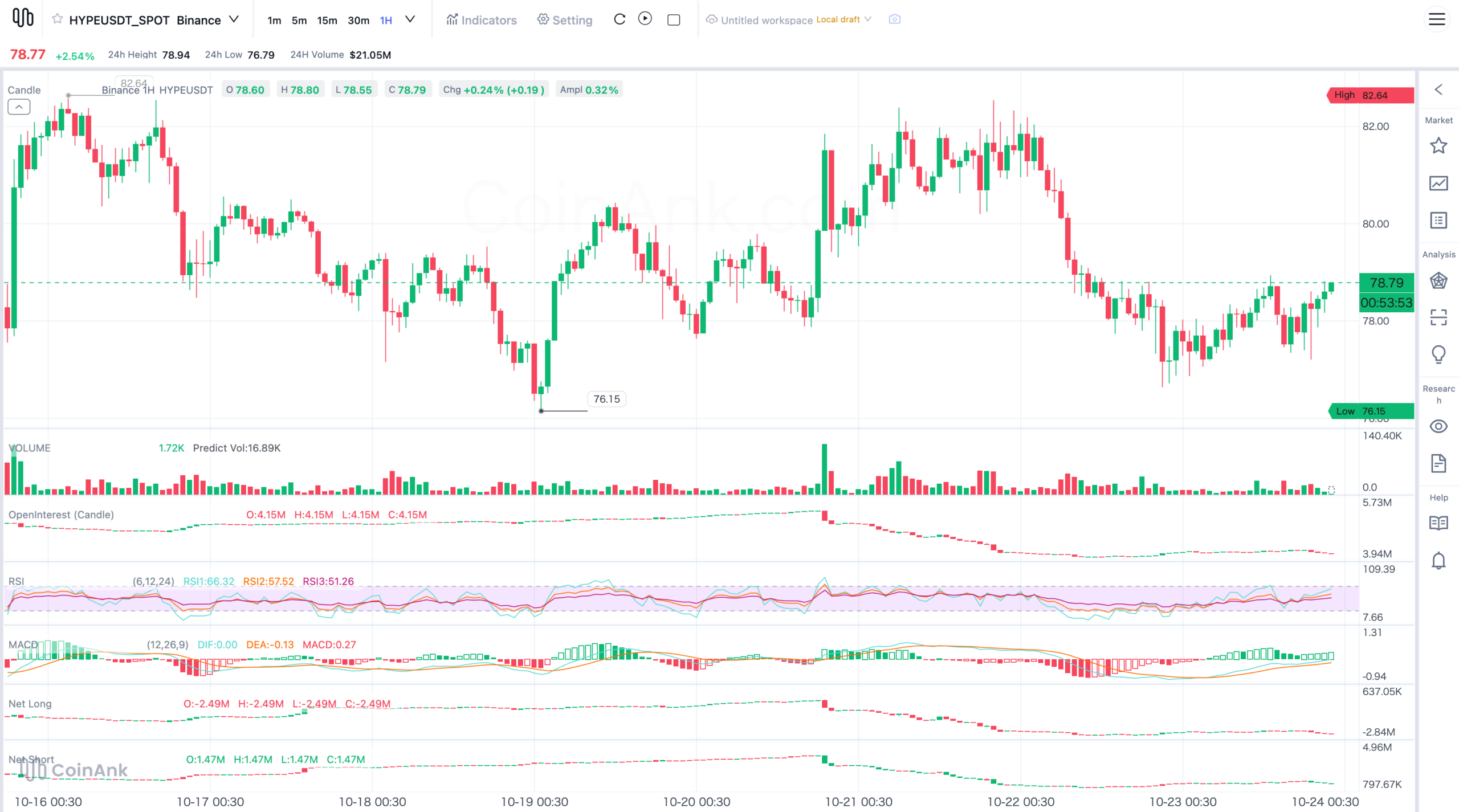
- •HYPE traded at $78.79, up 2.54% in 24 hours, with resistance between $79.00 and $79.50 and support around $78.00 to the $76.15 low, while RSI and MACD signals pointed to improving buying pressure.
- •Hayes named Ethereum his top pick in late August, saying it could rise three to five times quickly, while his interest in Zcash remains conditional on further technical progress.
BitMEX co-founder Arthur Hayes has questioned the investment case for Hyperliquid's HYPE token, arguing that Ethereum (ETH) and Zcash (ZEC) could deliver stronger returns despite Hyperliquid's established trading business. HYPE remained under pressure on October 24 as his comments drew fresh attention. The remarks come from an October 16 interview that resurfaced on October 23, and they mark a notable turn for a trader who earlier this year projected a sharply higher price for HYPE — before selling his entire position.
His remarks draw attention in part because of where he comes from: BitMEX, the derivatives exchange he co-founded, is widely credited with popularizing perpetual futures — the same instrument at the heart of Hyperliquid's business.
A Warning About Opportunity Cost, Not a Crash
Hayes does not expect HYPE to collapse. His warning centers on opportunity cost — the return an investor forgoes by choosing one asset over another. In a recently circulated clip, he described perp DEXs, Zcash and Hyperliquid as some of crypto's most crowded consensus trades, meaning positions that much of the market already holds.
The danger, Hayes said, "is not that you lose money per se on Hyperliquid, it's that you severely underperform other assets." He added that he does not think "the risk return is there for a new unit of fiat to invest Hyperliquid" when buyers could instead choose ETH, Zcash or another fresh narrative.
That framing matters for anyone holding Hyperliquid's token today. An asset can keep climbing and still lose out if other assets climb faster. Hayes made much the same point in September, telling The Rollup that the same capital might earn more in Ethena.
Where HYPE Stands Technically
HYPE is trading at $78.79, up 2.54% over the past 24 hours, after bouncing from a low near $76.15. On the 1-hour chart, resistance sits at $79.00 to $79.50, then $80.00 to $80.50, with a larger wall at $81.50 to $82.64. Support rests at $78.00 to $78.30, with deeper backing at $76.15 to $77.00.
Momentum indicators point to improving buying pressure: RSI readings sit between 51 and 67, and the MACD histogram has turned positive. A strong move above $79.50 could carry HYPE toward $80.50 and then $81.50. A rejection at that level and a drop below $78 would put $77 and the $76.15 low back in play. Those thresholds frame what short-term traders are watching, though intraday charts address timing rather than the multi-month capital-allocation question Hayes raises.
From a $150 Target to a Full Exit
Earlier this year, Hayes ranked among HYPE's loudest backers. In a March podcast, he discussed Hyperliquid's HIP-3 markets, which allow users to trade assets such as oil over the weekend. By spring, he was calling for HYPE to reach $150 by August 2026, and in May he named HYPE, NEAR and ZEC as his "holy trinity."
Then he sold. In early June, Hayes said he had exited his full HYPE position, along with his NEAR holdings, to take profits. He cited rising energy prices, upcoming AI-related IPOs and political uncertainty around artificial intelligence. In a later interview, he warned that centralized crypto exchanges and traditional finance venues could chip away at Hyperliquid's market share.
By late August, Ethereum had become his top pick. He said ETH could rise three to five times fairly quickly, while expectations around Hyperliquid had already climbed after its strong run.
Crowded Competition Among Perpetual DEXs
Perpetual futures are derivative contracts with no expiry date that let traders take leveraged long or short positions — the product at the core of Hyperliquid's trading business.
The core of Hayes' cautious view is straightforward: perpetual DEXs increasingly look alike. "Everybody's launching a perp dex with some sort of real world asset attached to it," he said.
He gave Hyperliquid's team full credit. "Jeff crushed it. They proved the market's there," Hayes said, referring to founder Jeff Yan. But that success attracted rivals, and Hyperliquid now competes simultaneously with centralized exchanges, TradFi venues and other DEXs.
"They all offer the same product. They all charge the same amount of money. And so now you have a perfectly competitive market," he said. In that setting, he argued, marketing and tokenomics become the only ways to stand out — a difficult foundation for any business.
Why ETH and ZEC Make His List
Hayes believes the better trade lies with assets the crowd has given up on. "I think Ethereum's gonna be the best performing mega cap," he said. ETH has still not topped its 2021 all-time high, and Hayes called it "the most hated" major asset — which he treats as a reason for optimism. Once it starts moving, he expects sidelined traders to pile back in.
On October 15, he also backed long positions in Bitcoin and Ethereum while discussing a possible tech-sector downturn and bailout. His interest in Zcash has been more conditional, tied to further technical progress; ZEC is the native token of Zcash, a long-running, privacy-focused blockchain.
This article is for informational purposes only and does not constitute financial advice. Cryptocurrency investments carry substantial volatility and potential losses. Readers should conduct independent research before making investment decisions.
This article is based on reporting published by The Market Periodical on October 24, 2026. Source: The Market Periodical

