Standard Chartered Launches Arbitrum Coverage With $10 Target by 2030
Key Takeaways
- •Standard Chartered initiated coverage of Arbitrum with a $10 target for 2030, implying roughly a 70-fold rise from its $0.14 reference level, and expects ARB to outperform its own Bitcoin and Ethereum forecasts over the same period.
- •The bank's phased forecast calls for ARB at $0.50 in 2026, $1.50 in 2027, $3.50 in 2028, and $6.50 in 2029, and depends on additional traditional finance business as tokenized assets approach a projected $4 trillion by the end of 2028.
- •Arbitrum receives 10% of net protocol revenue from supported layer-2 projects, and Standard Chartered estimates around $5 million in September revenue — more than five times the level before Robinhood Chain launched in early July.
- •Standard Chartered noted that ARB lacks a direct mechanism for capturing network value, while 92.3% of the token's 10 billion maximum supply has vested, with the remainder unlocking through March 2027.
- •Technically, ARB is defending support near $0.129 with the MACD turning higher; a breakout above the $0.15–$0.16 range could target $0.185, while a fall below support may shift attention to the $0.11–$0.115 demand zone.
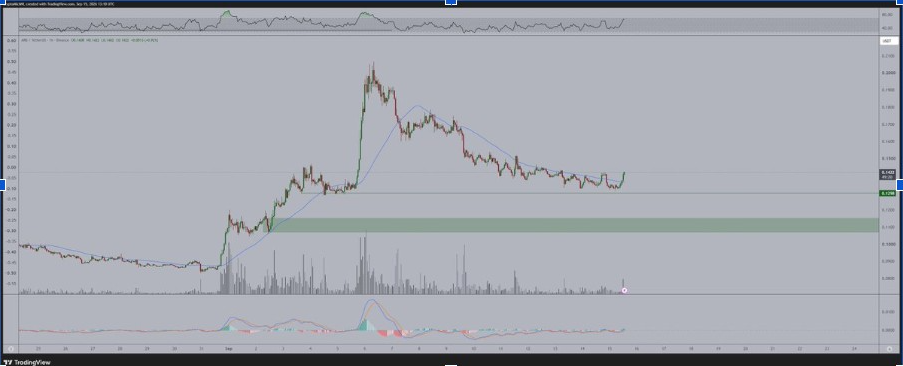
Arbitrum (ARB) has rebounded to around $0.1459, gaining approximately 3.49% over the past 24 hours after an extended decline. The recovery comes as Standard Chartered initiates coverage of the token with a long-term price target of $10 by 2030 — an increase of roughly 70 times from the $0.14 reference level used in the bank's September 15 report.
The projection, however, depends heavily on Arbitrum securing additional business from traditional financial institutions and the growing tokenized-asset market. For readers, the coverage is also a marker of how far bank digital-asset research has extended beyond Bitcoin and Ethereum forecasts — both of which Standard Chartered already publishes — into the layer-2 infrastructure layer of the tokenization trade.
Standard Chartered Maps a Gradual Path to $10
Rather than a single surge to $10, the bank anticipates a phased climb. Its forecast places ARB at $0.50 in 2026, $1.50 in 2027, and $3.50 in 2028. From there, Standard Chartered expects the token to reach $6.50 in 2029 before climbing to $10 by the end of 2030.
Geoff Kendrick, Standard Chartered's Global Head of Digital Assets Research, linked that outlook to Arbitrum's expanding role in financial infrastructure. Arbitrum is one of the largest Ethereum layer-2 networks and competes closely with Base. Unlike Base, however, Arbitrum has its own governance token, ARB, which gives investors direct exposure to the network.
Layer-2 networks such as Arbitrum process transactions off Ethereum's main chain before settling them on the base layer, a design that lowers costs for high-volume applications.
Standard Chartered also expects Arbitrum to outperform its own Bitcoin and Ethereum price forecasts over the same period. The bank noted, though, that ARB currently has no direct mechanism for capturing network value.
Traditional Finance Growth Anchors the Forecast
A major pillar of the bullish outlook rests on Arbitrum's work with traditional financial firms. The network helps companies create their own layer-2 chains and receives 10% of net protocol revenue from supported projects.
Robinhood Chain, the layer-2 network developed by Robinhood, is one recent example of this model. At the current run rate, Standard Chartered estimates Arbitrum could receive around $5 million in revenue for September. That figure would represent more than five times the level recorded before Robinhood Chain launched in early July.
The expects demand of this kind to build as more financial assets move onto blockchain networks. Tokenization — the representation of financial assets as blockchain tokens — has become a growing focus for traditional institutions, and Standard Chartered forecasts that tokenized assets could reach $4 trillion by the end of 2028. In that scenario, infrastructure demand from traditional financial firms could create additional revenue opportunities for Arbitrum.
The thesis also comes with trackable markers: whether more traditional finance firms follow Robinhood in launching Arbitrum-based chains, and how the monthly revenue run rate evolves from the estimated $5 million September level. Those data points map directly onto the conditions the bank says its target depends on.
Arbitrum also remains one of the leading Ethereum layer-2 platforms by total value locked and total value secured. On the supply side, 92.3% of ARB's maximum 10 billion token supply has already vested, with the remaining tokens scheduled for release through March 2027.
Technicals Point to $0.185 as the Next Hurdle
ARB is currently defending support near $0.129 after pulling back from its earlier September rally. Buyers have so far prevented a deeper breakdown, while short-term momentum has started to improve. The MACD has begun turning higher, although the token still needs to clear nearby resistance before confirming a stronger recovery.
According to the analysis, the first major test for ARB lies between $0.15 and $0.16. A breakout above that range could bring $0.185 into focus, a level marking a previous consolidation area. Conversely, if ARB falls below $0.129, attention could shift toward the larger demand zone between $0.11 and $0.115, weakening the short-term recovery setup.
This article is for informational purposes only and does not constitute financial or investment advice. Cryptocurrency investments involve risk, and monetary-policy or regulatory developments can cause sharp market volatility. Readers should conduct their own research before making investment decisions.

