Anthropic launches Claude Opus 5.5 at 40% below Opus 5, with 20-cent cache reads
Key Takeaways
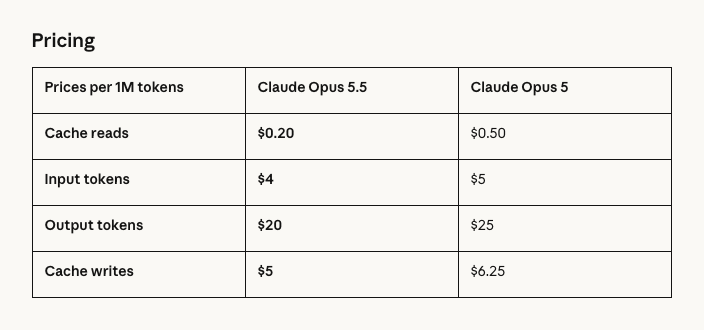
- •Claude Opus 5.5 is priced at $4 per million input tokens and $20 per million output tokens, 20% below Opus 5 and about 60% below Fable 5.1, with cache reads cut 60% to $0.20 per million.
- •The model scored 66.4% on Terminal-Bench 4.0, ahead of Fable 5.1 at 55.8%, Opus 5 at 52.3%, and OpenAI's GPT-6 Astra at 57.9%.
- •Anthropic ships the model with safeguards similar to Fable 5.1's, rerouting most cybersecurity tasks to Opus 4.8 after external evaluators including METR and Frontier Design examined it before release.
- •OpenAI launched GPT-6 Sol and Luna the same day, with Sol priced at $2 and $10 per million input and output tokens — half of Opus 5.5's base rates.
- •Opus 5.5 is available through the API as claude-opus-5-5 and on Amazon Web Services, Google Cloud, and Microsoft Azure, with Claude Sonnet 5.5 and Haiku 5.5 expected in the coming weeks.
Anthropic released Claude Opus 5.5 on Tuesday. According to the company's launch post, the model performs on par with its pricier Fable 5.1 on most work and costs about 40% less than Opus 5 on typical workloads.
Input and output tokens fall to $4 and $20 per million
Anthropic attributes the savings to two sources: lower token prices and a model that burns fewer tokens per job.
Input tokens are now $4 per million, and output tokens are $20 per million, both 20% cheaper than Opus 5's $5 and $25. Cache writes declined to $5 per million from $6.25.
The largest cut came on cache reads, which Anthropic says drive most of the cost in coding and agentic work. They fell 60%, to $0.20 per million tokens from $0.50 for Opus 5.
At base API pricing, Opus 5.5 is about 60% cheaper than Fable 5.1, which sells for $10 and $50 per million tokens. Fable 5.1 had arrived just weeks before, and Cryptopolitan had also covered how Opus 5 launched at half of Fable 5's price.
Anthropic says the model's output is over 30% faster than Opus 5's. Fast mode in the Claude Platform and in Claude Code is up to 2.5x faster, priced at $8 per million input tokens and $40 per million output — double the base rates.
Benchmarks and early tests
Opus 5.5 scored 66.4% on Terminal-Bench 4.0, ahead of Fable 5.1 at 55.8%, Opus 5 at 52.3%, and OpenAI's GPT-6 Astra at 57.9%. On GDPval-AA v2.1, a knowledge-work test, Anthropic put the model at 1,846 versus Fable's 1,735. The company noted that benchmark margins are a weaker guide to real differences at this capability level.
Anthropic said an early tester completed a migration of 680,000 lines of code in less than a day. Another tester audited and repaired a 200,000-line codebase in under three hours, work that took Opus 5 more than 20 hours and 2.5 times the tokens.
An internal test showed Opus 5.5 translated the load balancer HAProxy from C to Rust in 9.5 hours. Fable 5.1 took 12 hours, with Opus 5.5 costing 51% less.
Most cybersecurity tasks reroute to an older Claude model
Opus 5.5 is the first model Anthropic has shipped since CEO Dario Amodei called for pacing frontier AI development on safety grounds. External evaluators including METR, Frontier Design, and others examined the model before release.
The model posted the best results of any Anthropic model to date on the company's automated behavioral audit, according to Anthropic. But the company has seen signs that Opus 5.5 often suspects it is being evaluated, which makes its real-world behavior harder to gauge.
Anthropic says the model is comparable to Claude Mythos 5.1 in biology and cybersecurity, so it ships with safeguards similar to Fable 5.1's. Most cybersecurity tasks are rerouted to Opus 4.8, and vetted organizations can apply to a new Life Sciences Verification Program for biology work.
OpenAI launches GPT-6 Sol and Luna the same day
On the same Tuesday, Cryptopolitan reported that Open launched GPT-6 Sol and Luna. Sol is priced at $2 per million input tokens and $10 per million output — half of Opus 5.5's base rates — while Luna runs $0.10 and $0.50. The back-to-back releases trace how quickly flagship list prices have stepped down in a matter of weeks — from Fable 5.1's $10-and-$50 tier to Opus 5's $5 and $25, then Opus 5.5's $4 and $20 — with OpenAI's Sol arriving the same day at $2 and $10.
Opus 5.5 registered 40.0% on Zapier's AutomationBench at a cost of about $1.28 per task, according to Cryptopolitan. Its eight-point lead over GPT-6 Sol, which scored 32.0% at $0.34 per task, costs roughly 3.8 times as much. Cryptopolitan has also reported a forecast that inference costs per agentic workflow will climb by more than five times by 2028. For teams running agentic workflows, the figures frame the cost question: per-token prices keep falling, but what a finished task costs also turns on how many tokens a model burns — the efficiency Anthropic cites as part of its savings.
Availability
Opus 5.5 is accessible via the API as claude-opus-5-5 and on Amazon Web Services, Google Cloud, and Microsoft Azure, broadening access beyond Anthropic's first-party API. Anthropic said Claude Sonnet 5.5 and Haiku 5.5 are coming in the next few weeks — releases that would extend the 5.5 generation across the rest of Anthropic's model lineup.

