Nearly 15% of Americans expect inflation of 15% or more next year, a level unseen in the U.S. since 1947
Key Takeaways
- •Almost 15% of U.S. consumers expect inflation above 15% over the next year, a rate not recorded since 1947, according to UBS chief economist Paul Donovan.
- •Median year-ahead inflation expectations dropped from 4.7% to 3.7% in the University of Michigan's final November reading, matching September's actual inflation rate.
- •Since consumer-price records began in 1913, 12-month inflation has exceeded 15% only during 1917–1920 and from November 1946 through June 1947.
- •Highly visible costs tied to the Iran war—including gasoline prices up 37.4% over 12 months, record diesel prices, and rising airfares—are amplifying consumer inflation perceptions.
- •Unlike 1979, when inflation reached 13.3% and the federal funds rate eventually rose to 19%, current annual inflation is estimated around 3.8% and the Fed held rates at 3.75% to 4% in late October.
Even in 1979—the year of the Iranian revolution, gas lines and Paul Volcker, the Fed chair at the time—U.S. inflation never exceeded 15%. It peaked just below that level in early 1980 before Volcker's interest-rate increases brought it down, according to the Federal Reserve's history of the 1978–79 oil shock. Prices have not risen faster than 15% over a 12-month period since 1947.
Still, a significant share of Americans expects prices to rise at least that quickly over the next year. “Almost 15% of consumers expect (or claim they expect) inflation of over 15%,” UBS chief economist Paul Donovan wrote in a Nov. 20 note titled “The benign inflation scenario.”
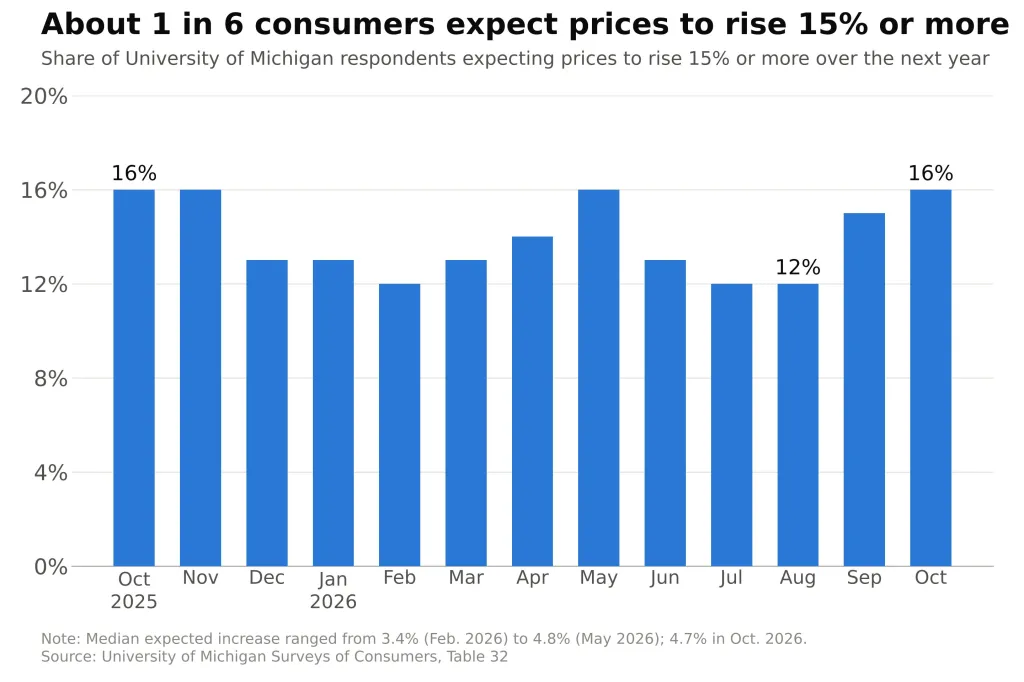
In the University of Michigan's October survey, 16% of consumers said prices would rise 15% or more over the following year, roughly the same proportion as a year earlier, according to the survey's published tables.
The typical household is considerably less alarmed—and has become more so. Median year-ahead inflation expectations “plunged from 4.7% last month to 3.7% this month,” Joanne Hsu, director of the University of Michigan Surveys of Consumers, said in the final November reading released Friday.
That divide between the most concerned consumers and the broader data is important for businesses setting prices or wages. In the late 1970s, expectations that became detached from actual inflation helped reinforce price increases.
A once-in-79-years expectation
Government consumer-price records begin in 1913. Since then, 12-month inflation has exceeded 15% during only two periods: intermittently from 1917 to 1920, when it peaked at 23.7% in June 1920, and from November 1946 through June 1947, after price controls imposed during World War II were removed. The figures come from Bureau of Labor Statistics data compiled by the Federal Reserve Bank of St. Louis and the BLS's history of the consumer price index.
For prices to rise 15% next year, they would have to increase at roughly four times the 3.7% rate recorded over the 12 months through September.
Consumers “tend to expect future inflation that is higher than official estimates of current inflation,” Federal Reserve economists wrote in a 2016 note. One reason is that people remember price increases more readily than price cuts and give greater weight to products they purchase frequently.
Consumers also experience price levels rather than inflation rates. Grocery prices were more than 27% higher in early 2025 than five years earlier, the Minneapolis Fed noted, even though the rate of increase had cooled.
Partisanship also affects expectations. Independents' views on inflation “have consistently been closer to the political party not in the White House,” the University of Michigan's survey team found in 2024 research. Hsu said “the overwhelming size and persistence of the partisan gap has generated substantial economic uncertainty.”
Voters have also indicated how strongly prices affect their political views. About nine in 10 midterm voters called the cost of living a “crucial” or “major” factor in their vote for Congress, while about six in 10 supported Democratic House candidates, according to the AP Voter Poll of roughly 100,000 voters. Republicans suffered significant losses in House, Senate and gubernatorial races, AP reported.
About two-thirds of voters said President Trump's policies had contributed to inflation. In 2022, only about half had said the same about President Biden's policies, AP reported.
Everyday expenses were a major concern. About six in 10 voters said they were “very concerned” about food and grocery costs, according to AP's analysis of the poll. Roughly one in five said inflation had caused severe hardship for their family, according to CBS News exit polls. Among voters earning less than $50,000, about six in 10 said they were worse off than two years earlier.
Earlier inflation scares
Americans have reacted to potential price surges before. In May 2008, when gasoline prices were at record levels, the University of Michigan's year-ahead inflation expectations rose to 5.2%, the highest reading since February 1982, CNBC reported. Inflation subsequently climbed to 5.6% in July 2008. The financial crisis then hit, and by July 2009 prices were 2.1% lower than a year earlier, according to BLS data.
The larger recent mismatch occurred last year. Tariff announcements pushed Michigan's year-ahead inflation expectations to 6.5% in April 2025, the highest level since 1981. Sixty percent of respondents volunteered comments about tariffs, The Boston Globe reported. The preliminary May reading reached 7.3%, before the final figure came in at 6.6%, according to the University of Michigan. Actual inflation in April was 2.3%.
This time, the median expectation is not the outlier. The typical Michigan household expects inflation of 3.7%, matching September's actual inflation rate.
Why more than one in 10 people see echoes of 1979
In 1979, the Iranian revolution reduced oil output by 4.8 million barrels a day, or about 7% of global production. Oil prices more than doubled between April 1979 and April 1980, according to the Federal Reserve.
The current comparison is the war involving Iran. Brent crude, the international oil benchmark, is up more than 60% from its level before the fighting and briefly exceeded $117 a barrel in late October, Al Jazeera reported. U.S. diesel prices reached records in September. Gasoline prices rose 37.4% in the 12 months through October, according to the Bureau of Labor Statistics.
These are prices households see regularly, and they influence inflation expectations. Donovan's argument is that U.S. median inflation “has been falling to near pre-pandemic norms,” while highly visible costs—including airfares and shipping affected by diesel prices—are being driven by the Iran war. Airline fares rose again in October, according to the BLS.
Federal Reserve researchers have documented this pattern for decades. A 2016 Fed note found that households hear more news about prices when gasoline prices move sharply. In 1979, when gasoline prices rose by roughly 20% or more, more than 10% of households reported hearing bad news about rising prices.
Why the current situation is not yet 1979
In the late 1970s, inflation was widespread. Consumer prices rose 13.3% in 1979 and 12.5% in 1980. This October, the BLS said prices increased 0.4% from the previous month, while core prices, which strip out volatile food and energy costs, rose 0.3%. The agency could not publish a 12-month rate because it collected no prices in October 2025, when the government shut down. Bank of America estimated the annual rate at about 3.8% for headline inflation and 2.7% for core inflation.
The median Michigan household expected inflation of 9.7% in both 1979 and 1980, according to the 2016 Federal Reserve note. Boston Fed researchers Philippe Andrade and Michael Wicklein found in 2025 that the rise in expectations from 1978 through 1980 was “much larger than the increase that rising prices usually would imply.” More than five percentage points of the increase could not be explained by actual prices; gasoline accounted for about one percentage point. The researchers described the phenomenon as the de-anchoring of expectations, which Volcker spent the early 1980s reversing.
Monetary policy was another major difference. The federal funds rate rose from 10% at the beginning of 1979 to 19% by the middle of 1981, according to the St. Louis Fed, while unemployment exceeded 10%.
The current Federal Reserve raised rates by a quarter percentage point in September and then held them at 3.75% to 4% at its Oct. 28 meeting. Two officials voted for another increase, according to the Federal Reserve's meeting announcement.
In 1979, the typical household's 9.7% expectation was, if anything, too low: inflation reached 13.3%. Donovan's share of consumers expects inflation higher than anything recorded during the Volcker era, while the median household expects 3.7%. The next comparison will come with the November consumer price index, scheduled for release Dec. 10.
This story was originally featured on Fortune.com.

