Altcoin Rally Broadens: Three Signals to Watch
Key Takeaways
- •CoinMarketCap's Altcoin Season Index rose to 62 on September 27, up from 50 a week earlier and 45 on September 23, but remains below the 75 threshold that defines an altcoin season.
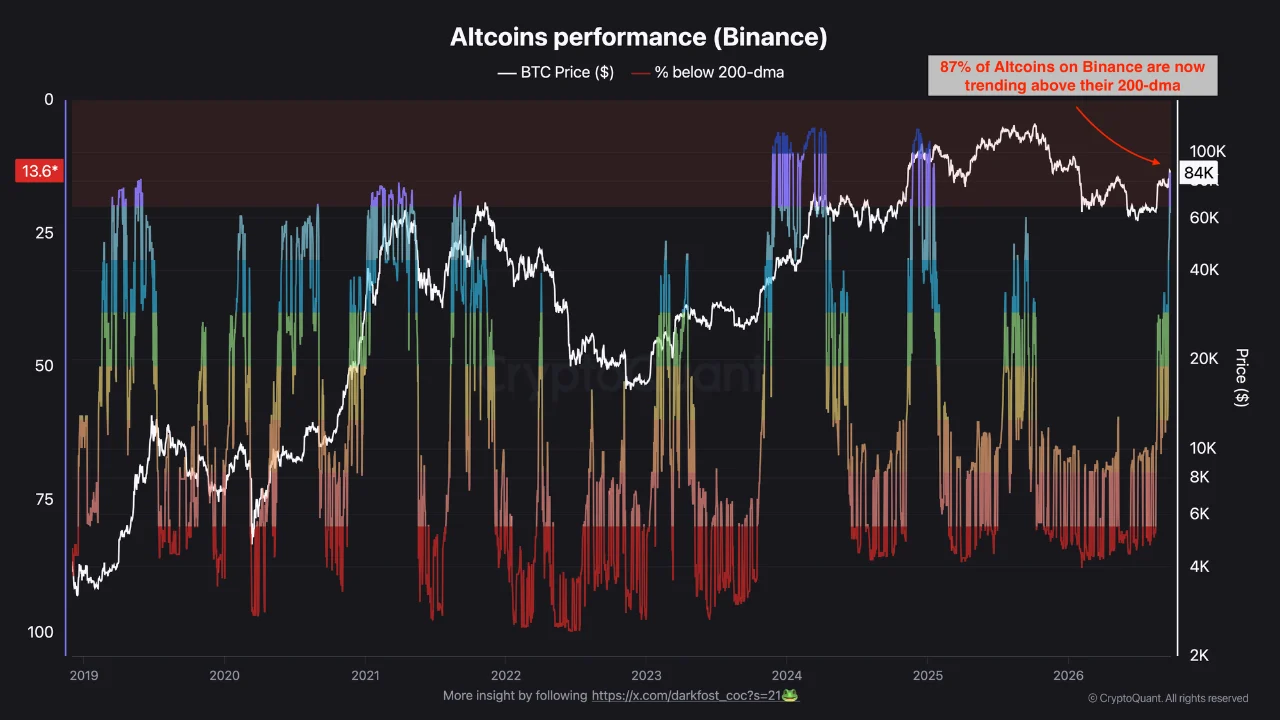
- •The share of Binance-listed altcoins trading below their 200-day moving average fell from roughly 80% in August to 13%, indicating the recovery has reached a much larger portion of the exchange's altcoin market.
- •Weekly average altcoin deposit transactions exceeded 22,700 on Binance, about 8,300 on Coinbase, and roughly 32,000 across other exchanges, though deposit counts alone cannot be treated as a sell signal.
- •Total stablecoin supply reached $306.61 billion, up about 0.54% over seven days, a gradual increase that does not yet point to a large new pool of capital buying into the altcoin rebound.
- •Aggregate futures open interest stood at about $363 billion on September 27, down 6% over 24 hours, showing derivatives exposure remains elevated but is cooling rather than building in one direction.
The altcoin rally is broadening. In a “crowded” rally, a wider group of assets and traders depends on continuing demand to support prices if selling activity increases. Data from CoinMarketCap, CryptoQuant, Kaiko, and DefiLlama outline three signals that frame the market’s next test.
Signal One: Breadth Is Improving, but the Season Test Remains Open
CoinMarketCap’s Altcoin Season Index stood at 62 when checked on September 27, up from 50 a week earlier and 45 on September 23. The index measures the rolling 90-day performance of the 100 largest eligible assets against Bitcoin, and CoinMarketCap uses 75 as the threshold for an altcoin season.
The climb to 62 confirms a broader recovery: it is no longer a story of a few individual tokens outperforming while the wider market stands still. The reading, however, remains below the season threshold, and it measures relative performance rather than cash flows. An altcoin can beat Bitcoin by rising faster, falling less, or benefiting from Bitcoin’s own weakness.
Darkfrost’s CryptoQuant analysis reaches a similar conclusion from a different dataset. The share of Binance-listed altcoins trading below their 200-day moving average — a long-term trend gauge computed from the average price of roughly the past 200 days — fell from roughly 80% in August to 13% in the latest reading. The metric does not show where individual investors bought, but it indicates that the recovery has reached a much larger part of the exchange’s altcoin market.
Signal Two: More Exchange-Ready Supply Raises the Value of Liquidity
The same analysis recorded weekly average altcoin deposit transactions of more than 22,700 on Binance, about 8,300 on Coinbase, and roughly 32,000 across other exchanges. A transfer to an exchange gives its owner several options: sell the asset, trade it, provide collateral, or simply reorganize wallet holdings. The count alone therefore cannot be treated as a sell signal.
The metric discloses neither the size of the transfers nor the sender’s purpose. A thousand small retail deposits and a handful of institutional transfers can produce the same transaction count while carrying very different implications for price.
The reason to watch the figures is the sequence: more assets are becoming available on trading venues after the market has broadened. If profit-taking grows, the key question is whether bids are deep enough to absorb it without a large price impact. Kaiko’s liquidity framework is useful here because it separates reported volume from order-book depth and slippage — the amount of resting orders around the market price and the gap between a trade’s expected and executed price, respectively. Busy trading does not guarantee a liquid exit — a market can report large turnover while a sizeable sell order still pushes through thin bids.
Signal Three: Futures Exposure Remains Elevated but Is Cooling
DefiLlama put total stablecoin supply at $306.61 billion, up about $1.66 billion, or 0.54%, over seven days and 0.9% over 30 days. USDC supply rose 1.45% over the week, while USDT increased 0.24%. Stablecoins — with USDT and USDC the two largest — are tokens pegged to fiat currencies, most commonly the U.S. dollar, and their combined supply is often used as a gauge of capital parked inside crypto markets. Total stablecoin supply is still increasing, but only gradually, and the data cannot show whether those dollars sit in wallets, DeFi positions, or exchange accounts. As a result, the latest issuance figures do not yet point to a large new pool of capital buying into the altcoin rebound.
At the same time, CoinMarketCap’s derivatives dashboard showed about $363 billion in aggregate open interest, down 6% over 24 hours, in its September 27 snapshot. Open interest covers outstanding contracts from both bullish and bearish traders; it cannot identify the market’s net directional position or substitute for evidence of spot demand.
The comparison with the previous day adds context, but not a clean trend line. Coindoo’s market-cycle report recorded $342.51 billion in open interest on September 26, after a 13.35% daily decline during the sell-off. The latest reading is higher than that earlier snapshot, while its 24-hour decline shows that futures exposure is easing again rather than building in one direction.
The Next Test: Whether the Market Can Absorb Supply
Taken together, the data describe a young but wider rotation: performance breadth is improving, on-chain dollars are still growing, and futures traders are returning. The unresolved issue is whether spot demand can carry that extra activity when holders decide to realize gains.
A shallow consolidation accompanied by fading open interest would show that the market can clear short-term excess without damaging the broader recovery. Persistent value-based exchange inflows, thinning bids, and expanding futures positioning would point to a more fragile setup.
That is why the current warning is useful without becoming a market call. The focus has shifted from whether altcoins can rise to whether the rally can remain supported once more supply becomes available to sell.
This article is provided for informational purposes only and does not constitute financial or investment advice. Market data and technical conditions can change quickly.
Source: Coindoo

