Tuberville's Lead Over Doug Jones Narrows in 'Surprisingly Close' Alabama Governor's Race, Poll Shows
Key Takeaways
- •A poll shows Tuberville leading Jones 49 percent to 41 percent in the 2026 Alabama governor's race, a far narrower margin than Tuberville's 61 percent win over Jones in the 2020 Senate election.
- •The contest is an open seat because Republican Gov. Kay Ivey is barred by Alabama's two-consecutive-term limit from seeking re-election.
- •No Democrat has won Alabama's governorship since Don Siegelman in 1998, and Donald Trump carried the state by roughly 25 percentage points in 2020.
- •The survey found 69 percent of likely voters agree education funding should follow a child to their selected school, and 65 percent would be more likely to support a gubernatorial candidate backing greater education freedom.
- •Tuberville faced a residency challenge during the Republican primary after his lawyers' documents showed he voted in Florida while claiming to live in Alabama.
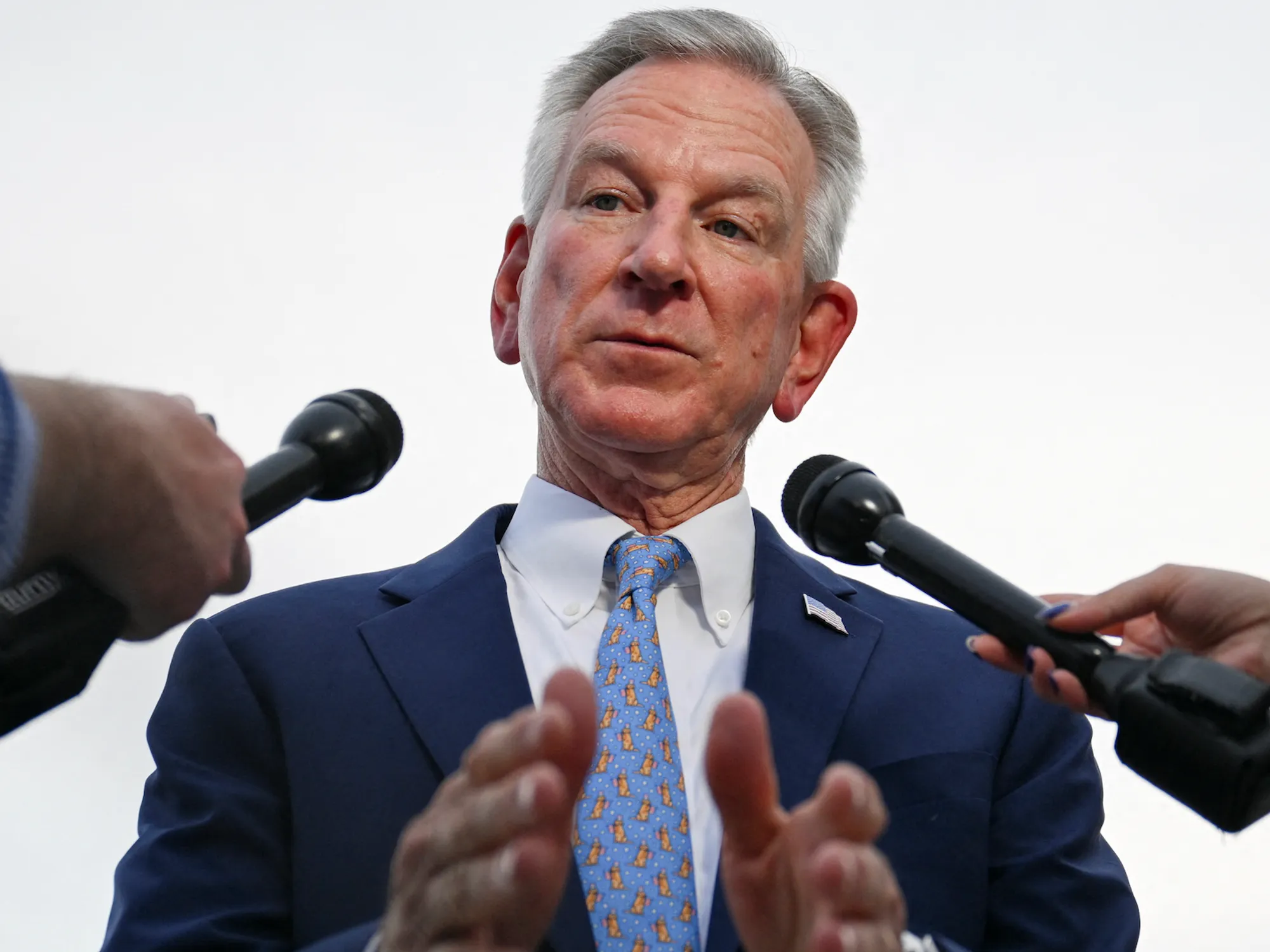
The Republican brand has become toxic enough that it is dragging down GOP candidates in some of the reddest areas of the country — including Alabama.
AL.com reported Thursday that Sen. Tommy Tuberville (R-Al.), a former Auburn University football coach, is not doing as well as expected in his rematch against former Sen. Doug Jones (D-Al.), whom he ousted in 2020 with 61 percent of the vote. Now, according to a poll from an education group that supports public funding for private schools, only 49 percent of voters say they will "definitely" or "probably" vote for Tuberville. The winner will succeed Republican Gov. Kay Ivey, who is barred by the state's two-consecutive-term limit from seeking re-election, making 2026 an open-seat contest.
An Aug. 4 article on AL.com described the race as "surprisingly close."
"For Jones and the state's Democrats, capturing 41 percent of the vote against 49 percent for Tuberville would be a tremendous feat," the report said.
The numbers mark a considerable shift from 2022, when Democrat Yolanda Flowers took just 29 percent to Gov. Kay Ivey's 67 percent. Donald Trump carried Alabama by roughly 25 percentage points in 2020, and no Democrat has won the governor's office since Don Siegelman in 1998.
"This would be an underperformance, to say the least. [Republicans] in Alabama are coming in full force in November," Katherine Robertson, the GOP candidate for Attorney General, told AL.com.
The survey questioned just 601 likely voters; 57 percent of them answered via a text-to-web poll question, and 43 percent answered the questions online — a single poll conducted by an advocacy group with a stake in one of its findings.
The survey also asked about so-called "school choice" positions, an issue that has divided people who believe that if the state pays for children to go to public school, it should also pay for them to go to private school — many of which are run by churches. Advocates of public education argue that such an approach takes money away from public education to subsidize private schools. Their argument is that the funds often do not cover the full cost of private school tuition, leaving poor families unable to make up the difference while wealthy families simply get free money. Other issues include allowing students to attend whichever public school they want, regardless of whether it is the closest school. Alabama entered that debate in 2024, when the Republican-led Legislature passed — and Ivey signed — the CHOOSE Act, which creates state-funded education savings accounts worth up to $7,000 per student toward private school costs, phased in beginning with the 2025-26 school year.
The group behind the poll believes Jones could be winning more votes if he is willing to support "school choice" legislation. The survey found "69 percent agree that education funding should follow a child to their selected school." And "65 percent would be more likely to vote for a candidate for governor who supports giving families more education freedom."
Jones, a former U.S. attorney whose prosecutions sent two Ku Klux Klan members to prison decades later for the 1963 bombing of Birmingham's 16th Street Baptist Church, had previously won the 2017 special election against Roy Moore, a far-right former judge who had nine women accusing him of inappropriate conduct. No Alabama Democrat has won statewide since that special election.
Tuberville, for his part, has faced his own slate of scandals in the Republican primary, where his opponent found reason to believe that Tuberville did not meet the residency requirement for the governor's race — a requirement obliging him to live in the state longer than he would need to in order to run for U.S. Senate. Tuberville's lawyers released documents showing his moves from Florida to Alabama, but those documents also showed that while he was claiming to live in Alabama, he was also voting in Florida, where he said he did not live.

