Airtel Nigeria Credits Customers With Airtime Compensation for February–April 2026 Network Failures
Key Takeaways
- •Airtel Nigeria has begun issuing airtime credits, ranging from less than ₦50 to ₦1,500, to customers affected by network failures between February and April 2026.
- •The payouts follow a Nigerian Communications Commission directive requiring operators to compensate subscribers in areas by prolonged or repeated poor service, marking a shift from fines toward direct redress.
- •Compensation is calculated from subscribers' typical spending and location in affected areas, and eligibility requires at least one billed call, SMS, or data session during the review period.
- •Neither the NCC nor the operators have disclosed the methodology behind the compensation figures, and the regulator has yet to release its June review of an earlier round said to have covered 75 million Nigerians.
- •The development coincides with Airtel Money's planned London initial public offering, which seeks to raise $800 million.
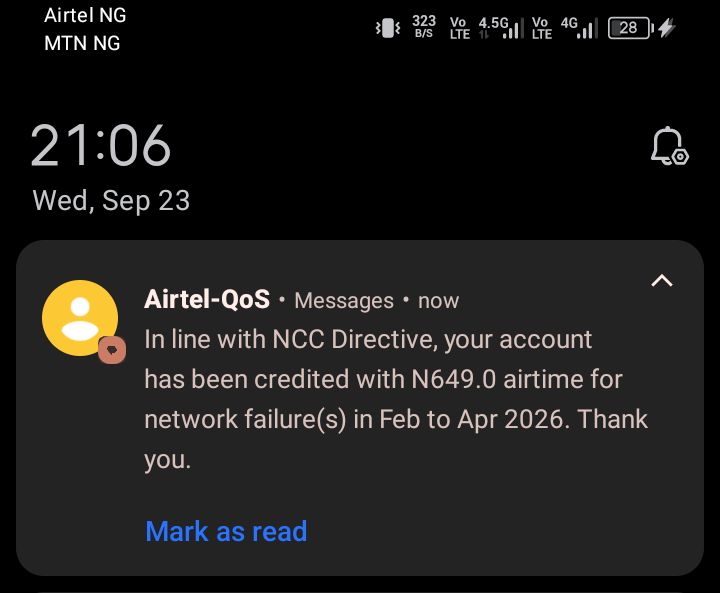
Airtel Nigeria has begun crediting customers with airtime compensation for poor network service experienced between February and April 2026.
Affected customers started receiving SMS notifications of the airtime credit on Wednesday night, with the amounts ranging from less than ₦50 to as much as ₦1,500.
"In line with NCC Directive, your account has been credited with ₦xxxx airtime for network failure(s) in Feb to Apr 2026. Thank you ," the Airtel message reads.
The payouts follow a directive from the Nigerian Communications Commission (NCC) requiring telecom operators to compensate subscribers affected by prolonged or repeated poor network service in qualifying areas — a strategic shift from fines toward direct subscriber redress.
According to the commission, compensation is calculated based on how much subscribers typically spend and whether they are located in areas affected by service failures and poor network quality. Qualifying subscribers can use the credited airtime for SMS, voice, and data services, and under regulatory directives the credit is not expected to expire.
This is not the first time Airtel has rolled out airtime compensation. In May, the operator compensated customers affected by poor network service between November 2025 and January 2026 — the first time such an intervention came to light.
With Airtel leading compliance this time, it remains unclear whether all qualifying customers have received their credits. Other mobile network operators (MNOs), including MTN, Globacom, and T2mobile (9mobile), are also expected to credit affected customers, and whether they follow within the same window will show how uniformly the directive is being applied across the market. The development comes as Airtel Money prepares for a London initial public offering, seeking an $800 million raise.
The intervention follows numerous complaints over network outages that have led to a drop in voice calls and a poor quality of experience. While the airtime compensation has been described as a landmark victory for Nigerian subscribers who were shortchanged by bad network service, several key modalities remain unclear.
Neither the NCC nor the mobile network operators, for instance, have disclosed the methodology used to arrive at the compensation figures, raising doubts that customers may be receiving airtime credits that fall short of the disruption they experienced. How the network outages and dropped calls are being measured also remains undisclosed, fueling concerns that both the NCC and telecom operators lack transparency with Nigerians on the calculations. Without those details, subscribers have no independent way to check whether the credit on their line matches the disruption recorded on it.
The commission has made only one attempt to investigate the airtime compensation. In June, the regulator moved to review whether eligible telecom subscribers received the compensation they were meant to receive, after the MNOs said they had compensated 75 million Nigerians between November and January 2026. However, five months later, the NCC has yet to release the report of that investigation — and with it the regulator's assessment of whether the earlier round reached the subscribers it was meant to cover.
In an explanation published on its website in early 2026, the NCC stated that operators have previously been mandated to monitor their network performance across various service disruptions against Quality of Service Key Performance Indicators (KPIs).
The regulator noted that this strategy enables operators to identify affected subscribers without the need for individual complaints, adding that the compensation is automatic.
According to the NCC, airtime compensation is intended for customers who experienced a drop in network services, but eligibility depends on specific technical criteria. A subscriber qualifies for compensation only if they experienced poor network service in an affected Local Government Area.
In addition, the subscriber must have made at least one outgoing revenue-generating event — a billed call, SMS, or data session — during the period under review, meaning customers in affected areas who recorded no billable activity in the window fall outside the stated eligibility criteria.

