Cooling Emissions Projected to Triple by 2050 as Global Heat Waves Intensify
Key Takeaways
- •Air conditioning currently prevents approximately 190,000 heat-related deaths globally each year, while nearly half a million people died annually from heat exposure between 2000 and 2019.
- •Refrigeration and air conditioning account for about 7% of global greenhouse gas emissions, and the International Energy Agency projects those emissions will double by 2030 and triple by 2050.
- •Only 40% of the over 80% of the world's population exposed to dangerous heat levels has access to air conditioning, with the greatest access gap in the poorest and hottest countries.
- •The poorest households spend up to 8% of their income on cooling compared to 0.2 to 2.5% in wealthier homes, while typically relying on the least efficient units in poorly insulated dwellings.
- •A study published in Nature Reviews Clean Energy found that passive cooling technologies can reduce air conditioning demand by up to 80% and lower ambient temperatures by more than 4 degrees Celsius.
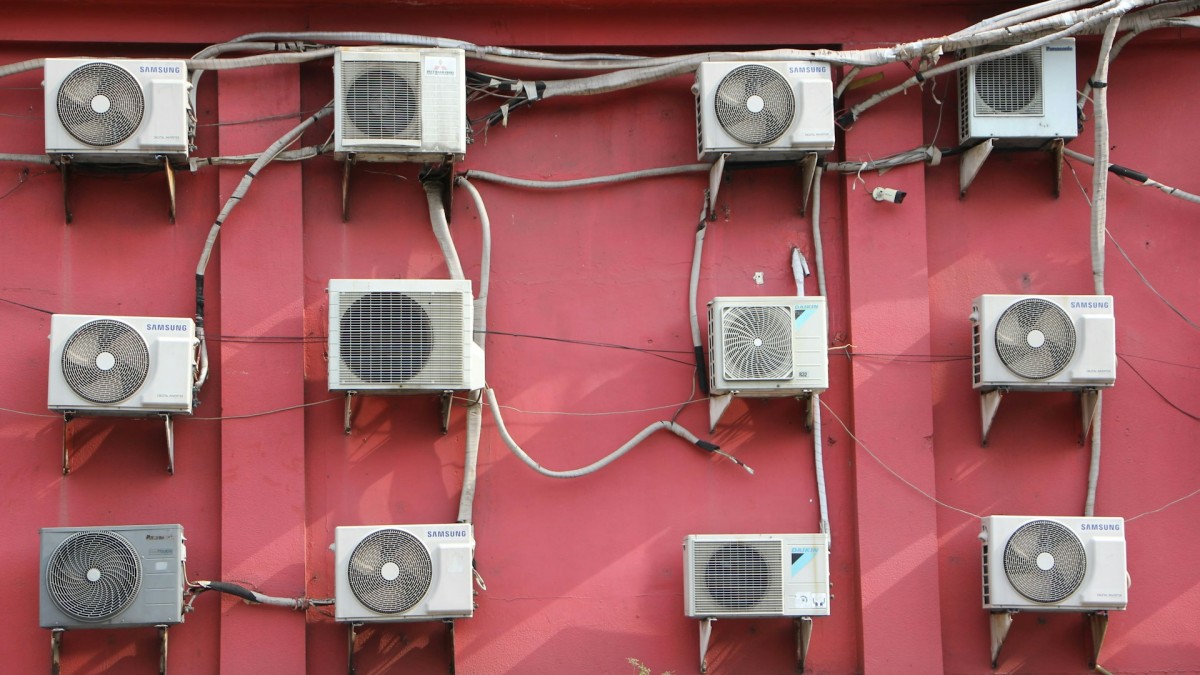
As global temperatures climb and heat waves grow deadlier and more frequent, air conditioning has evolved from a luxury into what many now consider "essential infrastructure." Yet while air-conditioning units undeniably save lives, their rapid proliferation is simultaneously fueling global warming and diverting attention from broader strategies to cut greenhouse gas emissions and combat climate change.
"Of all extreme weather, high temperatures are overwhelmingly the most deadly," The Economist wrote in a recent report. A Lancet study found that between 2000 and 2019, nearly half a million people worldwide died from heat each year, with the elderly disproportionately affected. Against this immediate threat, air conditioning stands as a logical and life-saving intervention, averting approximately 190,000 deaths annually.
However, the climate cost is substantial. Refrigeration and air conditioning currently account for roughly 7 percent of global greenhouse gas emissions. According to the International Energy Agency, those emissions are projected to double by 2030 and triple by 2050. A significant portion of this impact stems not only from electricity consumption but from the hydrofluorocarbon (HFC) refrigerants used in most cooling equipment, which are hundreds to thousands of times more potent as greenhouse gases than carbon dioxide. The 2016 Kigali Amendment to the Montreal Protocol, ratified by over 150 countries, commits signatories to phasing down HFC production and use, but full implementation stretches over decades.
"Air conditioning saves lives and will remain essential during extreme heat," said Mat Santamouris, Professor of High Performance Architecture at UNSW Sydney, in a statement released earlier this month. "But we cannot air-condition our way out of climate change. If every building depends entirely on mechanical cooling, we create enormous pressure on electricity systems while adding even more heat to our cities." That added heat is compounded by the urban heat island effect, in which dense, paved city environments absorb and retain warmth, leaving urban centers several degrees hotter than surrounding areas and intensifying cooling demand in the very places where most of the world's population now resides.
Access to air conditioning — and its consequences — remains deeply uneven. Most of the world's poorest countries are situated in hot-climate regions, yet they face severe constraints in adopting cooling technology. These nations often lack the capital to modernize power grids and expand electricity generation, while individual households frequently cannot afford units. The result is a deadly paradox: the populations most vulnerable to rising temperatures are the least equipped to cope.
"Though more than 80% of the world's population regularly encounter the kind of heat for which cooling is needed, just 40% of those people are able to get AC," The Economist reports. "The greatest gap is in the poorest, hottest countries."
Furthermore, the low-cost units typically purchased by lower-income consumers are especially inefficient, placing added strain on already stressed electrical grids. These units also impose a disproportionate financial burden. According to The Economist, the poorest households spend as much as 8 percent of their income on cooling, compared with a global average of 0.2 to 2.5 percent in wealthier homes. "Poor households also face a double-whammy in efficiency," the report notes. "The cheapest machines gobble up more electricity, and are being cranked up in the leakiest, worst-insulated homes."
This grid strain is not an abstract concern. During extreme heat events, simultaneous air-conditioning use can push electricity systems past their limits, triggering blackouts that leave even those with cooling units unprotected. The IEA has identified space cooling as one of the fastest-growing drivers of energy demand in buildings worldwide, a trajectory that many power grids are not built to absorb.
This dynamic means air conditioning is not only worsening global warming but also deepening climate injustice in ways that are both critical and life-threatening.
While air conditioning cannot be abandoned — it has become vital for human well-being in a warming world — experts argue that it should be treated as a last resort, with other technologies prioritized ahead of mechanical cooling.
A new study published in the journal Nature Reviews Clean Energy found that passive cooling technologies can reduce demand for air conditioning by up to 80 percent and lower ambient temperatures by more than 4°C (7.2°F). Many of these technologies, including ventilative cooling and solar control, are already technologically mature and could be scaled rapidly and with relative ease. The study's authors call for urgent policy measures to promote the development and deployment of passive cooling solutions, both to reduce reliance on air conditioning and to continue saving lives.
By Haley Zaremba for Oilprice.com

