African AI Businesses Raised $1.3 Billion, but High Cloud and Compute Costs Threaten Growth – Report
Key Takeaways
- •The report maps 311 African AI companies that collectively raised $1.3 billion in disclosed funding between 2016 and 2025, but over 75 percent of that capital went to ventures founded before 2020, leaving the post-2022 AI-native cohort underfunded.
- •Dollar-denominated compute costs against weak local purchasing power have inverted traditional SaaS economics, with 65 percent of surveyed startups naming cloud, GPU and infrastructure spending their single largest R&D expense while more than half price products below $2,500 per customer per year.
- •Infrastructure deficits compound the pressure: Africa holds 18 percent of the world's population but under 1 percent of global data centre capacity, and only 5 percent of African AI practitioners have access to the compute they need, with model iterations taking up to six days versus 30 minutes in G7 nations.
- •African AI startups increasingly serve institutional buyers, with 88 percent selling B2B and 44 percent B2G, while 65 percent of founders identify customer trust and low AI literacy as their primary scaling obstacle.
- •Founders' policy demands include R&D and compute subsidies (62 percent), harmonised cross-border data rules between markets such as Nigeria and Kenya (49 percent), and regulatory sandboxes to unlock undigitised public records (26 percent).
Building an artificial intelligence startup in Africa means surviving a stark macroeconomic contradiction. Founders must rent graphics processing units (GPUs), cloud storage and foundation model application programming interfaces (APIs) priced in US dollars, then sell the resulting software to local enterprises with battered budgets. This structural squeeze has flipped textbook Software-as-a-Service (SaaS) unit economics: unlike traditional software, where marginal costs flatten as user numbers grow, every new active user on an AI-native platform drives up foreign-currency compute bills in lockstep.
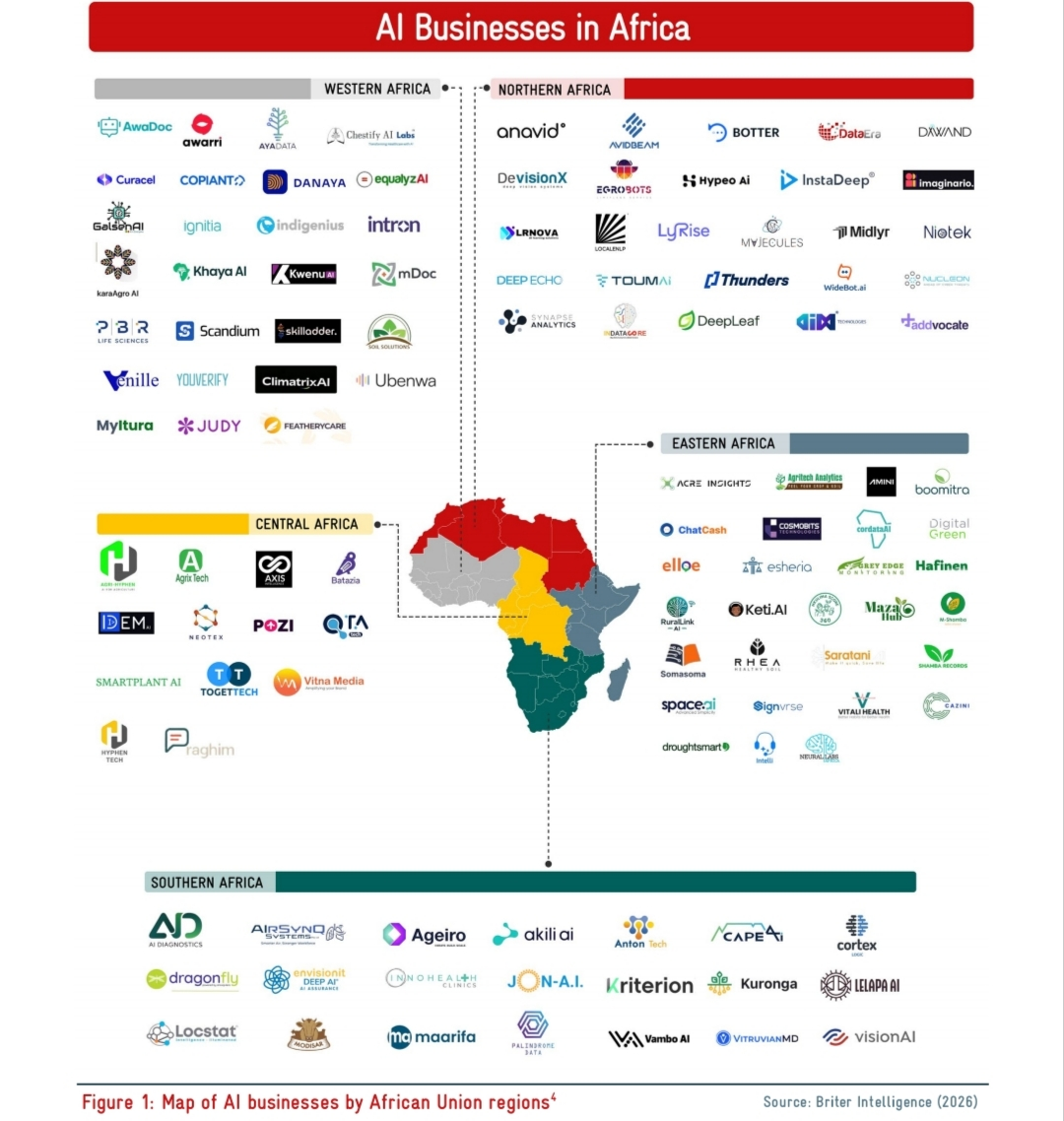
Those twin pressures are the crux of AI Made in Africa: Voices from AI businesses across Africa, a 70-page study published in October 2026 by the Deutsche Gesellschaft für Internationale Zusammenarbeit (GIZ) African Union office in partnership with market intelligence firm Briter Bridges. The study maps 311 for-profit AI companies that collectively received $1.3 billion in publicly disclosed funding across more than 35 sectors between 2016 and 2025, alongside an in-depth survey of 85 businesses and 16 stakeholder interviews conducted between April and July 2026.
From AI-enabled to AI-native
The maturing of the continent's AI conversation is visible in how founding cohorts have shifted since foundation models such as GPT, Llama and Mistral were publicly released in 2022. Across the broader 311-company dataset, 56 per cent of firms are "AI-enabled", meaning they layer machine learning onto an existing fintech, health or agritech service that could still function without it. Among the 85 surveyed businesses, which skew heavily toward post-2022 entrants, 75 per cent are "AI-native".
The result is a pragmatic evolution in how African engineers architect their tech stacks. At the pre-seed and bootstrapped stages, startups split evenly between third-party commercial APIs chosen for speed, open-source models adopted to avoid per-query fees, and in-house builds. Once companies scale into the $1 million to $10 million funding band, however, third-party API dependency becomes financially toxic: serving thousands of daily users can easily generate $20,000 to $50,000 in monthly token bills. Growth-stage startups therefore converge on hybrid architectures, fine-tuning open-source bases with proprietary local datasets.
In sectors such as healthcare and agriculture, building in-house or hybrid models is a necessity rather than a choice: off-the-shelf Western models routinely hallucinate on African clinical records and misidentify local crop diseases. That requirement inverts the prevailing global playbook of shipping fast on top of commercial APIs: for African builders, the model layer is simultaneously where differentiation is won and where most startups' single largest R&D expense sits.
The $208-a-month ceiling
The mathematics turn ugly quickly when development costs meet local purchasing power. A full 65 per cent of surveyed startups cite cloud computing, GPUs and infrastructure as their single largest research and development (R&D) expense, ahead of data acquisition and cleaning. At the same time, more than half of surveyed companies price their products below $2,500 annually per customer, or roughly $208 a month. For small African businesses with annual turnovers below $10,000, a $208 monthly software subscription competes directly with staff salaries and backup power.
Margin compression is worsened by acute infrastructure deficits. Africa hosts 18 per cent of the world's population but accounts for less than 1 per cent of global data centre capacity, routing roughly 80 per cent of its internet traffic through foreign servers. Independent industry tracking from the 2026 AI Data Centre Index projects 19 AI-ready facilities reaching 1.3 GW of capacity across seven African countries, but power grids remain the binding constraint. The report notes that Nigeria's national grid averaged just 4,000 MW of available capacity in early 2026 against 13,000 MW installed, while a planned $1 billion geothermal data centre in Kenya by Microsoft and G42 stalled in August 2025 because powering it would have starved half the country of electricity.
Currency shocks compound the problem. The 2023 naira devaluation reportedly drove local cloud bills up by 224 per cent. As a result, only 5 per cent of African AI practitioners have the compute they need, and model iterations that take 30 minutes in G7 nations can take six days on the continent.
Building for institutional buyers
Faced with fragile consumer purchasing power, African AI founders are building for institutional buyers. Some 88 per cent of surveyed companies sell to other businesses (B2B) and 44 per cent sell to governments (B2G), relying heavily on recurring subscriptions while straddling multiple customer segments simultaneously to stay afloat.
Yet selling to institutions exposes startups to the ecosystem's single largest scaling barrier: 65 per cent of founders cite customer trust and low AI literacy as their primary obstacle, ahead of high development costs (49 per cent), legacy system integration (34 per cent) and long sales cycles (33 per cent). Nigerian healthtech startup MyItura, for instance, had to build proprietary clinical datasets and equip primary healthcare agents with grant-funded tablets before doctors would trust its AI transcription and lending tools. In South Africa, enterprise AI firm The Awareness Company frequently has to install physical sensors for mining and real estate clients still running operations on manual spreadsheets before its software can even ingest data.
Lean teams and the talent gap
Inside these companies, teams remain remarkably lean: only 2 per cent employ more than 250 staff. Because Africa holds just 1 to 3 per cent of global AI talent, local startups cannot match foreign remote salaries. Some 51 per cent of founders struggle to hire senior AI researchers, and 33 per cent struggle to find MLOps engineers. In response, 47 per cent have turned their startups into de facto academies, building formal internal training pipelines to upskill junior local graduates. Ivorian regtech startup Danaya, for example, trains young local engineers in-house on computer vision while recruiting diaspora leadership from France to oversee architecture.
Capital and policy must match operational reality
The underlying message to investors and policymakers is that capital and policy must match operational reality. Although $1.3 billion flowed into mapped companies over the past decade, with a median ticket size of $225,000, over 75 per cent of that capital went to pre-2020 ventures. Weighed against the survey's post-2022, AI-native skew, that split means the continent's newest wave of AI builders has so far drawn on only a minority of the decade's disclosed funding. Nearly a third of surveyed startups remain entirely bootstrapped, only 15 per cent are profitable, and 60 per cent of those profitable firms operate beyond Africa, including Northern African startups relocating their headquarters to Dubai and Riyadh.
Two years after the African Union adopted its Continental AI Strategy in July 2024, founders are not asking for generic incubation; fewer than 5 per cent of Africa's 470 tech hubs offer GPU access or specialised AI mentorship. Instead, founders want patient investors who understand 12-to-18-month B2G procurement cycles and structural currency risk.
From governments, their demands are concrete: 62 per cent want R&D and compute subsidies, 49 per cent want harmonised cross-border data rules between markets like Nigeria and Kenya, and 26 per cent want regulatory sandboxes that unlock decades of undigitised public agricultural and health records.
AI Made in Africa shows that African engineers have already moved from consuming AI to building it. The remaining task, the report makes clear, sits with the continent's financiers, power grids and regulators, which now have to catch up. The survey's policy asks and the data centre buildout pipeline now double as benchmarks for measuring how much of that catch-up actually happens.

