The Creator Economy's Plagiarism Problem: How AI Is Amplifying a Growing Crisis
Key Takeaways
- •Actress Anita Joseph publicly apologized after content creator Caramel Plug accused her of using AI to superimpose her face onto an original photograph and publishing it without permission.
- •Content creator Tope Babalola reported that a larger YouTuber reposted his Platinum Card skit audio without attribution, drawing over 11 million views before removal and causing viewers to falsely accuse Babalola of stealing his own work.
- •Goldman Sachs estimated the creator economy at approximately $250 billion in 2023 and projected it would nearly double by 2027.
- •Platform tools such as YouTube's Content ID and TikTok's 2023 repost removal feature remain reactive rather than preventive, requiring original creators to discover and report infringements themselves.
- •AI-powered face-swapping, voice cloning, and text generation tools have significantly lowered the cost and barrier to producing derivative content that closely resembles original creative work.
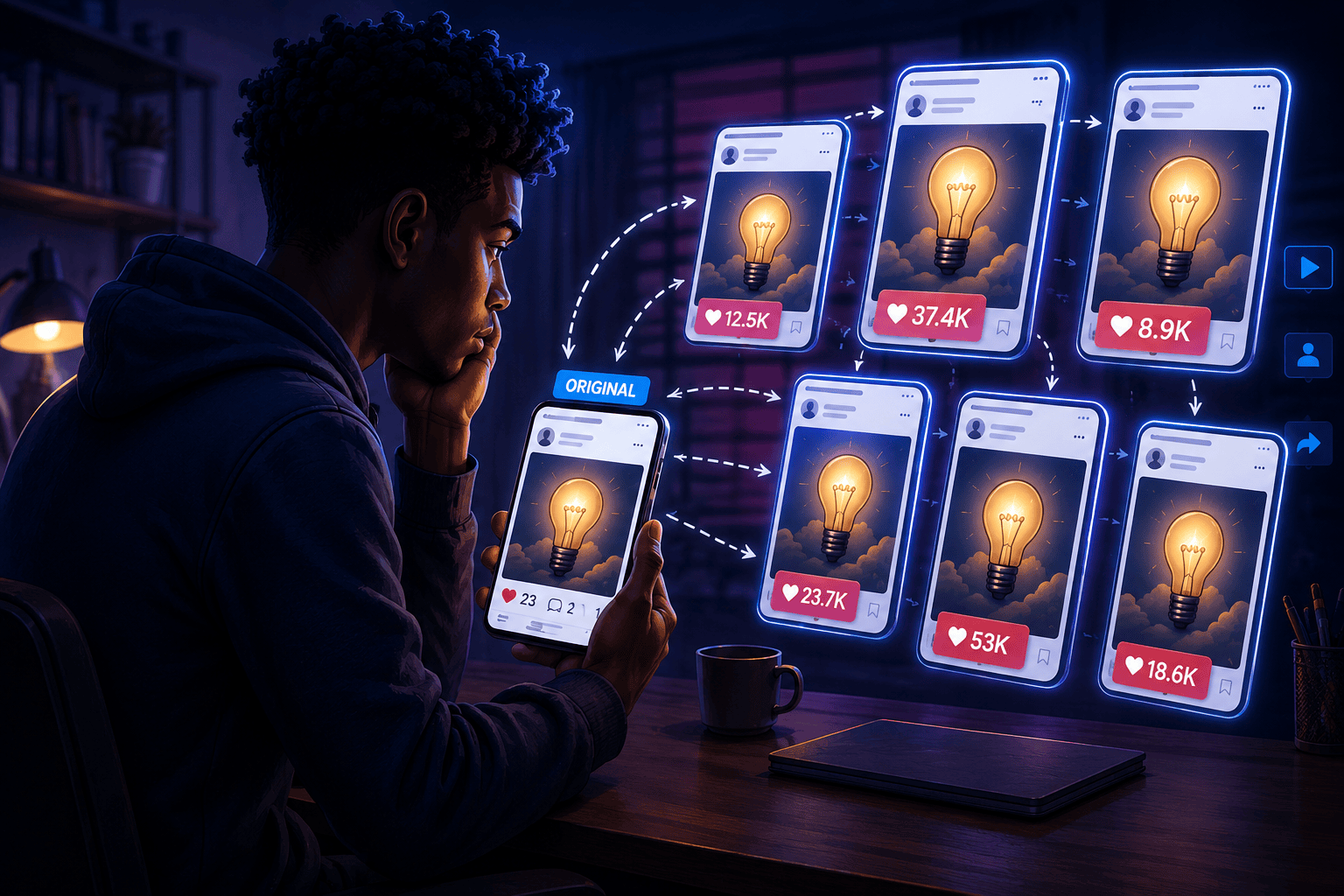
Content creators are all too familiar with the experience of opening social media only to discover their original work flourishing on someone else's account. The unauthorized use takes many forms: reposts without attribution, copied scripts, recreated skits, and increasingly, AI-generated versions altered just enough to appear original.
This issue drew renewed attention recently when actress Anita Joseph issued a public apology after content creator Caramel Plug accused her of using artificial intelligence to superimpose her face onto one of Caramel's original photograph and publishing it as her own. Although the dispute involved a single image, it sparked a wider discussion about authenticity, ownership, and the ease with which digital content can now be manipulated.
Social media has long been driven by trends. A creator develops an idea, others adopt it, and soon variations proliferate across platforms. However, the line between drawing inspiration and chasing virality has blurred, and the digital landscape has grown increasingly permissive toward copying. The pressure to be seen frequently overshadows the creative effort required to produce content worth watching.
A recent remark by Nigerian content creator and skitmaker Sydney Talker struck a chord with many aspiring creators. Speaking at the Creators Keynote event on Monday, he said: "The first ideas to start with are the ones that have been done before, so just do it in your own way."
His observation holds merit. The most successful creators seldom invent entirely new concepts; instead, they reinterpret existing ideas through a distinctive lens. The difficulty arises when "your own way" amounts to little more than altering a few words, swapping a face, changing a voice, or reposting another person's work with minimal or no acknowledgement.
Inspiration builds upon ideas. Plagiarism profits from them.
The experience of content creator Tope Babalola illustrates this distinction vividly. After his Platinum Card skit went viral, thousands of users created their own videos based on it, a development he says he genuinely appreciated. However, others went further by re-uploading his original audio as their own or using AI to modify his voice before posting without any credit.
The fallout was significant. According to Babalola, a substantially larger and more popular YouTuber reposted his original audio without attribution, drawing more than 11 million views before the video was removed following his copyright infringement report. By that point, many viewers had encountered the copied version first and accused Babalola of stealing his own script.
Babalola emphasized that the most frustrating aspect was not the recreation of his work but the absence of credit.
"Imagine being accused of stealing your own voice. Yeah, crazy. This is nothing new. I've created plenty of videos over the years where this has happened. And I'll usually just ask the people who took my audio to just credit me in the captions. Literally takes two seconds, and we're good," he said.
Without proper attribution, original work rapidly becomes anonymous, while those who copied it reap the benefits.
This dynamic underscores a fundamental problem within the creator economy, an industry that Goldman Sachs estimated at approximately $250 billion in 2023 and projected to nearly double by 2027. Algorithms reward engagement rather than originality. They do not evaluate who conceived an idea first; they amplify whatever sustains viewer attention. In many instances, the individual who copies the content earns the views, followers, and brand partnerships, while the original creator is left attempting to prove ownership. Platforms have introduced tools to address this, such as YouTube's Content ID system, which scans uploaded videos against a database of copyrighted works, and TikTok's 2023 feature allowing creators to identify and request removal of unauthorized reposts. These mechanisms, however, remain reactive rather than preventive, and enforcement typically depends on the original creator discovering the infringement first.
Artificial intelligence did not create plagiarism. People have copied creative works for decades. What AI has done is accelerate the process, reduce its cost, and make it considerably harder to detect. AI-powered face-swapping applications, voice cloning services, and text generation tools are now widely accessible, many available at little or no cost, lowering the barrier to producing derivative content that closely resembles original work.
This presents a challenge that existing copyright frameworks were not designed to resolve quickly. While copyright protects the original expression of an idea rather than the idea itself, proving infringement becomes increasingly difficult when AI can render copied content sufficiently distinct to evade straightforward detection. In practice, most creators rely on the Digital Millennium Copyright Act (DMCA) takedown process, which requires them to identify each infringing upload and submit individual requests to the host platform, a time-consuming burden that can leave creators outpaced by the speed at which copied content spreads.
The larger issue may be cultural rather than legal. Many internet users now regard publicly available content as communal property. The assumption is that if something is accessible online, it is free to repost, recycle, or repackage.
The creator economy has grown into one of the world's fastest-expanding industries precisely because it rewards originality. Yet each time an uncredited repost goes viral or an AI-generated copy outperforms the original, that foundational promise is undermined. The internet has made content creation more accessible than ever, but it should not make appropriating another person's creativity equally effortless.
No single individual holds a monopoly on the concept of comedy, gadget reviews, or street interviews. But when someone writes a script, records audio, shoots video, or creates artwork, that work belongs to them. Acknowledging that ownership is the minimum standard the rest of us can meet.

