Philippine CRE Leaders See AI Shaping Strategies Despite Execution Gap
Key Takeaways
- •About 73% of surveyed organizations expect their workforces to grow, while 35% anticipate some job reductions from automation.
- •Approximately 55% of organizations expect AI adoption to require rapid reskilling and new combinations of employee skills.
- •A lack of expertise, cross-functional coordination difficulties, and an evolving national AI strategy are identified as leading obstacles to creating value from AI.
- •Organizations are prioritizing advanced and reliable technology infrastructure, adaptable workspaces, and well-being amenities to improve productivity and employee experience.
- •JLL recommends planning for multiple workforce models, developing internal capabilities, and strengthening collaboration among real estate, HR, IT, finance, and operations teams.
By Janlo de los Reyes
Approximately four out of five business and corporate real estate (CRE) leaders in the Philippines believe artificial intelligence (AI) will largely shape their real estate strategies over the next three to five years. However, only 18% have progressed beyond monitoring and deployment to fully integrate AI into their operations and prepare their organizations for AI-related changes.
This is among the key findings of JLL’s 2026 Future of Work Survey, which examines how organizations are managing AI transformation, productivity imperatives, risk management, and portfolio strategy. The global survey, conducted from January to April of this year, collected responses from 100 corporate real estate leaders and executives in the Philippines. Respondents represented organizations with between at least 500 and more than 10,000 employees across 20 industries.
The AI execution barrier
Despite 79% of leaders acknowledging that AI will affect their portfolios, many organizations remain in the planning stage. The gap reflects the complexity of assessing AI’s impact on organizations during the early stages of adoption.
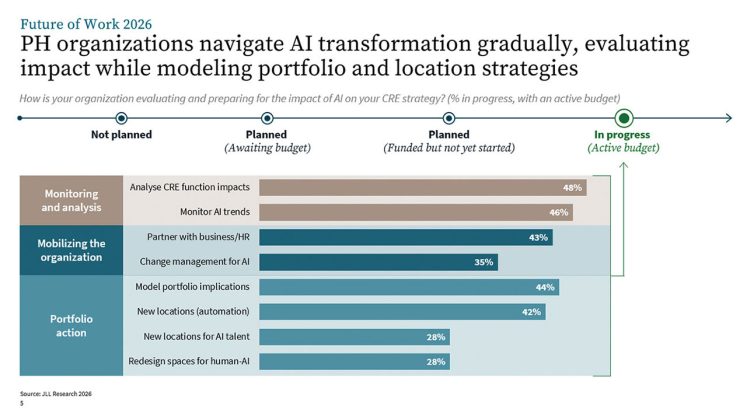
Among organizations currently pursuing AI transformation, 48% are still analyzing the impact on CRE functions and 46% are monitoring AI trends. About 44% are modeling the implications of AI for their portfolios, while 42% are modeling implications for new locations. Another 43% are working with business and Human Resources (HR) teams to mobilize their organizations.
About 73% of organizations expect their company’s workforce to expand. Banking and other financial services ranked first among the industries with this expectation, followed by professional and business services and healthcare. In contrast, construction and engineering as well as manufacturing companies expect workforce reductions.
At the same time, 65% of organizations recognize that AI will reshape human roles, while 35% foresee some reduction in roles because of automation. Banking and other financial services, healthcare, manufacturing, and professional and business services were the leading industries in expecting roles to be reshaped. Construction and engineering as well as banking and other financial services led the group expecting reductions caused by automation.
The findings add context to the debate over whether AI will reduce jobs or create new ones. The research acknowledges the potential for workforce reductions, but also points to job creation and the redesign of roles as consequences of AI adoption. Workforce reductions could eliminate jobs and reduce the need for office space. Conversely, workforce expansion in sectors such as banking and other financial services, healthcare, manufacturing, and professional and business services could generate additional office demand, resulting in net positive office take-up overall.
Talent scarcity has also emerged as a potential concern. About 55% of organizations believe AI will require rapid workforce reskilling and new combinations of skills. The industries most likely to expect this include banking and other financial services, construction and engineering, data centers, healthcare, and professional and business services. Meanwhile, 45% agree that AI augmentation can improve access to talent by enabling employees to perform higher-value tasks. Technology and digital companies lead this group.
Capability gaps outweigh budget constraints
Budget limitations rank outside the top five constraints on AI adoption and value creation over the next few years. This may help explain why many organizations remain in the monitoring and analysis phase. Even when budgets are available, organizations identify a lack of expertise to drive change, difficulties in cross-team collaboration, and the still-developing national strategy related to AI as the main obstacles to value creation.
The main future investment priorities for maximizing individual employee productivity include critical infrastructure, particularly advanced technology and AI support, as well as reliable technology infrastructure. Adaptable individual spaces and activity-based workplaces ranked third and fourth among productivity enhancers, respectively. For experience differentiators, organizations are focusing on well-being amenities and work-life management services.
These findings highlight the role of real estate in creating value. Following the pandemic, organizations have placed greater emphasis on offices’ ability to support employee productivity.
Affordability shapes portfolio execution
At the building level, organizations’ emerging priorities include long-term strategic positioning, AI-driven buildings, and building quality and amenities.
This is consistent with the flight-to-quality movement observed in the market, as occupiers seek better spaces in new premium-grade and certified buildings. Beyond cost considerations, the shift is influenced by the need—particularly among multinational corporations (MNCs)—to align with environmental, social, and governance (ESG) goals, the growing demand for technology-enabled offices, and the desire for a premium address that can help attract talent.
On the supply side, these trends strengthen the case for asset enhancement, particularly given the volume of aging stock in the metro area alone. As the landscape evolves rapidly, building owners need to remain relevant or risk obsolescence.
At the workplace level, the office has become more relevant. The question is no longer simply how much space an organization requires, but what type of environment it envisions for its employees. Offices have become experiential, much like other asset classes. Respondents identified a variety of collaborative spaces, hospitality-grade service delivery, customized user experiences, and innovative and experimental approaches as emerging priorities.
AI transformation is affecting Total Cost of Occupancy, creating a disconnect between aspiration and affordability. Although organizations aspire to adopt smart-building technology, AI-driven workforce automation and technology-infrastructure requirements remain major concerns. Inflationary pressures, rising operating costs, and energy and utility expenses are also significant sources of cost. These pressures can reduce the budgets available for other investments aimed at long-term strategic positioning and transformation.
A strategic action framework
JLL’s findings point to three action areas.
First, organizations need to prepare for multiple workforce futures. Given the variety of work arrangements, organizations can plan for different models, including fully remote, hybrid, and full return-to-office scenarios. Office space is expected to continue playing a pivotal role, making it important to invest in workspaces that balance productivity and well-being. Organizations can also preserve agility through varying lease terms and hub-and-spoke footprints, using either traditional office space or flexspaces.
Second, organizations need to address capability gaps while preserving optionality. This involves building internal capabilities while partnering with AI experts when in-house expertise is lacking.
Finally, organizations need to create sensing mechanisms and decision-making agility. This requires stronger collaboration among CRE, HR, information technology (IT), Finance, and Operations teams. Regular tracking of space usage, AI adoption, and employee preferences should also be prioritized, alongside clear rules for when to invest or adjust resources.
Ultimately, the organizations that pull ahead in CRE transformation will be those that build adaptive capability for the future.
Janlo De Los Reyes serves as JLL Philippines head of research and advisory.

