Week 35 Stocks Market Watch: AI Earnings Lifted the U.S. as Korea and Hong Kong Lagged
Key Takeaways
- •Nvidia's fiscal second-quarter revenue reached $96.2 billion, up 18% sequentially and 106% year over year, with management guiding fiscal third-quarter revenue to $108 billion plus or minus 2%.
- •U.S. indexes finished Week 35 higher, with the S&P 500 up roughly 0.5% and the Nasdaq Composite up about 0.8%, but both declined Friday after hawkish Jackson Hole remarks from Warsh emphasized inflation risk.
- •Korea's KOSPI fell about 1.8% to 6,788.88 and Hong Kong's Hang Seng declined about 1.6% to 25,584.79, showing that Nvidia's earnings did not translate into broad Asian equity gains.
- •July PCE inflation came in at 3.7% headline and 3.3% core year over year, well above the Federal Reserve's 2% target and limiting confidence in rapid policy easing.
- •Week 36's constructive case requires cooling U.S. rate pressure without breaking earnings, broader Korean semiconductor participation, and improved Chinese activity data, with key events including the August jobs report and Broadcom's fiscal third-quarter results.
Quick Answer
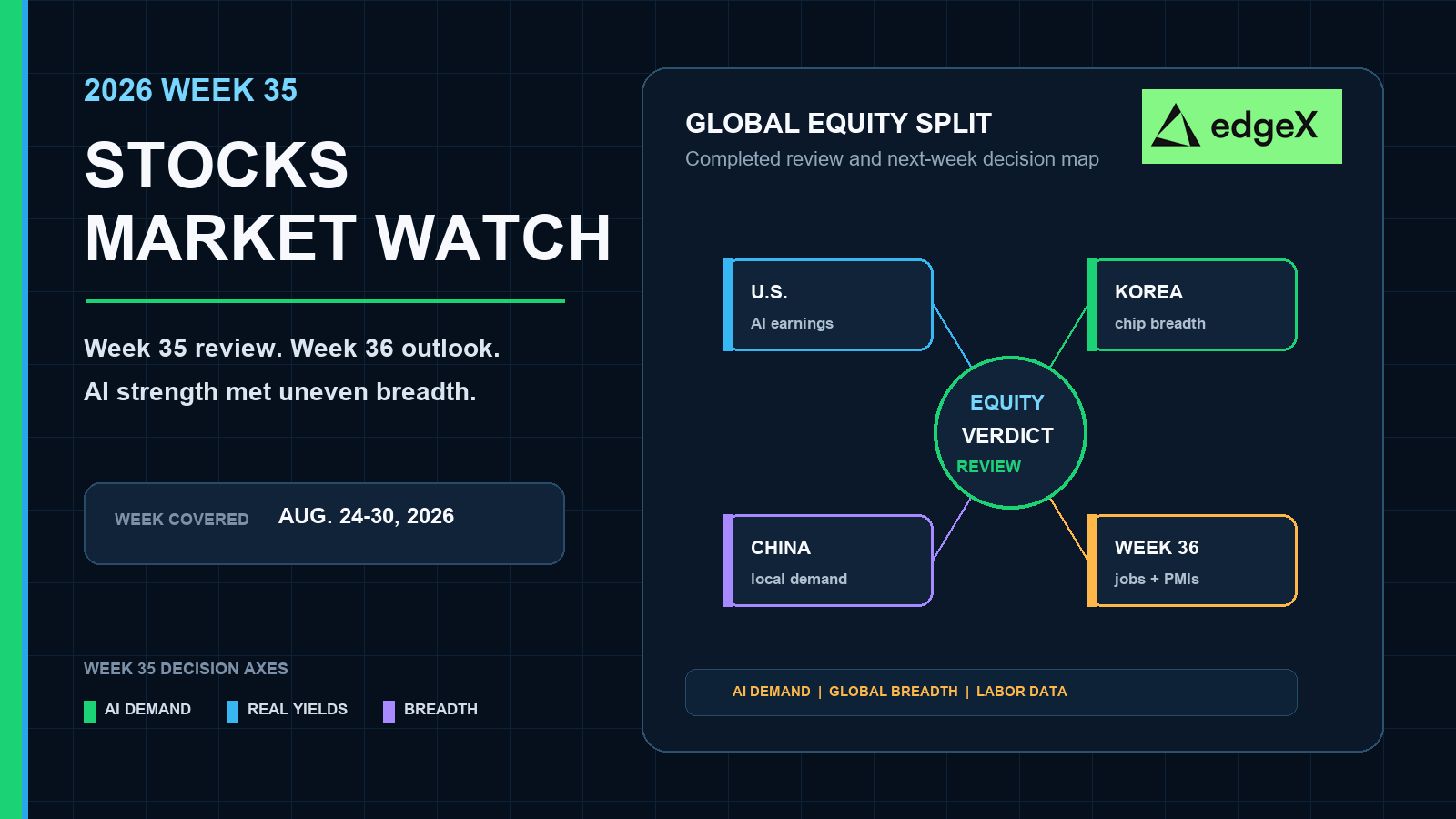
Week 35 confirmed that AI demand remained powerful, but it did not produce broad global equity confirmation. Nvidia and Salesforce strengthened the earnings case for infrastructure and enterprise software, helping U.S. indexes finish the week higher. Yet firm PCE inflation and hawkish policy language kept Treasury yields and valuation risk in focus. Korea’s chip-heavy benchmark fell, Hong Kong surrendered part of its prior-week advance, and mainland China still depended on evidence that policy and pricing improvements were reaching domestic demand. Week 36 therefore begins with a split setup: U.S. earnings momentum is constructive, but a durable global rally needs softer labor and rate pressure, broader Korean participation, and firmer Chinese activity.
Week 35 Delivered Earnings Strength Without Global Breadth
The completed Week 35 record matters more than the pre-earnings expectations that framed the week. U.S. equities absorbed strong technology results and finished above their August 21 levels, even though Friday’s policy-driven pullback removed part of the gain. South Korea and Hong Kong moved the other way. The divergence showed that one company’s earnings can validate a global investment theme without lifting every market exposed to that theme.
The week also separated the earnings numerator from the valuation denominator. Nvidia and Salesforce supplied evidence that AI spending was reaching both infrastructure and enterprise applications. PCE inflation and Jackson Hole communication, however, reminded investors that higher expected profits do not eliminate discount-rate risk. The result was a market willing to reward visible growth, but unwilling to treat strong earnings as permission to ignore inflation.
U.S. indexes rose, but Friday exposed the rate constraint
The S&P 500 closed August 28 at 7,711.76 and the Nasdaq Composite at 26,402.42. Compared with their August 21 closes of 7,674.37 and 26,180.45, that represented gains of roughly 0.5% and 0.8%. The Dow ended August 28 at 53,559.99.
Friday qualified that positive result. The S&P 500 fell 0.25% and the Nasdaq lost 0.52% after Warsh emphasized inflation risk, while the Dow was nearly flat. The late-week reversal showed that investors accepted Nvidia’s demand signal but still required compensation for policy uncertainty. Technology leadership survived; multiple expansion remained conditional.
Korea and Hong Kong did not confirm the U.S. move
The KOSPI fell from 6,912.95 on August 21 to 6,788.88 on August 28, a decline of about 1.8%. The move underscored how quickly Korea’s benchmark can diverge from the global AI demand signal when semiconductor concentration, foreign positioning, currency sensitivity, or local policy expectations dominate a weekly horizon. Because Samsung Electronics and SK Hynix carry exceptional index weight, changes in memory expectations, foreign flows, or the won can dominate the benchmark even when Nvidia’s results support the longer-term data-center demand case.
Hong Kong also lost ground. The Hang Seng closed August 28 at 25,584.79, about 1.6% below its August 21 close of 26,009.46. That retreat followed the prior week’s strong offshore rally and showed how quickly liquidity-sensitive gains can fade when global yields rise or China’s domestic-demand evidence remains incomplete. Mainland Chinese shares firmed late in the week, but the move was less firmly established than in the U.S., Korea, and Hong Kong. Policy and technology interest helped, while property, consumption, and earnings breadth remained unresolved.
Week 35 Global Equity Dashboard
| Market | Completed Week 35 evidence | What the result means |
| S&P 500 | About +0.5%; August 28 close 7,711.76 | Earnings strength outweighed part of the rate pressure, but Friday’s decline limited conviction |
| Nasdaq Composite | About +0.8%; August 28 close 26,402.42 | Nvidia reinforced AI leadership, while high-duration valuations remained yield-sensitive |
| Dow Jones Industrial Average | Finished the week higher; August 28 close 53,559.99 | Broader sector exposure reduced dependence on the AI trade |
| KOSPI | About -1.8%; August 28 close 6,788.88 | Semiconductor concentration and foreign-flow sensitivity outweighed the global AI demand signal |
| Mainland China | Directionally supported late in the week; precise weekly figure not certified | Policy and technology interest helped, but domestic-demand transmission remained the central test |
| Hang Seng | About -1.6%; August 28 close 25,584.79 | Offshore momentum cooled as rate and China-demand risks returned |
Nvidia Confirmed the AI Buildout
Nvidia’s fiscal second-quarter results exceeded the demanding baseline established by its previous quarter. Revenue reached $96.2 billion for the quarter ended July 26, up 18% sequentially and 106% from a year earlier. Management guided fiscal third-quarter revenue to $108 billion, plus or minus 2%, reinforcing the view that demand for accelerated computing remained strong.
The numbers mattered beyond Nvidia. Data-center demand transmits into foundries, advanced packaging, high-bandwidth memory, networking, servers, cooling, electrical equipment, and power infrastructure. A guidance step of that size supported suppliers and adjacent AI names because it indicated that hyperscaler and enterprise deployment had not stalled at the end of the prior product cycle.
The beat strengthened demand, not every valuation
The report reduced the probability of an immediate AI-capital-expenditure slowdown, but it did not remove customer concentration, export restrictions, supply execution, or margin risk. Investors still had to distinguish between companies participating in shipment growth and companies whose valuations already assumed flawless execution.
That distinction helps explain the global split. Nvidia’s result was directly constructive for U.S. AI leaders and for Korean memory demand over time, but the KOSPI did not rally automatically. Local index concentration, foreign positioning, currency sensitivity, and policy expectations can dominate a single global earnings signal over a weekly horizon.
Salesforce Added Evidence From the Application Layer
Salesforce’s fiscal second-quarter release provided a complementary test. Current remaining performance obligation grew 14% year over year in constant currency, and the company raised fiscal 2027 revenue guidance by $200 million, or $300 million in constant currency.
That result mattered because it moved the discussion from computing capacity to contracted software demand. Infrastructure spending can remain strong while application monetization disappoints. Salesforce’s bookings and guidance gave investors evidence that enterprise budgets were not limited to chips and servers, although the wider software group still needed company-specific proof of adoption, retention, and operating leverage.
Infrastructure and software pointed in the same direction
Nvidia and Salesforce reporting on the same day created an unusually clean comparison. Both produced constructive evidence, so Week 35 did not support the view that AI demand existed only at the infrastructure layer. The stronger conclusion was narrower: leading platforms could still monetize the cycle, while weaker companies could not rely on AI branding alone.
For equity breadth, the next confirmation would come from networking, memory, semiconductor equipment, cybersecurity, data platforms, industrial power suppliers, and enterprise services. Without participation from those groups, the rally would remain concentrated in the companies with the clearest reported numbers.
Inflation Kept the Discount Rate in Control
The earnings strength arrived alongside a less friendly macro backdrop. The July personal consumption expenditures report showed headline inflation at 3.7% year over year and core inflation at 3.3%, while personal income rose 0.4%. Separate official releases placed second-quarter real GDP at a 1.5% annualized pace and July durable-goods orders at $339.3 billion, up 1.1%.
For stocks, that combination was neither a recession signal nor a clean disinflation signal. Demand remained positive enough to support revenue, but inflation stayed firm enough to limit confidence in rapid policy relief. Warsh’s August 28 Jackson Hole remarks reinforced the constraint by emphasizing inflation risk rather than offering a simple near-term easing path.
Higher real yields affect the markets unevenly. U.S. mega-cap companies can partly offset multiple pressure with exceptional earnings growth. Korean and Hong Kong equities are more exposed to global flows, currency moves, and concentrated sector leadership. Mainland China responds more directly to domestic liquidity, property, consumption, and policy transmission. Week 35 therefore rewarded earnings certainty, not indiscriminate equity beta.
What Week 35 Changed for Global Stock Selection
The main lesson was that regional exposure represented different risks. U.S. technology offered the clearest reported earnings engine, but also carried the greatest sensitivity to an inflation-driven rise in discount rates. Korea offered direct memory-cycle exposure, but its benchmark remained vulnerable to the weight of two semiconductor leaders and to foreign-flow reversals.
Mainland China offered policy optionality without complete domestic-demand confirmation. Hong Kong provided higher sensitivity to offshore liquidity and global technology sentiment, which helped explain why its prior-week strength reversed more quickly. Investors comparing regions were not choosing between simple bullish and bearish markets; they were choosing among earnings duration, memory beta, policy transmission, and offshore liquidity.
The evidence also raised the bar for breadth. A healthy global equity advance would require U.S. gains beyond the largest AI names, Korean participation beyond Samsung and SK Hynix, and Chinese strength extending beyond policy-sensitive or thematic technology trades. Week 35 did not meet that standard.
Week 36 Outlook: Jobs, PMIs, and Broadcom Must Broaden the Signal
Week 36 runs from August 31 through September 6. Its role is to test whether Week 35’s earnings strength can survive a shift toward labor, manufacturing, and policy evidence. The base case is selective volatility: strong AI demand supports technology, while firm labor or inflation expectations keep valuation expansion constrained.
The U.S. calendar includes ISM manufacturing on September 1, Broadcom’s fiscal third-quarter results on September 2, and the August Employment Situation on September 4. Broadcom adds another AI infrastructure checkpoint. Korea’s exports and manufacturing indicators test whether the semiconductor cycle is improving beyond index leaders. Chinese official and private-sector activity readings test whether industrial stabilization is reaching orders, property-linked demand, and corporate earnings.
Investors should treat the week as a sequence rather than a single event. Manufacturing surveys establish the starting point for orders and pricing, Broadcom tests whether custom accelerators and networking extend Nvidia’s demand signal, and payrolls determine whether the rate backdrop can support wider equity participation. The base case remains positive but narrow until those checkpoints agree. The downside case is a combination of firmer wage pressure, higher yields, weaker chip guidance, and soft Asian orders. Confirmation requires improving advance-decline breadth, stable credit spreads, a steadier won, and gains across Korean and Chinese domestic-demand shares rather than only the largest technology weights.
U.S. labor data will decide whether yields help or hurt breadth
A moderate jobs report with stable participation and wage pressure would be the most constructive outcome. It could reduce the risk of another sharp yield increase without implying an abrupt earnings slowdown. That mix would give software, small caps, housing-linked shares, and other rate-sensitive groups a better chance to participate.
A strong payroll result accompanied by firm wage pressure could keep front-end yields elevated and return the market to narrow mega-cap leadership. A weak report would not automatically be bullish: if investors interpret it as an earnings warning rather than policy relief, defensives could outperform while cyclicals and smaller companies lag.
Korea needs export confirmation and China needs demand transmission
Korean equities need evidence that AI demand is reaching memory shipments, equipment, components, and exporters. A KOSPI rebound led only by Samsung and SK Hynix would repair the index without resolving concentration. Won stability and foreign inflows would make the signal more durable.
Mainland China and Hong Kong need activity data that supports revenue expectations rather than only liquidity. Improving new orders, manufacturing conditions, consumption, or property-related demand would help the CSI 300 and could restore offshore confidence in the Hang Seng. Weak readings would leave policy expectations carrying too much of the valuation case.
Week 36 Decision Map
| Week 36 setup | U.S. stocks | South Korean stocks | Mainland China and Hong Kong |
| Moderate jobs, stable yields, strong Broadcom guidance | Breadth can expand beyond Nvidia and mega-cap technology | Memory and equipment shares gain with better foreign flows | Lower global rate pressure helps Hong Kong; mainland still needs local data |
| Strong jobs and rising yields | Earnings leaders outperform while long-duration and small-cap multiples compress | Chip leaders may hold up, but won and flow pressure limit breadth | Hong Kong technology faces valuation pressure; mainland policy trades may diverge |
| Weak jobs and softer activity | Bonds may rally, but earnings concerns favor quality and defensives | Exporters and cyclicals face demand questions | Weak external demand adds pressure unless domestic indicators improve |
| Better Korean exports and firmer China PMIs | U.S. industrial and semiconductor suppliers gain confirmation | Leadership broadens beyond the two largest chipmakers | CSI 300 and Hang Seng receive stronger earnings and demand support |
The constructive Week 36 scenario requires three confirmations: U.S. data must cool rate pressure without breaking earnings expectations, Korean strength must broaden through the semiconductor supply chain, and Chinese activity must improve enough to support revenues. Failure on any one dimension can preserve a selective rally; failure across all three would turn Week 35’s optimism into a short-lived earnings bounce.
Closing prices, market breadth, currencies, and yields will show whether the initial reaction held.
Trade Stocks Without the TradFi Gatekeeping
The stock market moves fast. Your trading infrastructure should too.
As RWA markets mature and tokenized stocks become a serious alternative to traditional access points, more traders are asking why a centralized platform should control their assets, identity, and trading costs.
edgeX Exchange offers a decentralized perpetual-futures venue where eligible users can trade stock-linked markets while retaining control of their assets. The platform combines self-custody, an order-book trading experience, USDC settlement, and mobile access.
- Self-custody: users retain control of their private keys.
- Order-book execution: the platform is designed for high-speed trading and deep liquidity.
- No traditional brokerage onboarding: access does not depend on a conventional securities account.
- USDC settlement: positions use a familiar dollar-linked settlement asset.
- Mobile access: edgeX is available on iOS and Android.
Stock-linked perpetuals carry leverage, liquidity, smart-contract, oracle, and market risks and do not represent ownership of the underlying shares. Availability may vary by jurisdiction. Explore markets on edgeX.
Frequently Asked Questions
What defined the stock market in Week 35?
Strong Nvidia and Salesforce results supported U.S. technology, but firm PCE inflation and hawkish Jackson Hole communication limited valuation expansion. Korea and Hong Kong did not confirm the U.S. advance.
How did U.S. stocks perform in Week 35?
The S&P 500 gained about 0.5% from its August 21 close, while the Nasdaq Composite rose about 0.8%. Both fell Friday as policy and inflation risk returned to focus.
Why did the KOSPI fall despite strong Nvidia earnings?
Nvidia supported the long-run memory-demand case, but Korea remained exposed to concentrated heavyweight performance, foreign flows, currency conditions, and local positioning. The KOSPI ended August 28 about 1.8% below its August 21 close.
What happened in Chinese and Hong Kong equities?
Mainland shares received support from policy and technology interest, but domestic-demand evidence remained incomplete. The Hang Seng fell about 1.6% from August 21 to August 28 as offshore momentum cooled.
What is the base case for stocks in Week 36?
The base case is selective volatility. AI earnings remain supportive, but U.S. labor data, ISM surveys, Broadcom guidance, Korean exports, and Chinese activity must broaden the signal before a synchronized global rally becomes credible.
What would invalidate the constructive Week 36 outlook?
A combination of strong wage pressure, rising yields, weaker semiconductor guidance, soft Korean exports, and disappointing Chinese activity would pressure long-duration shares and expose the lack of global breadth seen in Week 35.

