NASA's AI System Helps Scientists Discover Rare Rogue Black Hole Feeding Event
Key Takeaways
- •An AI system identified a rare tidal disruption event by scanning approximately 500,000 nightly space observations to flag an unusual signal that had previously gone unnoticed.
- •Tidal disruption events occur when a star approaches too close to a black hole and is ripped apart by extreme gravitational forces in a process known as spaghettification.
- •Only a few dozen tidal disruption events have been observationally confirmed since the phenomenon was first theorized in the late 1980s, making each new detection scientifically valuable.
- •Rogue black holes are notoriously difficult to detect because they typically do not produce visible light unless they interact with and consume material from another object.
- •The discovery highlights how AI is becoming an indispensable tool for astronomy, as upcoming surveys like the Vera C. Rubin Observatory's Legacy Survey of Space and Time are expected to generate data on billions of stars and galaxies.
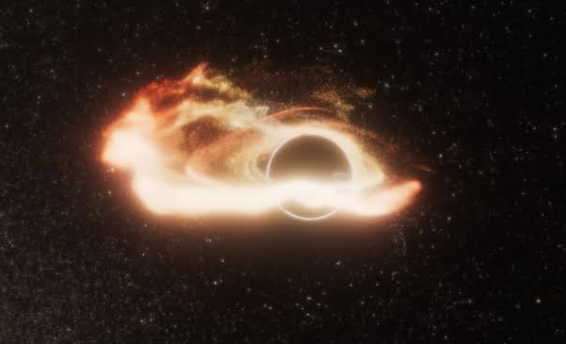
Scientists have achieved a rare astronomical discovery using an advanced artificial intelligence system, which identified a mysterious cosmic event involving a rogue black hole tearing apart and consuming a nearby star.
The breakthrough occurred after the AI system analyzed hundreds of thousands of nightly space observations, allowing astronomers to detect an unusual signal that might have otherwise been overlooked. This highlights the expanding role of AI in modern astronomy, particularly as massive datasets from space surveys become increasingly difficult for human researchers to process manually.
According to information shared within the astronomy community and highlighted by discussions from the Coin Bureau account on X, artificial intelligence is emerging as a crucial tool for identifying rare phenomena hidden within enormous volumes of astronomical data.
The detected event is known as a tidal disruption event, which occurs when a star moves too close to a black hole and is ripped apart by the immense gravitational forces surrounding it. Tidal disruption events were first theorized in the late 1980s, and only a few dozen have been confirmed observationally, making each new detection scientifically significant. Black holes are among the most powerful objects known in the universe, possessing a gravitational pull so extreme that nothing, not even light, can escape once it crosses the boundary known as the event horizon.
When a star approaches a black hole, the extreme difference in gravitational pull between the star's sides stretches and destroys it in a process scientifically described as "spaghettification." During this violent interaction, some of the star's material is pulled into orbit around the black hole, emitting intense bursts of radiation detectable by telescopes.
Because these events are exceptionally rare, each discovery provides critical value for scientists seeking to understand how black holes grow and interact with their environments. This latest discovery was enabled by AI technology capable of scanning approximately 500,000 nightly space events to flag unusual patterns that deviate from normal cosmic activity.
Traditional astronomical surveys generate massive volumes of data every night, with telescopes worldwide capturing images and measurements of millions of objects. This data challenge has grown beyond what human researchers can process manually. AI systems are now routinely utilized to filter these observations, searching for anomalies such as changes in brightness or unusual movement. Machine learning techniques have already proven valuable in astronomy for classifying galaxies and identifying exoplanet candidates, and their application to transient event detection represents a natural extension of this trend. In this instance, AI algorithms successfully located a rare black hole event that had previously gone unnoticed.
Astronomers emphasize that the rapid identification of unusual cosmic activity marks a significant advancement in space research. Historically, scientists depended on manual observation and pre-programmed searches to detect changes in the night sky. While still relevant, these methods are limited by the sheer scale of modern data. AI systems, by contrast, can process information at unparalleled speeds, empowering researchers to concentrate on the most promising discoveries.
Rather than replacing astronomers, AI functions as a powerful assistant that highlights opportunities for deeper investigation. Space agencies and scientific institutions globally are investing heavily in AI to bolster missions across planetary science, astrophysics, and Earth observation. NASA, in particular, has been at the forefront of integrating artificial intelligence to enhance scientific research and analyze complex datasets from space missions and telescopes.
Detecting rare events like black hole activity is vital for understanding galaxy evolution and extreme gravitational environments. Black holes remain one of the biggest mysteries in modern physics. While millions exist throughout the universe, including supermassive ones at the centers of most large galaxies like the Milky Way, smaller "rogue" or wandering black holes are notoriously difficult to detect because they do not always produce visible light.
A rogue black hole drifting through space typically remains hidden unless it interacts with another object. When it consumes material from a nearby star, the resulting explosion of energy creates a detectable signal for astronomers to study. This newly identified event offers a valuable opportunity to examine these elusive objects and better understand their role in the universe.
By studying how black holes interact with stars, researchers gain insights into gravity, matter, and energy under extreme conditions. The process of a black hole consuming a star also provides vital information about how black holes gain mass over time. Although the material absorbed in a single event may be relatively small, repeated interactions over billions of years contribute to their growth.
The use of AI in this context reflects a broader shift across scientific research, where AI tools are increasingly deployed to decipher complex datasets in fields ranging from medicine to climate science. As upcoming astronomical surveys such as the Vera C. Rubin Observatory's Legacy Survey of Space and Time are expected to monitor billions of stars and galaxies, generating unprecedented volumes of data, AI will become an indispensable component of scientific discovery. Without AI assistance, many important discoveries could remain hidden within massive datasets.
Scientists envision a future where the synergy between human expertise and artificial intelligence accelerates discoveries that were previously impossible. While AI is proficient at flagging anomalous patterns, human astronomers remain essential for interpreting these findings, formulating theories, and validating discoveries through subsequent observations. The discovery of the rogue black hole consuming a star represents a powerful example of this partnership between technology and human curiosity.
Furthermore, the event underscores the importance of continued investment in space exploration. Extreme environments around black holes allow scientists to test theories of physics under conditions impossible to recreate on Earth, refining the understanding of gravity, space, and time. As AI technology evolves, it is poised to unlock further discoveries of rare and unexpected cosmic phenomena, continuously advancing humanity's exploration of the cosmos. While telescopes provide the data, artificial intelligence helps scientists uncover the stories hidden within that information.

