Princeton's Arvind Narayanan predicts chatbots could become a 'truth oracle' as journalism heads somewhere it hasn't been in 200 years
Key Takeaways
- •A Pew Research Center survey conducted this year found that 10% of Americans already treat chatbots as a source of truth.
- •Narayanan described today's chatbots as "neurosymbolic systems" that combine a language model with tools for web search, document retrieval, and code-based data analysis, making errors common a year ago increasingly rare.
- •He estimated that the shift toward chatbots becoming the default place to settle factual questions is about a decade away.
- •He argued the bundled newsroom is no longer the most economically viable way to produce news, with trade reporting migrating to outlets like Politico and Punchbowl News, local journalism moving to a philanthropy-funded model, and analysis shifting to independent journalists and creators.
- •He proposed democratic input into AI companies' algorithm tuning, similar to Meta's Oversight Board with journalists given a seat, and urged journalists to form a broad, nonpartisan political movement that could include a tax on AI and social media companies.
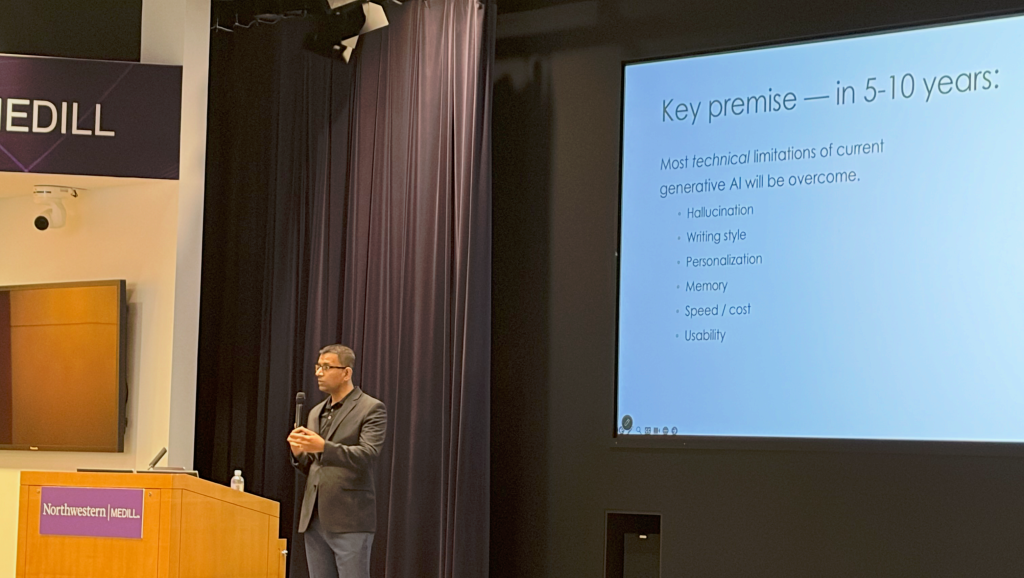
Arvind Narayanan believes artificial intelligence will come to feel more trustworthy—and that, in doing so, it will strip away the tells that currently alert readers when they are encountering AI slop in the wild. The Princeton computer scientist even predicts that increasingly accurate chatbots could become, for many people, a "truth oracle." A Pew Research Center survey conducted this year found that 10% of Americans are already treating chatbots that way.
Narayanan made the remarks in a keynote titled "AI and Journalism: Skating Where the Puck is Going" at the Computation + Journalism Symposium, an academic conference on computing and journalism held at Northwestern's McCormick Foundation Center and attended by Fortune. The symposium's agenda centered on the challenges facing the media and the proliferation of AI slop. Narayanan urged the audience to prepare for AI "not as it is today, but as it will be five or 10 years from now." He said his computer science background helps him distinguish which of today's limitations are fixable engineering problems and which are inherent. He has never worked in a newsroom, he acknowledged. "It's possible I don't know what I'm talking about," he cautioned, before laying out his argument.
That argument had two parts. First, if chatbots become the default place to settle factual questions—Narayanan said "virtually all" questions such as who is running for political office are headed there—then the newsroom loses one more piece of its bundle, and arguably its most basic one. What remains is the work a machine cannot settle: contested questions, narrative, storytelling, and being explicit about what he called "positionality," a difficult demand for an industry that strives for objectivity.
Narayanan directs Princeton's Center for Information Technology Policy, but he has recently emerged as a thought leader on AI, the future of work, and the media industry. He cowrote AI Snake Oil with Sayash Kapoor, and his newsletter, AI as Normal Technology, has more 87,000 subscribers. He spoke to Fortune in August about the AI backlash, which he views as a complicated phenomenon, and offered insight into why AI's productivity gains and return on investment have proven so hard to measure—or, in some cases, nonexistent. He calls it a "skinny hamburger, fat bun" problem: with AI, the meat of execution shrinks to almost nothing, while the decision and deliberation "buns" swell, accompanied by a great deal of anxiety and uncertainty.
The oracle and the slop
Narayanan argued that the common picture of chatbots as simple next-word predictors is outdated. Today's chatbots are "neurosymbolic systems," he said: a language model combined with tools that search the web, retrieve documents, and write code to analyze data. Errors that were common a year ago—miscounting the letters in "strawberry," or Google's AI Overviews suggesting glue on pizza—now rarely occur, and he described the remaining problems as "gradually getting solved."
He then asked what happens when public expectations catch up with the technology. His elementary-school-age children, he said, may never experience hallucination the way adults do, much as Wikipedia once evolved from an untrusted reference into a "much more authoritative" source. "I'm not saying it's inevitable. I'm not saying it's a good thing," he noted. On X, he added, users already settle arguments by asking Grok, the chatbot built by xAI and integrated into the platform—mostly conservatives with low trust in legacy media. He estimated the wider shift at about a decade away.
An audience member ventured that chatbots can suffer from what Jay Rosen, the New York University journalism professor and press critic, famously called the "view from nowhere"—the false neutrality expressed by journalists reluctant to exercise their own judgment and properly inform the audience. Daniel Trielli of the University of Maryland raised this danger, and Narayanan agreed, saying it is a challenge journalism must continue to define going forward.
One of Narayanan's most contrarian claims was that agenda-setting by the media has backfired. He called The Washington Post's role in Watergate "an unalloyed good," but cited research from "many communication scholars and economists" showing that similar efforts in the Trump era, with audiences already splintered, have fed polarization and hastened the collapse of trust.
The unbundling
Narayanan said his talk was "as much about the continuing effects of social media on newsrooms as it is about AI." The newsroom is now thought of as a single institution bundling reporting, analysis, fact-checking, and distribution, but he argued that this arrangement was a "historically contingent" development rather than a given going forward. The ad-supported penny papers of the 1830s broadened what counted as news because earlier papers relied on subscriptions and political patronage. Objectivity arose in response to World War I propaganda, and paid reporters and interviews likewise "had to be invented." Calling someone a "hired reporter," he noted, was once an insult—"like a hired gun."
His framework draws on earlier debates. He quoted the writer Clay Shirky's line that "society doesn't need newspapers. What we need is journalism," and noted that Princeton sociologist Paul Starr had warned, in the same era, that the loss of newspapers' economics would leave public goods like accountability unfunded. Starr has been proven right "in many ways," Narayanan said, "but it's maybe not been as apocalyptic" as feared, because philanthropy has stepped in.
His claim is that, piece by piece, specialists now perform each function more cheaply than a newsroom can, with AI hastening the process. "For each of these components, there is kind of a competitor that produces this component in a more stand-alone way that is better structurally equipped just based on the economics of production," he said. Trade reporting, for instance, migrated to outlets such as Politico, Punchbowl News, and Stat. Local journalism has largely shifted to a "philanthropy-funded model," and investigations increasingly run on nonprofit money—"a reversion to historical patterns." Analysis, he stressed, has moved to independent journalists, social media creators, and "people like me." Returning to what he called the "overarching point" of his talk, he said that packaging everything together in a single newsroom "is no longer the most economically viable way of producing news."
Analysis, as Narayanan defines it, is a "layer that is between fact and opinion." Citing economics blogger Noah Smith, he argued that journalists have too long and too often treated this dividing line as binary, so the analysis layer "never really had a home in newsrooms." He offered the question of whether the AI industry is a bubble as the kind of subject an analysis could tackle. An analyst's authority, he argued, now comes from a body of work rather than a masthead. (Fortune and Fortune Intelligence often run pieces as analysis, for what it's worth.)
The internet "democratized distribution," he said, and AI is now "democratizing production": "It is now possible to produce first-rate journalistic content of various kinds with a one- or two-person team." What is under way is "not so much a decline of news," he said, as "the migration toward a bunch of other institutions."
Who pays
The "real crisis," Narayanan said, is the power gap between AI companies and publishers. Publishers need chatbot distribution more than AI firms need any single outlet, so licensing deals underprice journalism. He pointed to the "pivot to video"—when a Facebook algorithm change forced news organizations to remake their business models—as "an awful illustration of the extreme power asymmetry."
His proposed fix is democratic input into how AI companies tune their algorithms—something like Meta's Oversight Board, the independent body the company set up to review its content moderation decisions, but with journalists given a "seat at the table." Narayanan added that journalists need to form a broad political movement, banding together to advocate for the profession's future, possibly including a tax on AI and social media companies. Such a movement would have to be "broad-based," not "perceived as partisan," and would need to include creators alongside legacy outlets, he said.
But the alternative—mostly unmentioned in the room—is that journalism is simply a phenomenon of the past two centuries, and that technology and economics are evolving away from it as an organized and aggregated industry.
This story was originally featured on Fortune.com.

