Economists Weigh the Revenues Needed to Justify AI CapEx
Key Takeaways
- •Jared Bernstein, a former chair of the White House Council of Economic Advisers, and other economists computed the revenue levels needed to justify current and planned AI capital spending in a post on the Econbrowser blog.
- •The analysis indicates the revenues required to make the AI buildout economically rational are unlikely to materialize soon enough to meet financial markets' expected time horizon.
- •Columbia University economist Stijn Van Nieuwerburgh examines the same subject in a paper published in Brookings Papers on Economic Activity, while commentary on the buildout notes its financing is migrating toward more exotic, less transparent corners of the financial system.
- •Surveys of businesses' planned AI services spending are far smaller than the sums implied by the investment pipeline, meaning the revenue case currently depends on demand companies have not yet budgeted.
- •Price-to-forward-earnings ratios for the Mag-7—Apple, Microsoft, Alphabet, Amazon, Nvidia, Meta, and Tesla—are low by historical standards, though these figures rest on analysts' projected profits rather than reported results.
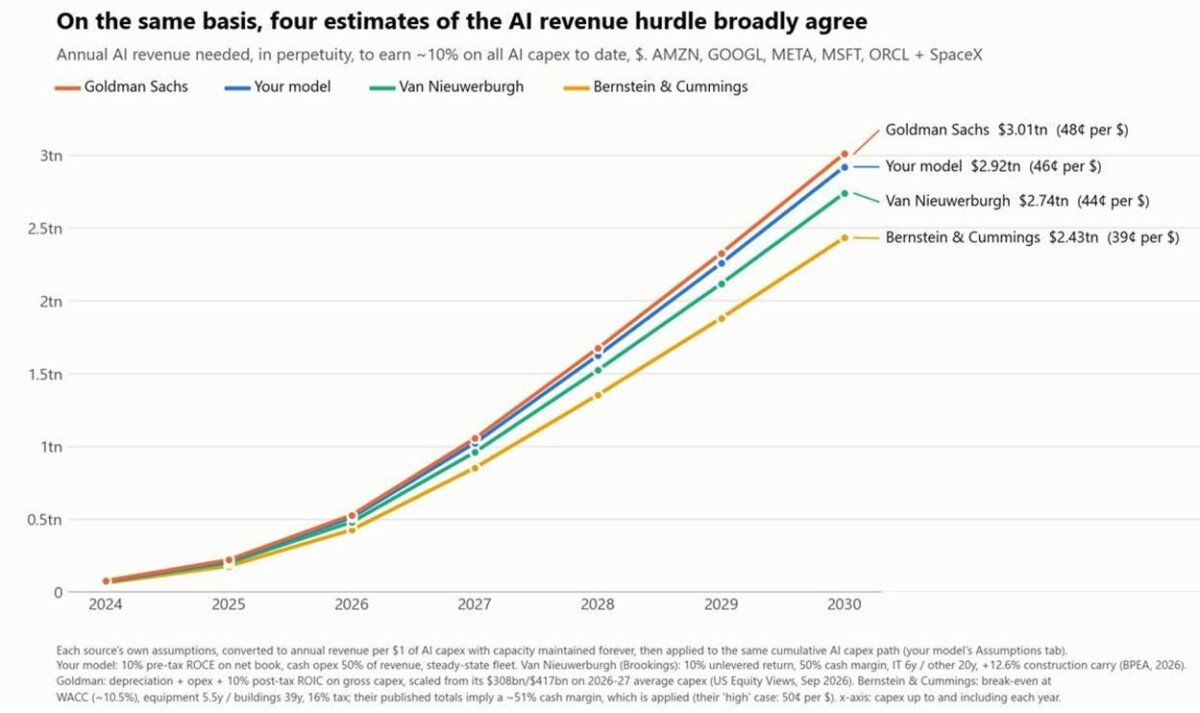
Economist Jared Bernstein, a former chair of the White House Council of Economic Advisers, along with others, has calculated the revenues needed to rationalize the artificial intelligence (AI) capital investment now in place and planned, in a post on the long-running economics blog Econbrowser.
The estimate, based on a chart compiled by Callum Williams and shared by Bernstein (available via his Substack), points to a revenue level that, as Bernstein recounts, is unlikely to materialize within a time frame financial markets are likely to tolerate — that is, soon. The calculation is effectively a bar-clearing exercise: how much income AI providers would need to book for the spending already underway to make economic sense.
A paper in Brookings Papers on Economic Activity (BPEA) by Columbia University economist Stijn Van Nieuwerburgh addresses the same subject; the series is the Brookings Institution's long-running economic research venue. Financing for these expenditures, it has also been pointed out, has been migrating toward more exotic, less transparent areas of the financial system.
That raises a basic question: if the revenues are coming, where are they coming from? Surveys of planned spending on AI services — which are themselves highly speculative — are much smaller than the sums implied by the investment pipeline. The gap matters because it means the revenue case for the buildout currently rests on demand that businesses have not yet put in their budgets.
A big payoff can still accrue to the firm or firms that come first in the race to market AI services. However, a big mess could arise from the aftermath for the firms that come in last, or next to last.
One notable aspect of monitoring the sector: price-to-forward-earnings ratios for the Mag-7 — not exactly AI labs, since they draw revenues in from other streams — are pretty low, historically speaking. Such ratios compare a company's share price with the profits analysts project for it ahead of time, rather than the profits it has already reported, and the Mag-7 label is shorthand for Apple, Microsoft, Alphabet, Amazon, Nvidia, Meta, and Tesla. Even so, it bears remembering that these are forward earnings, which are analysts' "guesses." How those guesses are revised, whether planned-spending surveys close the gap with the investment pipeline, and where the financing ultimately sits are the practical gauges for judging whether the revenue case behind the buildout firms up.

