AI Adoption Statistics 2026: How Different Industries Are Using Artificial Intelligence
Key Takeaways
- •Stanford's 2026 AI Index found that 88% of organizations used AI in at least one business function in 2025, up from 55% in 2023, while regular generative AI use climbed to 79%.
- •Sector adoption differs widely: 84% of developers use or plan to use AI tools, 75% of UK financial firms deploy AI, physician usage rose from 38% to 66% in one year, and legal generative AI adoption nearly doubled to 26% between 2024 and 2025.
- •Despite broad adoption, AI agent deployment stayed in the single digits across most business functions in 2025, positioning 2026 as a transition year toward more autonomous systems.
- •Manufacturing trails other sectors, with only 2% of surveyed large manufacturers reporting AI fully embedded in operations, even as 93% plan to spend more than 1% of cost of goods sold on digital and AI over the next five years.
- •Trust and governance gaps persist, as 46% of developers distrust AI output accuracy, 34% of law-firm professionals use unapproved AI tools, and only 12% of news consumers are comfortable with fully AI-produced journalism.
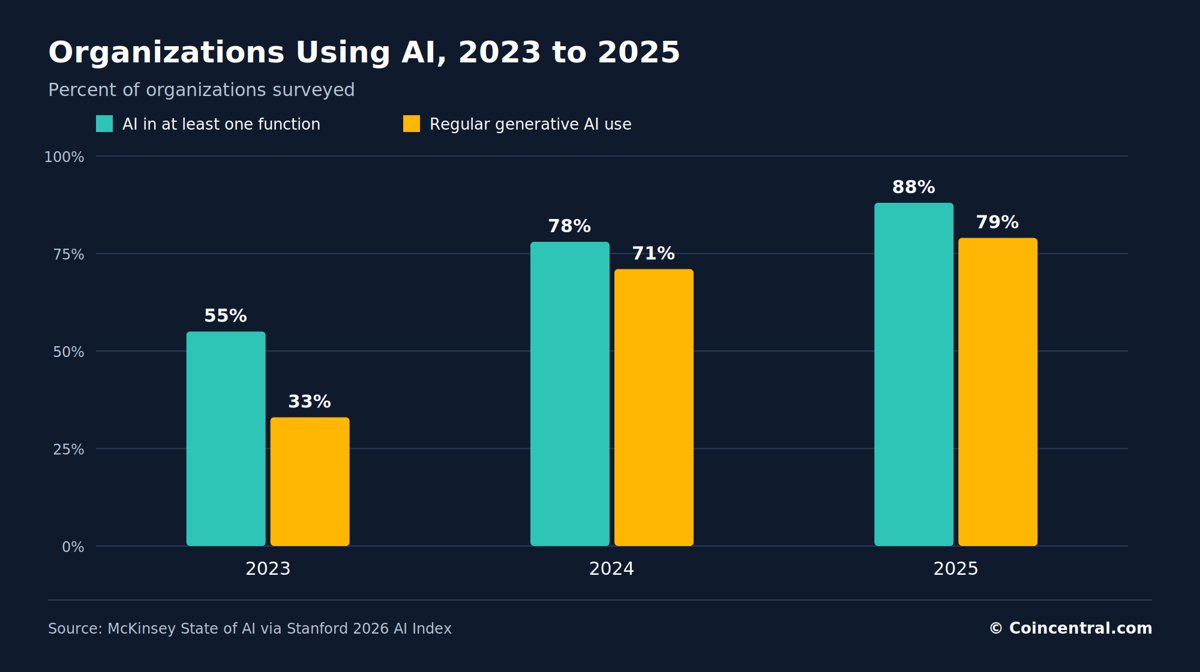
Artificial intelligence has moved from experimental pilots to a standard tool of daily business. According to McKinsey's global State of AI survey, 88% of organizations said in 2025 that they used AI in at least one business function, up from 78% a year earlier.
That adoption is not spread evenly across the economy. Software developers, banks, doctors, lawyers, journalists, retailers and manufacturers each confront different costs, regulatory environments and risks, and the survey data reflects those differences. This report reviews the latest figures for each sector.
Because the numbers come from separate surveys with different methods, populations and questions, they should not be read as a perfect side-by-side comparison. They do, however, show clearly where AI use has gone deepest and where it still faces limits.
Overall Business AI Adoption Statistics
The Stanford 2026 AI Index, which draws on McKinsey's global State of AI survey, found that 88% of organizations used AI in at least one business function during 2025. That compares with 55% in 2023 and 78% in 2024.
Generative AI has grown even faster. Regular organizational use rose from 33% in 2023 to 71% in 2024 and 79% in 2025, and more than half of respondents reported that AI was deployed in at least three business functions.
Using AI in one area, however, is not the same as rebuilding a company around it. Stanford found that AI agent deployment remained in the single digits across almost all business functions in 2025. That positions 2026 as a year of transition, as the first wave of AI assistants gives way to a second wave of more independent AI agents.
AI Adoption by Industry at a Glance
Each adoption figure cited in this article comes from a separate survey of a different population, with different questions and methods. Taken together, they show that AI is no longer confined to technology companies. It has become part of everyday work across much of the economy. The sections that follow give the figures, the use cases and the sticking points sector by sector.
AI in Finance and Banking Statistics
Financial services relied on machine learning for years before the generative AI boom. Banks, insurers and payment firms have long applied it to fraud detection, credit scoring, anti-money-laundering checks, trading and risk management. Generative AI is now being layered onto customer service, compliance, research and software work.
A joint survey by the Bank of England and the Financial Conduct Authority found that 75% of responding UK financial firms already used AI, with another 10% planning to adopt it within three years. In 2022, the share using AI stood at 58%. Adoption is uneven within the sector: insurers and international banks report the highest rates.
Where Finance Uses AI
The median firm reported about nine AI use cases, a number firms expect to reach 21 within three years. Large international banks already report a median of close to 49.
Operations and IT account for the largest share of reported use cases at roughly 22%, followed by retail banking at around 11% and general insurance at about 10%. Foundation models, the large systems behind generative AI, account for 17% of use cases.
Finance remains one of the most mature industries for AI, yet firms stay cautious with high-impact decisions, because errors in credit, trading, insurance or compliance carry large financial and legal costs.
AI in Healthcare Statistics
Healthcare has traditionally been slower to adopt new technology because mistakes can harm patients, but AI use is climbing quickly. The American Medical Association found that the share of physicians using some form of health AI rose from 38% in 2023 to 66% in 2024, a gain of 28 percentage points in a single year.
Common applications include medical notes, billing codes, visit summaries, care plans, discharge instructions, translation and patient messages. Some physicians also use AI for diagnostic support and radiology.
Paperwork is a major driver. Physicians spend many hours documenting care, and AI transcription tools can listen to a visit and draft the clinical note, cutting that workload. For patients, the changes so far are mostly administrative — notes, summaries and messages — while diagnosis remains a human-led task where AI plays only a supporting role.
Doctors See Benefits but Want Safeguards
About 68% of physicians surveyed said AI offered at least some advantage to their practice, but that support came with conditions. Most wanted clear protections before broader use.
Accuracy standards in medicine are higher than in most business tasks. A wrong marketing slogan is an inconvenience; a wrong diagnosis can be dangerous. For that reason, human review is likely to remain central.
AI in Law Statistics
Legal work involves vast amounts of text, which made it an early candidate for generative AI. Tools can search case law, review contracts, summarize documents, draft memos, compare clauses and support discovery, and adoption has grown quickly as a result.
Thomson Reuters found that generative AI use in legal organizations rose from 14% in 2024 to 26% in 2025. Personal use outpaces formal company use: across legal, tax, risk and government professionals, 41% said they used public tools such as ChatGPT, and 17% used industry-specific generative AI systems.
Law Firms Are Moving Past Testing
Thomson Reuters' 2026 research points to a shift in the debate. The question is less whether to use AI and more how fast to reorganize around it. More than three-quarters of highly rated lawyers surveyed said their firm had an AI strategy.
Pressure is building. About 38% of law-firm professionals reported financial pressure to move faster on AI, and 32% of in-house lawyers said they were reconsidering ties with firms that failed to demonstrate AI-enabled value.
AI may also challenge the billable hour. If a system can complete hours of document review in minutes, clients may resist paying by time, pushing firms toward value-based pricing.
Governance is a concern. Thomson Reuters found that 34% of law-firm professionals used AI tools their firms had not approved.
AI in Software Development Statistics
Software development is where generative AI is most deeply embedded in daily work. The 2025 Stack Overflow Developer Survey found that 84% of developers used or planned to use AI tools, up from 76% a year earlier. Among professional developers, 51% used AI tools every day.
Developers use AI to write code, explain unfamiliar code, find bugs, write tests, create documentation and convert code between languages. Tools such as GitHub Copilot, ChatGPT and Claude are now common.
High Use, Low Trust
Heavy use does not equal strong trust. Stack Overflow found that 46% of developers distrusted the accuracy of AI output, compared with 33% who trusted it. Only 3% said they highly trusted it.
The top complaint involved answers that are almost right but not quite, cited by 66% of respondents as a frustration. Another 45% said fixing AI-written code often took longer than expected.
Developers remain careful with high-responsibility tasks: about 76% did not plan to rely on AI for deployment and monitoring, and 69% did not plan to use it heavily for project planning. AI is acting as a copilot, not a replacement.
AI Agents in Software
AI agents remain less common than basic assistants. Stack Overflow found that 52% of developers either did not use agents or stuck with simpler AI tools, and 38% had no plans to adopt them. Among developers who did use agents, about 70% said agents reduced the time spent on tasks, and 69% reported better productivity. Code is easier to test and verify than many real-world tasks, which helps explain the field's early interest.
AI in Media and Journalism Statistics
Media presents both a large opportunity and a trust problem. AI can handle transcription, translation, headlines, summaries, data analysis, fact-checking and personalization, and it can also produce text and images.
A Reuters Institute study of 1,004 UK journalists found that 56% used AI professionally at least once a week, while another 27% used it less often. Only 16% said they had never used AI for journalism tasks, and about 27% used it daily for at least one task.
Publishers Focus on Back-End Tasks
Media executives are most interested in efficiency. Among publisher respondents, 96% said back-end automation would be important. Personalization and recommendations followed at 80%, content creation at 77%, newsgathering at 73%, coding at 67% and commercial uses at 63%.
Some publishers already use AI to rewrite or distribute stories at scale, but audience attitudes limit how far that can go. The Reuters Institute found that only 12% of consumers were comfortable with news produced entirely by AI, while comfort rose when a person stayed in charge. Entirely human-made news drew the most support at 62%.
For readers, that means AI's footprint in news is most likely to show up in less visible work — transcriptions, translations, summaries and data analysis — rather than in fully automated stories. These results suggest mainstream journalism is likely to be AI-assisted rather than AI-written.
AI in Retail Statistics
Retail AI has grown well beyond product recommendations, now touching fraud detection, pricing, inventory, demand forecasting, customer support, marketing, supply chains and store operations.
Deloitte's 2026 Global Retail Outlook found wide use across core functions. Fraud detection and cybersecurity led, with 64% of surveyed retailers already using AI there, and use is expected to grow over the next 12 months. Another 41% of retailers expect to add AI-based supply-chain visibility, and 38% plan to add pricing and promotion optimization.
Agentic Shopping May Be Next
Retail could be among the first industries to feel the effects of AI agents. A shopper might ask an agent to find running shoes under €150, compare reviews and prices, and buy the best pair, shifting influence from search engines and retailer websites to AI intermediaries.
Deloitte found that about 68% of retail respondents expected to use agentic AI for important operational or enterprise activities within 12 to 24 months. AI referral traffic is already material for some retailers, and over time it could reshape product discovery and advertising.
AI in Manufacturing Statistics
Manufacturing differs from software and law because AI must work alongside physical equipment. Common uses include predictive maintenance, computer vision, quality inspection, production scheduling, robotics, digital twins and energy savings.
Deployment is harder as well. A software firm can distribute an AI tool to thousands of staff quickly; a manufacturer may need to connect AI to machines that are 10, 20 or 30 years old.
Most Manufacturers Have Not Reached Full Scale
McKinsey surveyed more than 100 chief operating officers at manufacturers with yearly revenue above $1 billion. About two-thirds said their AI work remained at the exploration or targeted-implementation stage, and only 2% said AI was fully embedded across operations.
Spending plans are nevertheless large. Some 93% planned to spend more than 1% of cost of goods sold on digital and AI over the next five years, and almost one-third expected to spend at least 5%.
Advanced Factories Show a Different Picture
The World Economic Forum's Global Lighthouse Network tracks leading factories. By 2026 it included more than 220 sites, and AI and machine learning appeared in about 62% of the top use cases at those sites. Generative AI's share of leading solutions rose from 9% in 2024 to 23% in 2025. Traditional machine learning handles prediction and optimization, while generative AI helps workers communicate with machines, create instructions and retrieve company knowledge.
Physical AI and Robotics
Deloitte's 2026 Manufacturing Outlook found that 9% of manufacturers used physical AI, and 22% expected to use it within two years. Physical AI covers robots that act more flexibly instead of repeating a fixed motion. These machines can move goods, inspect factories, sort parts and operate in changing settings. Manufacturing may be where AI has its biggest effect on physical output.
Which Industries Lead AI Adoption?
No perfect ranking exists, because the surveys measure different things. Some broad conclusions can still be drawn from the data.
Software shows the deepest individual use: with 84% of developers using or planning to use AI and half of professionals using it daily, AI coding tools are close to standard equipment.
Finance has the most mature institutional use: about three-quarters of UK financial firms use AI, and rates among insurers and international banks are above 90%.
Healthcare has grown fast for a high-stakes field, with physician use rising from 38% to 66% in one year despite strict safety and privacy rules.
Law is changing quickly as specialized tools improve. Media shows high professional use but low consumer comfort with automation. Retail applies AI across many operations, while manufacturing lags because AI must connect to machines and supply chains.
From AI Assistants to AI Agents
The next shift may be from AI that answers questions to AI that takes actions. Today, a person writes a prompt, reads the AI response and makes a decision. In an agent workflow, a person sets a goal, the AI plans and uses software to complete the task, and a person reviews the result.
Examples could include AI that checks transactions for fraud in finance, or AI that summarizes records and books tests in healthcare. In law, it could review thousands of documents and draft a case analysis. In software, it could find a bug, write a fix and submit it for review.
Stanford found that agent deployment stayed in the single digits across most business functions in 2025, though early use is already visible in software and other technology-heavy fields.
Barriers to AI Adoption
Several problems recur across industries. Accuracy is one: AI models can state wrong information with confidence, which matters most in medicine, finance and law.
Data privacy is another. Firms cannot put confidential customer, patient or legal data into open public tools. Regulation adds limits, since AI decisions in regulated fields must comply with existing rules.
Integration is often the hardest part. The challenge is less about obtaining a model than about linking it to databases, software and workflows, and staff must know when not to trust AI.
Governance gaps are common. Thomson Reuters found that 34% of law-firm professionals used unapproved AI tools, and its 2026 professional-services research found that only 18% of professionals said their organizations tracked AI return on investment, while 40% did not know whether their organization did.
AI Investment and the Job Market
The Stanford AI Index quantifies the money involved. Global corporate AI investment reached about $581.7 billion in 2025. Private AI investment alone reached about $344.7 billion, and generative AI investment grew by more than 200% during the year.
Current data points to AI changing parts of jobs more than eliminating whole occupations. A lawyer may spend less time searching documents, a doctor may spend less time writing notes, and a journalist may automate transcription.
There are early signs of strain at the entry level. Stanford reports that employment among software developers aged 22 to 25 fell almost 20% from 2024. If fewer junior workers are hired, fields such as law, accounting and software will need new ways to train future experts.
The Bottom Line
AI adoption is no longer only a technology-sector story. By 2025, 88% of surveyed organizations used AI somewhere in their business, and 79% regularly used generative AI.
Depth of use varies by industry. Software leads on daily personal use at 84%. Finance has the most mature setup, with 75% of UK firms using AI. Healthcare use rose from 38% to 66% in a year, and legal generative AI use nearly doubled between 2024 and 2025. More than half of UK journalists use AI each week, though consumers prefer AI that assists reporters over AI that replaces them. Retailers use AI in security, pricing and forecasting, while manufacturers face the hardest path to scale, even as advanced factories show what is possible.
The question facing most firms is shifting from whether they can use AI to whether they can redesign work around it while preserving accuracy, security and human accountability. The next editions of the recurring surveys behind these figures — from McKinsey, Stanford, Stack Overflow, the AMA, Thomson Reuters, Deloitte and the Bank of England — will show whether agent deployment climbs out of the single digits and whether manufacturers' spending plans turn into scaled deployment.
Sources
- Stanford AI Index 2026 Report: global data on enterprise AI adoption, investment, employment and AI agents.
- Stanford AI Index 2026: Economy: organizational adoption and investment statistics.
- Bank of England: Artificial Intelligence in UK Financial Services: survey of AI use across banking, insurance and financial markets.
- American Medical Association: Two in three physicians are using health AI: physician AI use rising from 38% to 66%.
- Thomson Reuters 2026 AI in Professional Services Report: AI use in legal, tax, accounting, risk and government work.
- Thomson Reuters 2025 Generative AI in Professional Services Report: adoption data for law firms and professional services.
- Thomson Reuters Institute: Turning law-firm AI strategies into practice: AI strategy, client pressure and workflow change at law firms.
- Stack Overflow 2025 Developer Survey: AI: developer AI use, trust and agents.
- Reuters Institute: AI adoption by UK journalists and their newsrooms: survey of 1,004 UK journalists on professional AI use.
- Reuters Institute: Generative AI and News Report 2025: public attitudes toward AI in journalism.
- Deloitte 2026 Retail Industry Global Outlook: AI use across retail operations, pricing, forecasting and supply chains.
- National Retail Federation: Retail AI Trends 2025: survey of AI leaders at US retailers.
- McKinsey: From Pilots to Performance, How COOs Can Scale AI in Manufacturing: survey of large manufacturers on AI deployment and spending.
- Deloitte 2026 Manufacturing Industry Outlook: smart manufacturing, agentic AI and physical AI.
- World Economic Forum: Global Lighthouse Network: AI and generative AI use in advanced factories.
- Source: CoinCentral

