Manufacturing Employment Shows a Dropoff in BLS and ADP Data
Key Takeaways
- •Private nonfarm payroll employment increased by 38,000, below the Bloomberg consensus estimate of 47,000.
- •The latest ADP release did not show a decline in private payrolls, even though growth missed expectations.
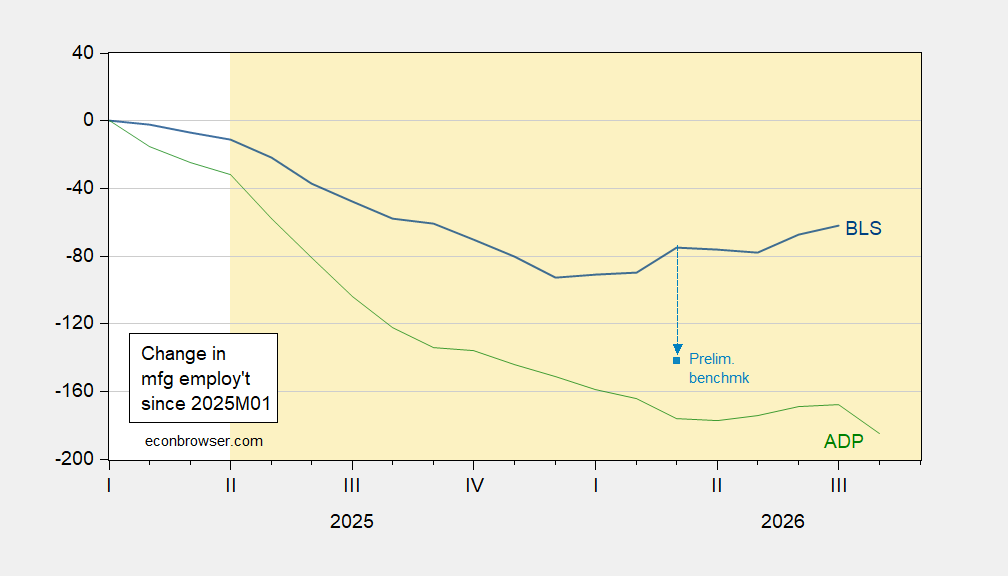
- •The article compares manufacturing employment since January 2025 using BLS data, ADP data, and the preliminary BLS benchmark revision.
- •The charts highlight the period after Liberation Day in the employment comparisons.
- •ADP and BLS labor data are presented as closely watched indicators ahead of the next official employment release.
From the ADP release:
Figure 1 shows the change in manufacturing employment since 2025M01 using BLS data (blue), the preliminary benchmark revision from BLS (light blue square), and ADP data (green). The orange shading denotes the post-Liberation Day period. Source: BLS, ADP via FRED, BLS, and the author’s calculations. The comparison matters because manufacturing payrolls are often watched as a narrower gauge of factory-sector labor conditions, and the BLS benchmark revision provides an updated reference point for how the series has tracked this year.
Private nonfarm payroll employment does not show a dropoff, but growth did not match expectations, coming in at +38K versus the Bloomberg consensus of +47K:
Figure 2 shows the change in private nonfarm payroll employment since 2025M01 using BLS data (blue), Bloomberg consensus (blue +), the preliminary benchmark revision from BLS (light blue square), and ADP data (green). The orange shading denotes the post-Liberation Day period. Source: BLS, ADP via FRED, BLS, Bloomberg 8/28, and the author’s calculations. For readers comparing labor indicators, the chart highlights that headline private payroll growth can remain positive even when it falls short of expectations, which is one reason both ADP and BLS data are often tracked together ahead of the next official employment release.

