Emma Revell: The 24-Hour News Cycle Is Damaging Political Decision-Making
Key Takeaways
- •Emma Revell argues that the continuous 24-hour news cycle pressures politicians to prioritize rapid responses over careful deliberation.
- •The demand for constant media content has shifted the focus away from long-form interviews toward generating short clips and one-liners.
- •Politicians who attempt to revise hasty statements often face immediate criticism for making a U-turn, which hinders substantial policy development.
- •Traditional media outlets no longer hold exclusive power to break major investigative stories due to the rise of social media.
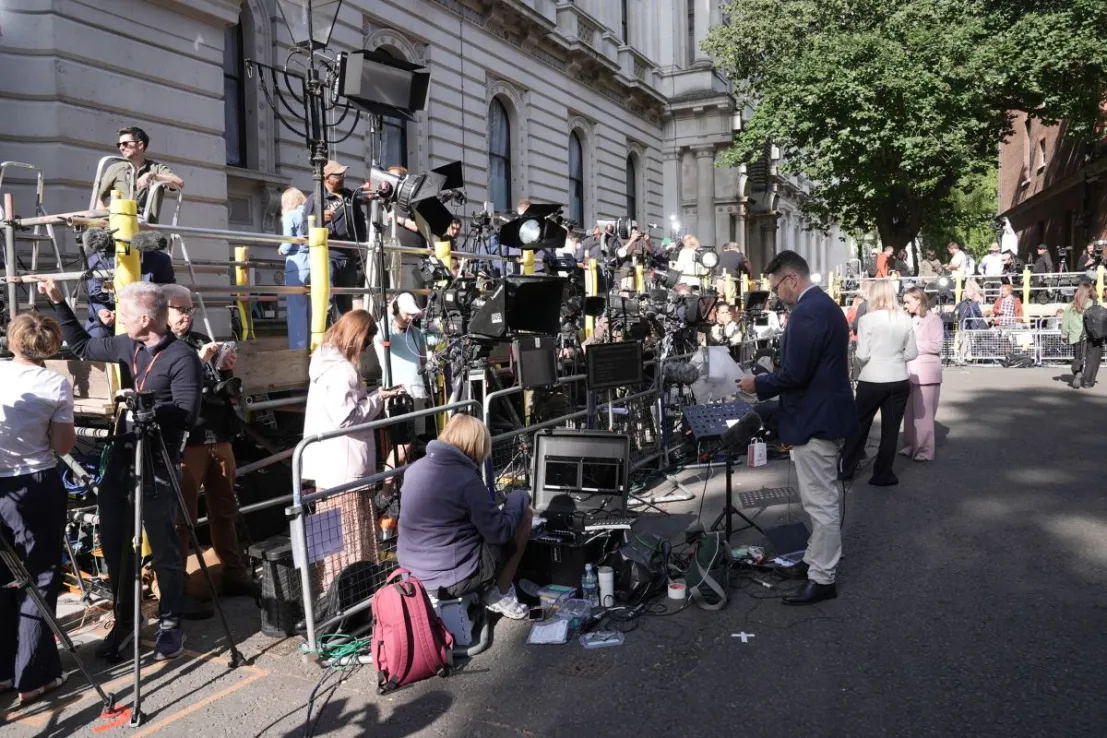
- •Revell asserts that the intense media presence outside Downing Street is sustained by public attention and viewing habits.
The relentless 24-hour news cycle, reinforced by social media, has reshaped political debate by rewarding rapid and performative responses over careful deliberation, according to Emma Revell, external affairs director at the Centre for Policy Studies, the centre-right think tank founded in 1974 by Margaret Thatcher and Keith Joseph that has long influenced Conservative policy thinking.
In what Revell describes as the continuing “perma-crisis” of British politics — a term widely used to capture the succession of leadership changes, economic shocks and institutional turbulence that have defined the post-Brexit era — one of the few predictable scenes is the sight of political correspondents and camera crews clustered opposite Britain’s most famous black door, waiting outside Downing Street for developments that may still be hours away.
She questions why journalists and camera operators need to arrive so far ahead of any actual news, sometimes from 5am, equipped as though they were queuing for Wimbledon. Yet, she argues, their presence has become an unavoidable feature of the modern news cycle because rolling coverage requires constant images, updates and commentary.
The result, Revell writes, is often limited in substance. Reporters shout the same unanswered questions at incoming Cabinet ministers as they walk up Downing Street. Broadcasters deliver repeated pieces to camera while trying to produce fresh details for viewers, but are often reduced to trivia such as “Did you know Andy Burnham’s middle name is Murray?”, or the observation that he is the first Cambridge-educated prime minister since Stanley Baldwin. Viewers, meanwhile, are shown footage of an increasingly tired-looking Larry the Cat and are left wondering whether Andy Burnham’s notes-free arrival speech means “Hot Podium Guy” might finally be able to take a well-earned break.
Rolling news has existed for almost 30 years, since the launch of BBC News 24 and Sky News in the late 1990s transformed British political coverage from scheduled bulletins into continuous live programming. Many journalists now working in politics grew up with it and have never known a professional environment without it. Revell acknowledges that it has expanded both the breadth and depth of news coverage. But combined with social media, she argues, it is no longer clear that the system benefits the public or politics.
One major consequence, she says, is that it has removed the space needed for deliberation. With politicians unable to escape the continuous news cycle, any delay in responding to an incident or question can be framed as hesitation or indecision. Political leaders and their teams are therefore pushed to prioritise speed over thoughtfulness.
If an initial response proves too hasty and later needs to be revised — whether after reflection, feedback from colleagues or contact with reality — it is quickly labelled a U-turn, a climbdown, a betrayal, or all three. In Revell’s view, this creates incentives that make careful policy development harder.
She contrasts the current environment with an earlier era of political journalism. The legendary political interviewer Robin Day conducted only a handful of sit-down interviews with Margaret Thatcher over the course of a decade. By comparison, today’s political leaders appear to spend much of their time moving from one media outlet to another.
Journalists may argue that they still do not get enough time with politicians, and Revell says they may be right. However, she adds that the art of the long-form interview has been eroded by demand for clips and concise one-liners. Policymaking, she argues, has suffered from pressure to generate compelling content rather than strong ideas.
Breaking the news
Revell also argues that the combination of rolling news and social media has brought far greater attention to issues that might previously have gone unnoticed under earlier administrations. This, she says, can be highly valuable.
Major investigations no longer necessarily require the support of an editor or a traditional newsroom. A single person with an X account and enough time can publish detailed threads alleging that businesses are sponsoring hundreds of visas for so-called skilled workers who, in Revell’s view, are likely no such thing. Traditional media may amplify those stories, but it no longer has exclusive power to break them.
At the same time, she writes, the need to fill airtime means that even minor missteps can become headline news. Producers may spend an entire day booking commentators to analyse and criticise Wes Streeting and Shabana Mahmood for sharing a joke about the new Justice Secretary.
Revell accepts that there is an argument that public life cannot be subject to too much scrutiny. But she warns that scrutiny can reach a point where it begins to inhibit the ability of politicians and government to get things done.
She refers to a column she wrote a few weeks earlier, in which she argued that her generation has only known political instability and that this instability has gone hand in hand with economic stagnation. Politicians, she says, need breathing room to develop and test policies rather than seeing half-formed ideas leaked into the public domain and then attacked because they were rushed.
“Our current feedback mechanisms reward the banal, the safe, the uncontested,” Revell writes. Under those circumstances, she argues, it is unsurprising that Andy Burnham would prioritise a measure such as removing VAT from energy bills, even though she describes it as insignificant in the broader context of Britain’s economic malaise.
In her assessment, Burnham could not arrive on day one without announcing anything, and the measure had to be one that directly benefited households. Otherwise, she argues, criticism would have begun before he had even unpacked his bags.
A more substantial policy addressing why Britain has the highest energy costs of any major economy — a distinction repeatedly documented in international comparisons by the International Energy Agency and OECD, driven by factors including wholesale gas prices, network charges and policy levies — would require time for consideration, time to build support within the parliamentary party and courage to confront opponents directly. Revell says the failure of successive prime ministers to address the issue is not caused solely by the relentless media cycle, but she argues that the cycle has not helped.
Rolling news, she concludes, is not going away. Nor is social media, unless politicians abandon what she calls their worst “nannying instincts.” Before blaming the journalists gathered on the Downing Street pavement, Revell says, the public should remember that they are there because people are watching.
“The doorstep circus runs on our attention,” she writes. “If we actually wanted politicians to think before they spoke, we might need to give them a moment in which to do it.”
Emma Revell is external affairs director at the Centre for Policy Studies.

