10-Year Minus 3-Month Term Spreads Rise in France and Italy; UK Up Through September
Key Takeaways
- •A November 14 Econbrowser post charts the 10-year minus 3-month government term spread for Canada, France, Germany, Italy, and the United Kingdom using OECD data.
- •Term spreads in France and Italy rose in October, while the United Kingdom's spread rose through September.
- •According to Chinn and Ferrara (2026), the term spread has historically worked better as a recession predictor for Canada and Germany than for the other countries examined.
- •The post flags that 5-year credit default swap pricing indicates material sovereign default risk in France and Italy, making CDS quotes a necessary cross-check for interpreting their long-term yields.
- •The OECD compiles long-term interest rate statistics for member countries on a standardized basis, allowing yield curves to be compared across borders on like-for-like terms.
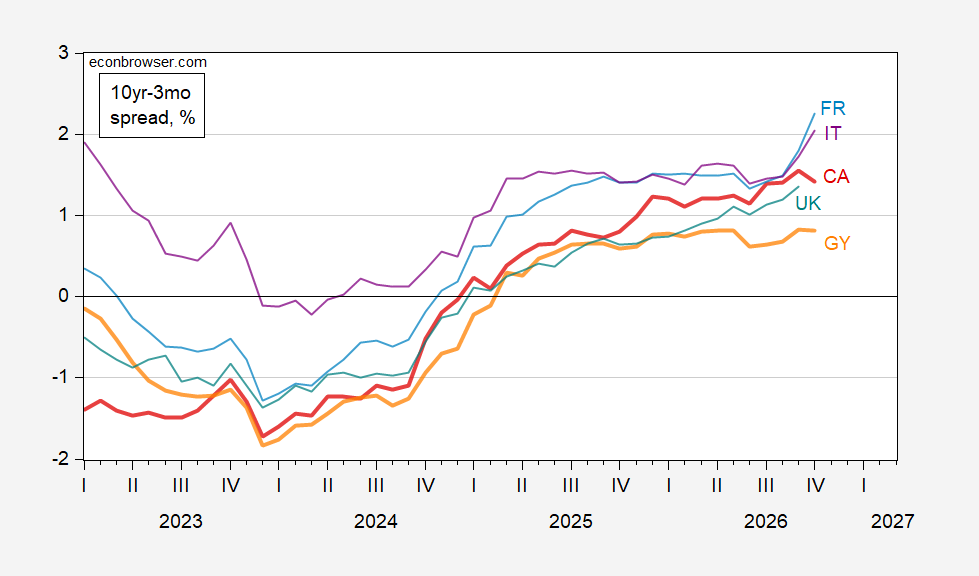
A November 14 post on the economics blog Econbrowser examines the 10-year minus 3-month government term spread across five advanced economies, reporting that spreads in France and Italy rose in October, while the United Kingdom's spread rose through September.
Figure 1 of the post charts the 10 year – 3 month government term spread for Canada (red), France (light blue), Germany (orange), Italy (purple), and the UK (teal), all expressed in percent. The data are drawn from the Organisation for Economic Co-operation and Development (OECD), a Paris-based intergovernmental organization that compiles long-term interest rate statistics for member countries on a standardized basis, allowing yield curves to be compared across borders on like-for-like terms.
The term spread — the gap between long-term and short-term government borrowing costs — is among the most closely watched gauges in business cycle analysis, since yield curve inversions, in which short-term yields exceed long-term yields, have historically preceded recessions in a number of advanced economies. In this framework, a rising reading means the gap between the two maturities is widening; an inversion, by contrast, refers to the difference itself turning negative. As the post notes, however, the indicator's track record is uneven across countries: historically, this term spread worked better as a predictor of recessions for Canada and Germany, as discussed in Chinn and Ferrara (2026), available here.
The post also flags a methodological caveat. For business cycle analysis, it is typical to assume constant or near-zero default risk; for France and Italy, this seems implausible, as illustrated by 5-year credit default swaps (CDS). Where sovereign default risk is material, long-term yields can reflect perceived credit risk alongside the macroeconomic conditions the spread is meant to capture, which is why the post points to CDS pricing as the relevant cross-check for those two markets. CDS pricing reflects the market's assessment of a sovereign borrower's default risk, with the five-year tenor serving as a standard benchmark. The source cited for the CDS data is Investing.com.
For readers following the indicator, the datasets the post identifies as its reference points — the OECD long-term rate series and the cited CDS quotes — are the ones to watch as subsequent observations extend the October and September readings. The original post is available at Econbrowser: Some 10yr-3mo Spreads in October.

