2026 Week 29 Stock Market Watch: AI Valuation Pressure, Inflation Relief, Earnings Season and Oil Price Risks
Key Takeaways
- •The Nasdaq underperformed major U.S. indexes as technology and AI-related stocks faced heavier valuation pressure.
- •Softer June CPI and PPI data supported expectations for easing inflation but did not fully offset equity weakness.
- •Early earnings season made guidance, margins and demand commentary more important for individual stock reactions.
- •Oil prices remained a risk factor because higher crude can affect inflation expectations, consumer costs and sector performance.
- •Traders are watching whether earnings breadth, yields and AI stock stability can determine whether the pullback becomes a reset or deeper de-risking.
Why Week 29 Matters for the Stock Market
Week 29 was a useful stress test for the stock market rally. The macro data was not bad. In fact, the inflation data gave markets something to like. The problem was that stocks had already priced in a great deal of optimism, especially AI-related technology shares. When expectations are high, even decent macro news may not protect the most crowded parts of the market.
That is why the Nasdaq lagged. This week was not simply a broad risk-off collapse across all assets, but a valuation check. Investors were willing to question whether the AI trade had gone too far, too fast, even as the broader economy still appeared resilient enough to support corporate earnings.
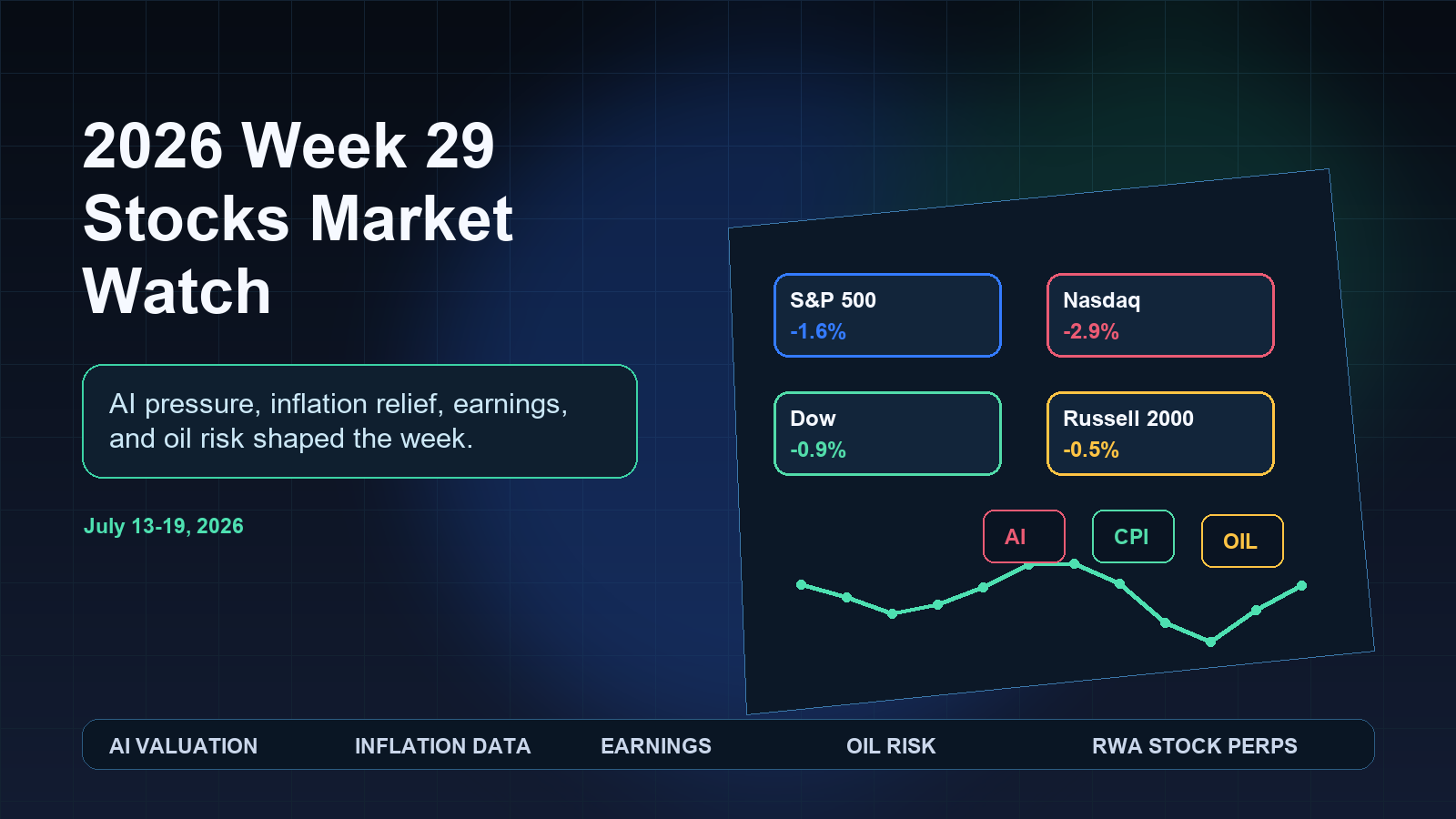
The S&P 500 fell 1.6% for the week, showing that weakness had moved beyond a handful of stocks. The Nasdaq fell 2.9%, showing where the pressure was concentrated. The Dow declined less, suggesting that old-economy and defensive exposure held up better. The Russell 2000’s modest decline showed that small caps were not the main source of pressure.
The Pullback Is About Structure
For traders, the lesson is straightforward: if positioning, valuations and earnings expectations are already stretched, the market can still fall even when inflation relief arrives.
That is exactly what makes Week 29 valuable as a trading case study. It separates macro support from equity market resilience. The macro backdrop gave investors a reason not to panic, but price action still forced them to ask whether market leadership had become too narrow. When a rally depends heavily on a small group of expensive growth companies, broader indexes can look stable until those leaders begin to wobble.
The week also showed that weekly stock analysis should not stop at closing numbers. A 1.6% decline in the S&P 500 tells readers the direction, but it does not explain the structure. Nasdaq weakness, oil price sensitivity, early earnings reactions and inflation relief each tell a different part of the story. The real market signal lies in the combination.
Week 29 Market Dashboard
| Market Signal | Week 29 Interpretation |
|---|---|
| S&P 500 | Down 1.6% for the week, reflecting broader equity market weakness. |
| Nasdaq Composite | Fell 2.9%, showing greater pressure on technology and AI-related stocks. |
| Dow Jones Industrial Average | Declined 0.9%, outperforming the Nasdaq but still negative. |
| Russell 2000 | Dropped 0.5%, showing less weakness than large-cap growth stocks. |
| CPI and PPI | Inflation data supported the disinflation narrative. |
| Retail Sales | Helped investors assess whether consumer demand remained resilient. |
| Oil Price Risk | Kept inflation and geopolitical concerns in the background. |
| Earnings Season | Began separating companies with solid demand from those facing valuation pressure. |
The dashboard points to a market that is correcting, not breaking. Inflation data helped the bond-market narrative. Earnings brought company-level differentiation. Oil prices reminded investors that headline inflation risk has not disappeared. The biggest pressure point remained the valuations of growth stocks and AI shares.
In this environment, traders should be careful with simple labels. Calling the week “bearish” would ignore inflation relief. Calling it “constructive” would ignore the damage to the Nasdaq. Calling it an earnings week would ignore the fact that macro data still mattered. Week 29 was a repricing week: investors did not abandon the equity story, but they were no longer willing to pay any price for it.
Inflation Helped, But Did Not Save the Week
The June CPI and PPI reports mattered because they arrived while investors were looking for confirmation that inflation was moving in the right direction. Softer inflation data usually helps stocks by reducing pressure on Treasury yields and supporting expectations that the Federal Reserve may eventually be able to ease policy.
That part of the narrative was constructive. If inflation cools while growth remains intact, stocks can usually support higher valuations. Lower inflation also helps long-duration assets because the discounting pressure on future earnings eases when yields are contained.
But Week 29 showed the limits of that logic. Inflation relief can improve the backdrop, but it cannot solve every valuation problem. When the market is crowded into a small group of winners, the question is no longer just “Is inflation slowing?” It becomes more about “How much future growth is already priced in?”
That question hit AI-related stocks the hardest. The disinflation story helped indexes avoid deeper declines, but it did not stop investors from taking profits in the most expensive parts of the market.
Demand Still Has to Remain Resilient
Retail sales added another layer of information. Consumer data matters because it helps investors determine whether lower inflation is arriving alongside resilient demand or alongside a weakening economy. A healthy consumer can support earnings for retailers, payment companies, travel stocks and broad discretionary spending. A weak consumer can turn disinflation from a rate-friendly story into a growth-negative story.
Week 29 did not reduce the market to one clear consumer signal, but it did remind traders that inflation and demand must be viewed together. Equity bulls want milder inflation, but they do not want demand to collapse. That balance is the core of the soft-landing trade.
Earnings Season Starts to Matter
Earnings season added another layer to the week. Investors were no longer trading only macro expectations. They began comparing actual company results, guidance, margins and demand commentary with elevated market expectations.
This is where the market became more selective. Companies with clear demand, good cost control and credible guidance could still attract buyers. Companies priced for perfection had less room for error. This is a typical late-rally dynamic: indexes may look healthy, but individual stock reactions become more violent.
The early earnings tone also mattered because it came before the largest mega-cap technology companies reported. Traders were already asking whether large AI and platform companies could justify their valuation premiums. Week 29 did not fully answer that question, but it made the question louder.
For stock market readers, this is where macro and micro analysis intersect. Lower inflation can support the valuation environment, but earnings still have to carry the next leg of the rally.
The earnings lens is especially important because the equity market had already rewarded companies tied to AI, automation, cloud infrastructure and semiconductor demand. When a theme becomes that powerful, results need to do more than avoid disaster. They need to confirm that the growth story is still accelerating, or at least durable.
Guidance Matters More Than Headline Beats
That is a high bar. It means guidance may matter more than past revenue. Margins may matter more than headline sales. Capital expenditure commentary may matter more than a single-quarter beat. In Week 29, investors began shifting from “What is the theme?” to “Which companies can prove that the theme is turning into cash flow?”
AI Valuation Is the Pressure Point
The AI trade remains the market’s most important leadership story, but Week 29 showed that leadership can become fragile when expectations become too concentrated. If prices already assume exceptional growth, smooth execution and sustained investor enthusiasm, a stock can fall even without bad news.
That is why AI-related weakness affected more than the technology sector. AI has become a market narrative, a capex narrative, a semiconductor narrative, a cloud narrative and a productivity narrative at the same time. When investors question AI valuations, they are not just questioning a group of stocks. They are questioning the premium attached to a large part of the market’s earnings growth story.
The Nasdaq’s underperformance reflected this risk. Growth stocks are more sensitive to valuation resets because more of their value lies in future expectations. When investors become less willing to pay for forward growth, the same inflation data may help indexes but still be insufficient to protect the leaders.
A Good Theme Can Still Be a Difficult Trade
This does not mean the AI story has broken. It means the market has started demanding more discipline. AI can still be a long-term growth engine while AI-related stocks correct in the short term. That distinction matters. A good theme can still become a bad trade if entry prices, positioning and expectations become too aggressive.
A healthier version of the AI trade needs broader confirmation: strong enterprise demand, durable semiconductor orders, rational capex and earnings that spread beyond a handful of large stocks. A weaker version would remain concentrated, expensive and vulnerable to any sign that monetization is lagging infrastructure spending.
Oil Prices Keep Inflation Tail Risks Alive
Oil prices were not the main driver of the stock market decline, but they remained part of the market discussion. Higher crude prices can complicate the disinflation story by affecting headline inflation, consumer costs, transportation expenses and energy-sector earnings.
For equities, oil prices have a divergent impact. Energy stocks may benefit from stronger crude prices, but consumers, travel, transportation and margin-sensitive businesses may face pressure. A rising oil market can also make bond investors less comfortable with the idea that inflation has been safely controlled.
In Week 29, the key point was not that oil prices overwhelmed the equity story, but that they limited the market’s ability to fully relax. Investors received inflation relief from the data, but they could not ignore the possibility that energy prices might reintroduce pressure later.
Oil prices also matter because they can change sector leadership. A firmer crude market can support energy producers and some commodity-linked stocks, but it can also weigh on airlines, logistics companies, consumer discretionary stocks and fuel-sensitive margin businesses. That divergence can make indexes look calmer than the underlying sector rotation.
For the Fed narrative, oil is a timing issue. Central banks may look through temporary energy swings, but markets often react before policymakers do. If oil prices push inflation expectations higher, yields can firm even if recent inflation data looks softer. That is why crude remains a watch item, not background noise.
Cross-Asset Impact Map
| Driver | Impact on Equities | What Traders Are Watching |
|---|---|---|
| Softer Inflation Data | Supports the rate-cut narrative and helps cushion downside. | Treasury yields, Fed expectations, growth-stock valuation multiples. |
| AI Valuation Pressure | Weighs on the Nasdaq and high-growth leaders. | Semiconductor stocks, mega-cap tech, cloud and AI capex-linked companies. |
| Earnings Season | Increases company-level differentiation. | Guidance, margins, revenue quality, demand commentary. |
| Retail Sales | Tests whether consumers remain resilient. | Consumer discretionary, retailers, credit-sensitive stocks. |
| Oil Price Risk | Keeps inflation and margin risks alive. | Energy stocks, transportation stocks, airlines, inflation expectations. |
| RWA Stock Perpetuals | Highlights demand for around-the-clock access to equity-related trading. | Liquidity, leverage, custody and after-hours reaction speed. |
This map shows why Week 29 was not a single-factor market. Softer inflation data helped one side of the trade. AI valuation pressure hurt the other. Earnings created differentiation. Oil prices kept inflation tail risk visible. The result was a market that looked weaker on the surface, but still contained multiple competing stories underneath.
For traders building a weekly plan, the best approach is to look for confirmation rather than prediction. If yields stay calm and earnings breadth improves, the pullback may be viewed as a reset. If yields rise, oil prices strengthen and AI leaders keep falling, the same pullback could turn into a deeper de-risking phase. Week 29 did not settle that debate, but it gave traders the right checklist.
The Market Needs Confirmation
The strongest bullish signal would have been a cleaner mix: cooling inflation, controlled yields, improving earnings breadth and stabilizing AI leaders. The more cautious signal would be the opposite: higher oil prices, firmer yields, narrow leadership and earnings reactions that punish expensive stocks. That is the framework traders are taking into the next week.
Trade Stocks Beyond TradFi Barriers
Stock markets move quickly. Your trading infrastructure should as well.
As RWA markets mature and tokenized stocks become a serious alternative to tradFi access points, more traders are asking the same question: why accept a centralized platform that controls your assets, requires KYC and keeps your trading fees?
edgeX Exchange offers a different answer. Built on EDGE chain and settled on Ethereum via Arbitrum, edgeX is a decentralized perpetual futures platform that lets you trade stocks with high leverage without handing over your identity or private keys.
Here is what sets it apart:
- True self-custody: Users always control their own private keys. Withdrawals do not require platform approval.
- Institutional-grade liquidity: $10 million of depth within a one-basis-point spread, with slippage below 0.1 basis point on trades above $100,000.
- CEX-level speed: The order book processes up to 200,000 orders per second, with matching latency below 10 milliseconds.
- No KYC required: Sign up and start trading without the friction of traditional account-opening processes.
- 100% trading fee rewards: Every fee you pay is returned to you through the Trade to Own program.
- USDC-backed settlement: USDC is designed by Circle and redeemable 1:1 for U.S. dollars, giving traders a familiar stablecoin foundation.
Whether you are rotating out of tradFi stocks, exploring RWA perpetuals or simply looking for a smarter way to trade equities on-chain, edgeX provides top-tier exchange execution quality with the security of decentralized infrastructure.
edgeX supports iOS and Android and is designed to let your edge move with you.Start trading on edgeX.
What Traders Should Watch Next
The next test is whether earnings can broaden leadership beyond the same group of AI winners. If companies outside the largest technology stocks can provide solid guidance, the market may absorb the Week 29 pullback as a healthy reset. If earnings disappoint while AI valuations remain under pressure, the Nasdaq may stay fragile.
Traders should also watch whether inflation relief continues to show up in yields. An equity pullback while yields are falling is very different from a pullback while yields are rising. The former may be a valuation reset. The latter can become a broader tightening of financial conditions.
Oil prices remain a swing factor. If crude stabilizes, inflation concerns may stay contained. If oil keeps rising, the market may become less confident that the Fed can look through headline inflation pressure.
For equity-linked crypto and RWA traders, Week 29 also reinforced a practical point: traditional stock market hours do not always match the speed at which narratives change. AI headlines, earnings reactions and macro repricing can all matter before or after cash trading sessions. That is why liquidity, custody and around-the-clock access are becoming part of the equity trading discussion.
FAQ
What was the main story for the stock market in Week 29 of 2026?
The main story was a weekly pullback led by the Nasdaq and AI-related stocks. Inflation data helped the macro backdrop, but valuation pressure and earnings-season caution weighed on high-growth stocks.
Did the inflation data help stocks?
Yes. Softer CPI and PPI data helped support the disinflation narrative and eased some interest-rate pressure. However, inflation relief did not fully offset profit-taking and valuation pressure in AI-related technology stocks.
Why did the Nasdaq underperform?
The Nasdaq underperformed because technology and AI-related stocks faced greater valuation pressure. When expectations are high, investors may sell even without a major negative catalyst.
Why do oil prices matter for stock traders?
Oil prices matter because they affect inflation expectations, energy earnings, consumer costs, transportation margins and central bank expectations. Even if CPI and PPI data look calmer, higher oil prices can complicate the disinflation story.
How does this relate to edgeX stock perpetuals?
Week 29 showed how quickly equity narratives can change. edgeX stock perpetuals are designed for traders who want around-the-clock equity-related exposure, self-custody, deep liquidity and faster access than traditional brokerage channels.
