US and Japan Jointly Intervene to Support the Yen Amid Fears of Forced Treasury Selling
Key Takeaways
- •The US Treasury and Japan's Ministry of Finance jointly intervened in currency markets on Friday to support the yen, marking a rare coordinated action not seen since the G7 response to the 2011 Tohoku earthquake.
- •The intervention was driven by concerns that Japan, holding over $1 trillion in US Treasuries, might be forced to sell those securities to fund yen purchases, which could have driven Treasury yields sharply higher.
- •The yen appreciated from approximately ¥164 to ¥156.9 per dollar following the combined effects of intervention rumors, the operation itself, and subsequent official confirmations.
- •The Bank of Japan will use the Federal Reserve's FIMA Standing Repo Facility to obtain dollar liquidity by posting Treasury securities as collateral, thereby avoiding the need to liquidate its Treasury portfolio.
- •Analysts maintain that the intervention offers only temporary relief and that substantially higher BOJ policy rates and deeper balance sheet reduction are required to establish a durable floor under the yen.
Joint Currency Intervention Confirmed by US Treasury and Japan's Ministry of Finance
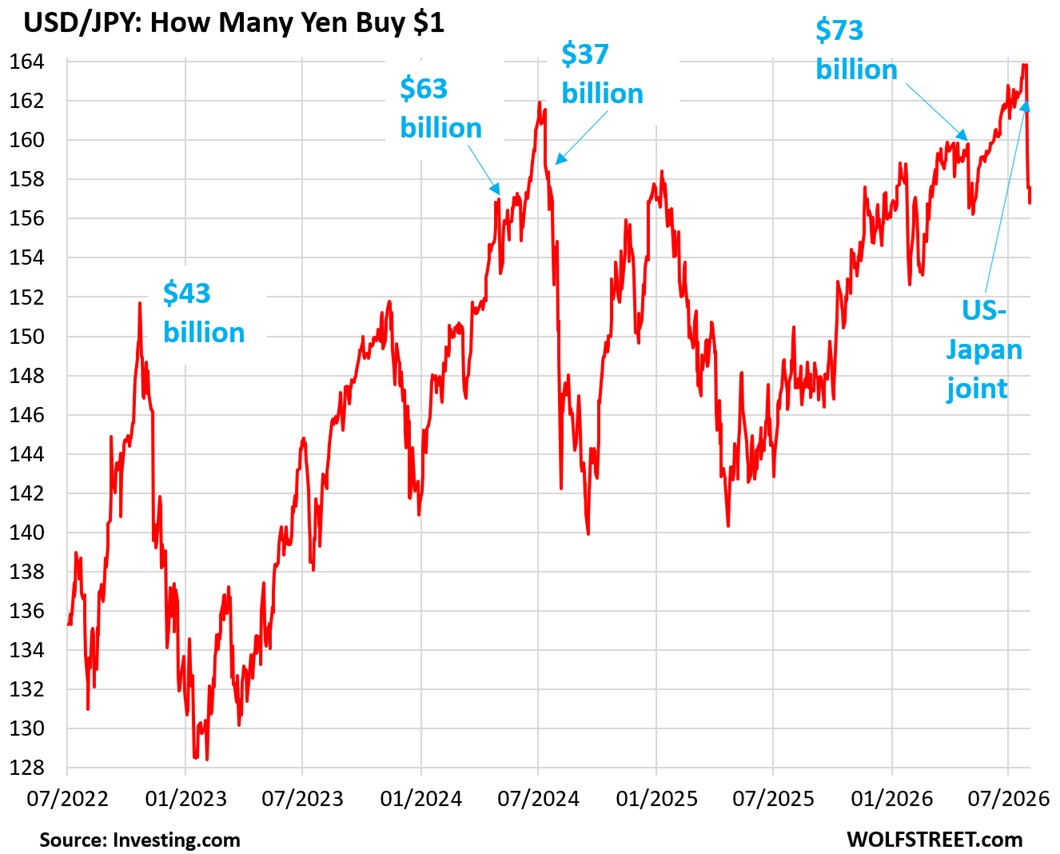
The US Treasury Department, acting through its fiscal agent the New York Fed, and Japan's authorities jointly intervened in the currency market on Friday to prop up the yen, which had plunged to approximately ¥164 to the USD by July 28. While the specific amounts remain undisclosed, the operation has been confirmed by both US Treasury Secretary Bessent and Japan's Ministry of Finance (MOF). Both sides indicated they stand ready to repeat the intervention if necessary. Coordinated US-Japan currency intervention is rare; the most notable precedent was the G7's joint action following the March 2011 Tohoku earthquake, making Friday's operation a signal of how seriously both governments viewed the yen's slide.
The catalyst for the coordinated action was mounting concern that Japan might be forced to sell US Treasury securities to raise the dollar cash needed to purchase yen as it battled to defend its collapsing currency. Japan is the largest foreign holder of US Treasuries, with holdings exceeding $1 trillion, meaning any large-scale liquidation could ripple through the world's deepest bond market. Such forced selling of Treasuries would have driven a further spike in Treasury yields. As the top bond salesman in the United States, Bessent's objective is to prevent long-term yields from blowing out regardless of other prevailing conditions. Multiple measures were taken to forestall this scenario.
Rumors of an impending joint move had already pushed the yen higher on Thursday. Then, in a conspicuous gesture, Bessent placed a one-item "To Do" list within view of cameras at the cabinet meeting held at Camp David on Friday. The sole item read: "Buy Japanese Yen (JPY) $5 – 10 bill."
According to a leaked comment reported by the Financial Times, the New York Fed sold euros from its reserves — not dollars — and purchased yen with the proceeds on Friday. The use of euros rather than USD has not yet been officially confirmed. While the precise amount was not leaked, Bessent's "To Do" list provided an indication of the scale. Simultaneously, the MOJ and the Bank of Japan (BOJ) also intervened, buying yen in the market.
The MOF discloses intervention amounts on a monthly basis, with a cut-off date around the 28th, meaning the figures for this operation will be published at the end of August.
Market Impact and the Limits of Intervention
The combined effect of pre-intervention rumors, the visual theatrics, the intervention itself, and the subsequent announcement and confirmation drove a significant appreciation of the yen against the dollar — from roughly ¥164 to the USD on Wednesday to ¥156.9 at the time of reporting. This was described as the largest single joint intervention to date.
However, prior unilateral interventions by Japan had failed to permanently reverse the yen's downward trajectory, offering only temporary respite before the currency resumed its slide. Analysts argue that substantially tighter monetary policy from the BOJ — including aggressive quantitative tightening (QT) and meaningfully higher interest rates implemented quickly — is required to end the yen's decline on a lasting basis. The root cause is widely attributed to the BOJ's ultra-loose monetary policies pursued from 2012 to 2022, which created a persistent interest rate gap between Japan and the rest of the world. That differential incentivized investors to borrow in low-yielding yen and deploy capital into higher-yielding assets elsewhere, a strategy known as the carry trade, which amplified downward pressure on the currency. Currency interventions, in this view, amount to temporary window dressing that will ultimately be tested again by market forces.
FIMA Standing Repo Facility as an Alternative to Treasury Sales
To further avert the risk of forced Treasury selling by Japan, the Bank of Japan will utilize the Federal Reserve's Standing Repo Facility (SRF) for Foreign and International Monetary Authorities (FIMA) rather than liquidating its Treasury holdings. Under the FIMA SRF, approved foreign central banks can post their Treasury securities as collateral in exchange for USD cash. This mechanism allows the BOJ to obtain the dollars needed for yen-support operations while keeping its Treasury portfolio intact. This shift was included as part of the announcement, although the BOJ has had access to the facility for years.
The Fed announced the establishment of the FIMA SRF on July 28, 2021, alongside its regular SRF available to US banks. This standing facility replaced the temporary FIMA repo facility the Fed had created in March 2020.
Japan's shift toward the FIMA SRF to obtain USD liquidity for future interventions removed upward pressure from the Treasury market. On the morning of the report, Treasury yields across maturities of two years and longer declined, with the 10-year Treasury yield falling approximately 5 basis points to 4.69% and the 30-year Treasury yield dropping about 4 basis points to 5.23%.
BOJ Policy Rate and Balance Sheet Reduction
The yen's protracted weakness stems from a decade of aggressively accommodative monetary policy. The resulting currency depreciation and the inflationary pressures channeled into the Japanese economy through increasingly costly imports — priced in yen terms — have compelled the BOJ to retreat from those policies.
Nevertheless, the BOJ's policy rate remains at just 1.0% following five incremental rate increases spread over more than two years, and it remains negative in real terms — below the rate of inflation. With the Federal Reserve's benchmark rate substantially higher, the wide rate differential continues to weigh on the yen. In late 2024, the BOJ initiated QT and subsequently accelerated it, reducing its balance sheet by approximately 16% to date. While this may have slowed the yen's downward spiral, observers contend it has not been sufficient and that substantially deeper balance sheet reduction coupled with significantly higher policy rates is needed to establish a durable floor under the currency.

