UNIGRID and Syntropic Power plan U.S. sodium-ion battery manufacturing
Key Takeaways
- •UNIGRID will share its sodium chromium oxide cell design with Syntropic Power to support U.S. manufacturing.
- •The companies plan to deploy 1 GWh of NCO-based energy storage in 2027, starting with the Tenet and GridSpan systems.
- •Independent testing at Rochester Institute of Technology found the 210-Ah cells delivered 216-218 Ah of discharge capacity and at least 97.9% round-trip energy efficiency.
- •UNIGRID said its NCO cells have exceeded 1,000 cycles with more than 99% capacity retained and remained thermally stable in abuse testing.
- •Syntropic plans to manufacture NCO cells in the United States by the end of 2027, but the companies have not disclosed manufacturing locations.
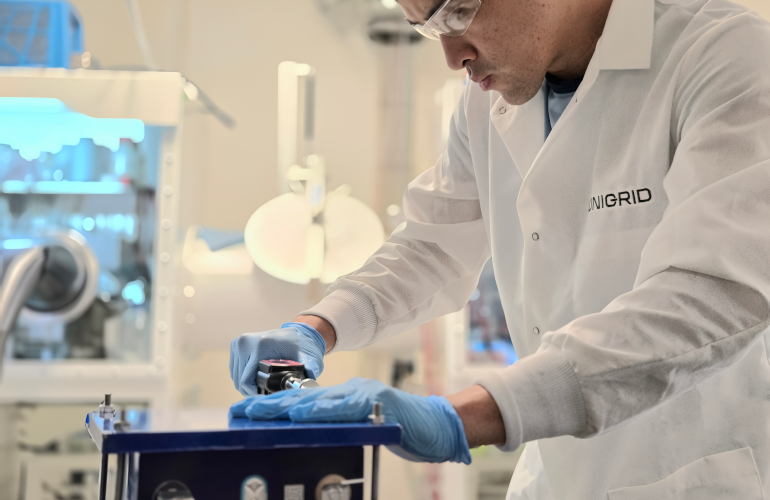
Sodium-ion battery cell developer UNIGRID said it will share its sodium chromium oxide (NCO) design with Syntropic Power to support U.S. manufacturing.
The companies plan to deploy 1 GWh of NCO-based energy storage in 2027, beginning with Syntropic’s Tenet residential system and the GridSpan system for large-scale applications. Under the arrangement, Syntropic will design, manufacture and deploy battery energy storage systems based on UNIGRID’s independently validated cell chemistry, reflecting broader industry efforts to pair alternative chemistries with domestic supply-chain and deployment plans as demand grows for stationary storage.
To evaluate UNIGRID’s NCO prismatic cells, Syntropic commissioned the Rochester Institute of Technology Battery Development Center, an ISO 17025-accredited laboratory, to perform independent characterization testing.
Initial RIT testing of the 210-Ah cells measured 216-218 Ah of discharge capacity against a 210-Ah nameplate rating, at least 97.9% cell-level round-trip energy efficiency, just 2.3% capacity loss between C/10 and 1C rates, and endothermic behavior during charging. Cycle life testing at full depth of discharge from UNIGRID has reached more than 1,000 cycles with greater than 99% capacity retained. According to the companies, the RIT results are intended to help Syntropic’s products, including GridSpan, make use of the chemistry’s measured strengths by informing electrical architecture, operating controls and passive thermal-management design. That approach is intended to allow the platform to be engineered to operate without mechanical cooling, even at grid-scale charge and discharge rates.
RIT abuse testing also found that UNIGRID’s NCO cells remained thermally stable under extreme test conditions. The cells have passed UN 38.3 transport testing, completed cell-level UL 9540A testing and achieved IEC 62619 certification, supporting transportation qualification and downstream system-certification activities.
“The RIT program gives us independent data on the performance characteristics that matter for stationary energy storage,” said Matt Huber, CTO of Syntropic Power. “UNIGRID’s NCO chemistry combines high round trip efficiency, high power capability, strong cycle life performance and distinctive thermal safety behavior, providing the foundation for a GridSpan platform designed to operate without active cooling.”
The first shipment of UNIGRID NCO cells has already been delivered to Syntropic for product development, testing and integration across its stationary energy storage portfolio.
Commercialization is expected to begin with Tenet, a wall-mounted system focused on safety in close-proximity environments and designed for residential, light-commercial and virtual power plant applications.
GridSpan, Syntropic’s flagship modular DC platform, extends the same NCO technology to large-scale stationary applications. Its power and energy configurations are designed for uses ranging from fast-response power and ride-through to energy storage durations of about 20 minutes to 20 hours, covering use cases where response speed and thermal management are often central to system design.
“As surging power demand from AI and electrification collides with extreme weather and rising energy costs, the modern grid requires unmatched reliability and thermal resilience,” said Darren H. S. Tan, CEO of UNIGRID. “The inherent stability and high power capability of the NCO chemistry make it exceptionally well-suited for these demanding conditions. Partnering with Syntropic allows us to scale this robust technology to deliver the dependable power infrastructure North America urgently needs.”
Syntropic plans to manufacture NCO cells using UNIGRID’s technology in the United States by the end of 2027. The companies have not released information on manufacturing locations.
News item from UNIGRID

