Trump Says U.S.–Iran Talks 'Moving Along Very Nicely,' Hints Strait of Hormuz Could Reopen Soon
Key Takeaways
- •President Trump stated in a Fox News interview that U.S.–Iran negotiations are progressing favorably but did not disclose specific details or timelines for any potential agreement.
- •No official announcement has been made confirming a diplomatic deal between the United States and Iran regarding the Strait of Hormuz.
- •The Strait of Hormuz is a vital maritime passage through which a substantial portion of the world's seaborne crude oil and liquefied natural gas exports transit daily.
- •Global financial markets, energy traders, and geopolitical analysts responded quickly to Trump's remarks due to the waterway's outsized influence on energy prices and inflation expectations.
- •Analysts caution that meaningful diplomatic breakthroughs require extensive negotiations, and Trump's comments reflect optimism rather than confirmation of finalized accords.
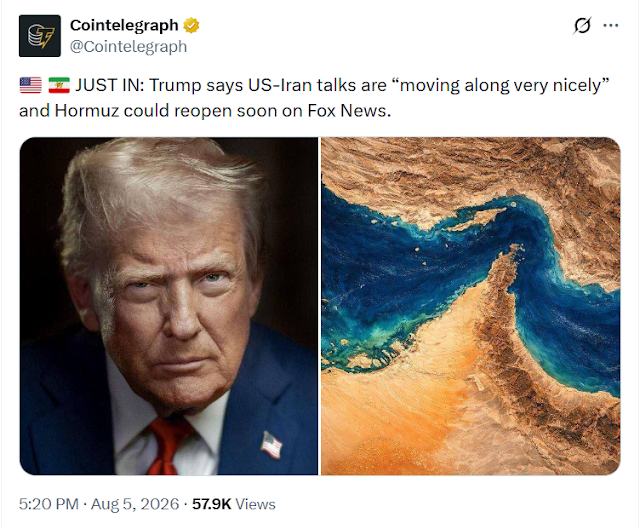
U.S. President Donald Trump indicated that negotiations between the United States and Iran are advancing in a positive direction, expressing optimism that the strategically critical Strait of Hormuz could reopen in the near future if diplomatic momentum is sustained.
In an interview with Fox News, Trump characterized the ongoing discussions as "moving along very nicely," suggesting that recent diplomatic engagement has yielded encouraging developments. He did not disclose specific details about the negotiation topics or offer a precise timeline for reopening the waterway. His remarks nonetheless immediately captured the attention of global financial markets, energy traders, and geopolitical analysts.
The comments gained additional visibility after being surfaced by the crypto news account Cointelegraph on X (https://x.com/Cointelegraph/status/2084947746838945995) before broader international media coverage followed. Investors interpreted the statement as a potentially significant signal regarding regional stability, given the Strait of Hormuz's central role in global energy transportation.
No official announcement has confirmed an agreement between Washington and Tehran. However, Trump's remarks have raised expectations that diplomatic negotiations may be entering a more constructive phase.
A Critical Waterway for Global Energy Markets
The Strait of Hormuz is widely considered one of the world's most strategically significant maritime passages. Situated between Iran and Oman, the narrow shipping lane connects the Persian Gulf with the Gulf of Oman and the Arabian Sea. A substantial share of the world's seaborne crude oil and liquefied natural gas exports transits the strait daily, making it an indispensable artery for international energy markets.
Major oil-producing nations—including Saudi Arabia, Iraq, Kuwait, the United Arab Emirates, and Qatar—depend heavily on the route to deliver energy supplies to customers across Asia, Europe, and other regions. Any disruption to shipping through the Strait of Hormuz can rapidly affect global commodity prices, inflation expectations, shipping costs, and financial markets. Because of its outsized strategic importance, developments involving the waterway are closely monitored by governments, multinational corporations, and investors worldwide.
Trump Expresses Optimism About Diplomatic Progress
During the Fox News interview, Trump indicated that negotiations with Iran were progressing favorably. "We're moving along very nicely," he said when asked about the current state of talks. He also suggested that the Strait of Hormuz could reopen soon if diplomatic efforts continue to advance successfully.
Trump did not elaborate on specific negotiation topics or identify which issues had shown meaningful progress. Neither the White House nor Iranian officials immediately released detailed information confirming the status of any agreements following the interview. As diplomatic discussions continue, observers remain cautious while awaiting official announcements from both governments.
Why the Strait of Hormuz Matters Beyond the Middle East
Because such a significant proportion of globally traded oil moves through this narrow passage, disruptions can quickly influence international energy prices. Higher oil prices often contribute to rising transportation costs, increased manufacturing expenses, and broader inflationary pressures affecting consumers worldwide. Conversely, improved security and uninterrupted shipping through the strait generally support more stable energy markets.
Financial markets frequently respond to developments involving the waterway because investors view uninterrupted maritime trade as a key indicator of geopolitical stability.
Global Markets React to Diplomatic Signals
Trump's comments immediately attracted attention among investors monitoring geopolitical developments. Energy traders have spent months assessing risks associated with regional tensions that could affect shipping routes. Optimism surrounding diplomatic negotiations may reduce concerns about potential supply disruptions if discussions ultimately produce meaningful agreements.
Lower geopolitical risk premiums can influence oil prices, equity markets, government bond yields, and foreign exchange markets. Although markets typically avoid overreacting to individual political statements, investors closely monitor developments involving major geopolitical flashpoints.
Oil Prices and Inflation Expectations
The Strait of Hormuz plays an important role in global inflation dynamics. Oil remains a fundamental input for transportation, manufacturing, agriculture, aviation, and industrial production. Any sustained disruption to energy exports passing through the strait could contribute to higher fuel prices globally. Improved diplomatic relations that reduce supply risks, on the other hand, may help stabilize energy markets.
Central banks also monitor oil prices closely because energy costs influence inflation, monetary policy decisions, and broader economic growth. As a result, geopolitical developments in the Middle East often carry implications extending well beyond regional politics.
Cryptocurrency Markets Also Monitor Geopolitical Events
Although Trump's remarks primarily concern international diplomacy and energy markets, cryptocurrency investors also follow geopolitical developments closely. Periods of heightened geopolitical uncertainty often increase volatility across global financial markets. Depending on broader economic conditions, investors sometimes rotate capital into traditional safe-haven assets such as gold or U.S. Treasury securities. At other times, Bitcoin has attracted attention from investors seeking alternative stores of value during periods of macroeconomic uncertainty.
While cryptocurrency price movements depend on numerous factors, geopolitical developments increasingly influence investor sentiment across digital asset markets.
Diplomatic Negotiations Remain Ongoing
Despite Trump's optimistic assessment, negotiations between the United States and Iran remain subject to continued diplomatic discussion. Complex issues involving regional security, sanctions, nuclear policy, maritime security, and broader geopolitical relations typically require lengthy negotiations. Officials from both governments have historically approached such discussions cautiously, recognizing their significant implications for regional stability.
Observers note that meaningful diplomatic breakthroughs generally occur only after extensive negotiations involving multiple stakeholders. Consequently, Trump's comments should be viewed as reflecting optimism rather than confirmation that final agreements have been reached.
Strategic Importance for International Trade
Beyond energy exports, the Strait of Hormuz supports broader international commerce throughout the Gulf region. Numerous commercial vessels transporting chemicals, industrial materials, consumer goods, and other cargo also transit the waterway. Maintaining safe navigation through the strait contributes to global supply chain stability. Shipping companies, insurers, commodity traders, and multinational corporations all monitor regional security conditions when planning commercial operations. Reduced geopolitical tensions could improve confidence throughout international shipping markets.
Regional Stability Remains a Global Priority
Governments around the world continue to emphasize the importance of maintaining freedom of navigation through international waterways. International organizations, allied governments, and regional partners have repeatedly highlighted the strategic necessity of secure maritime commerce. Diplomatic engagement remains widely viewed as the preferred mechanism for reducing regional tensions while avoiding disruptions to global trade.
Trump's latest comments attracted attention not only for their political significance but also for their potential economic implications.
Investors Await Official Developments
Although financial markets often respond quickly to statements from political leaders, analysts caution that concrete policy actions remain the most significant driver of long-term market sentiment. Future announcements from U.S. and Iranian officials regarding negotiations, shipping arrangements, sanctions, or regional security will likely receive close scrutiny. Market participants will also monitor whether additional diplomatic meetings produce measurable progress.
Until formal agreements are announced, investors are expected to remain attentive to developments while avoiding conclusions based solely on preliminary comments.
Looking Ahead
President Trump's remarks suggesting that U.S.–Iran talks are progressing positively have renewed attention on one of the world's most strategically important maritime chokepoints. If negotiations continue to advance and lead to improved conditions for shipping through the Strait of Hormuz, the effects would be felt most directly in energy and trade channels that already shape global pricing, transport, and supply chains.
At the same time, significant diplomatic challenges remain. Complex geopolitical negotiations rarely conclude quickly, and final agreements often require extensive coordination among multiple governments and international stakeholders. For now, Trump's optimistic assessment has placed renewed attention on ongoing diplomacy, with markets around the world closely watching whether encouraging rhetoric evolves into concrete policy outcomes.
