Trans-Pacific Container Rates Climb as Peak Season Demand Outlasts Expectations
Key Takeaways
- •Asia–U.S. East Coast spot rates have held steady at approximately $9,012 per FEU since early July, while West Coast rates rebounded above $7,000 per FEU following August 1 general rate increases.
- •The National Retail Federation had projected August demand would fall below July levels, but steady rates and forwarder reports indicate prolonged peak season strength.
- •Section 122 tariffs expiring July 24 were immediately replaced by Section 301 duties ranging from 10% to 12.5% across more than 60 trading partners, preventing the sharp tariff spike shippers had feared.
- •Lean inventory levels and resilient consumer demand are supporting elevated shipping rates as back-to-school and holiday retail seasons approach.
- •The USTR is nearing completion of a Section 301 investigation into excess manufacturing capacity across 16 major trading partners, though implementation of any recommendations would lag findings by several weeks.
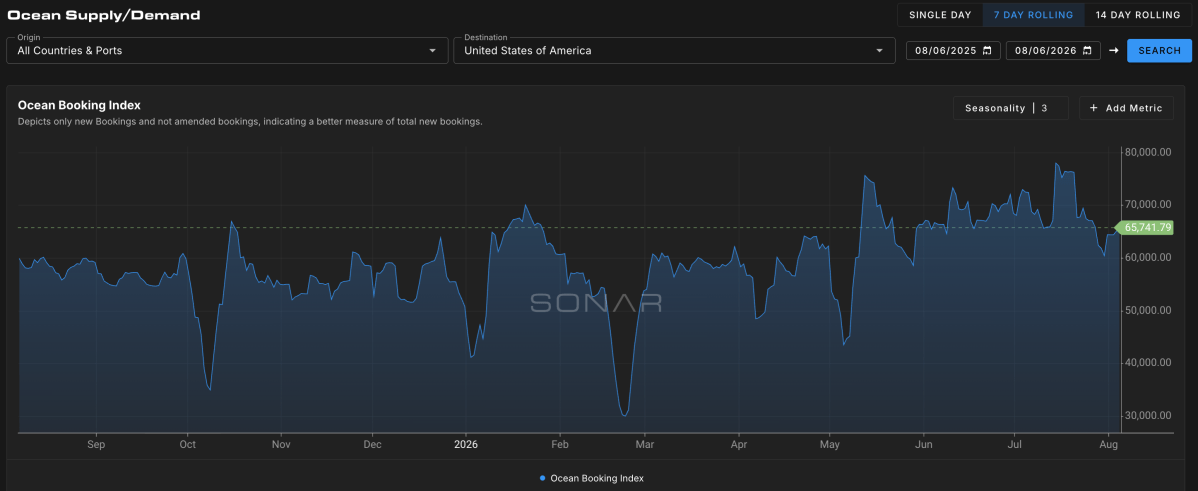
The trans-Pacific shipping market is showing signs of stronger-than-expected peak season demand, defying earlier assumptions that frontloading activity would cool by mid-summer.
The trans-Pacific corridor is the largest container shipping trade lane by volume, making rate movements there a key bellwether for U.S. retail supply chains and broader goods-sector inflation.
Asia–U.S. West Coast spot rates dipped 1% to $6,129 per forty-foot equivalent unit (FEU) in the latest weekly Baltic Freightos Index, as reported by Freightos (NASDAQ: CRGO), a contributor to SONAR data. Asia–U.S. East Coast rates held steady at $9,012 per FEU. While elevated, these levels remain well below the pandemic-era peaks above $20,000/FEU reached in 2021.
An early peak season running from late May through early July had pushed rates higher on major east-west trade lanes as shippers rushed to move cargo ahead of looming tariff deadlines.
"Since early July — and despite planned general rate increases and peak season surcharges for August 1 — rates on most of these lanes have eased or at least leveled off, suggesting that the frontloading-driven peak season rush was cooling earlier than usual," said Freightos analyst Judah Levine in a client note.
However, trans-Pacific East Coast rates have remained at their peak level of approximately $9,000/FEU since early July. West Coast rates, which had reached a peak of more than $7,500/FEU in early July, subsequently eased roughly 20% to around $6,000/FEU before rebounding.
"West Coast daily rates so far this week have jumped back above $7,000/FEU on August 1 GRIs," Levine noted.
The National Retail Federation had estimated that August demand would fall well below July levels. Yet steady East Coast rates, combined with forwarder reports of surprisingly strong demand and the recent West Coast rate increase, may signal that peak season strength is lasting longer than anticipated on the trans-Pacific corridor.
Other analysts point to unexpectedly lean inventory levels and resilient consumer demand as additional factors supporting rate levels. With back-to-school and holiday retail seasons approaching, lean inventories may leave importers with less buffer than in recent years, when many had over-ordered in the wake of pandemic-era disruptions.
"Another reason may be that the July 24 tariff deadline did not result in sharp tariff hikes," Levine said. "Many U.S. shippers were frontloading peak season volumes ahead of the Section 122, 10% global tariff July 24 expiration date out of concern that duties could be higher soon after."
Rather than spiking, Section 122 tariffs were immediately replaced by Section 301 tariffs applied to more than 60 trading partners, aimed at curbing forced labor imports, at rates of 10% to 12.5% — roughly on par with the expiring duties.
Duties could still return to emergency tariff levels, as the U.S. Trade Representative nears completion of its Section 301 investigation into excess manufacturing capacity across 16 of the largest U.S. trading partners. That probe, launched earlier in 2025, reflects escalating U.S. scrutiny of trade practices spanning semiconductors, shipbuilding, critical minerals, and other industrial sectors.
"But even once the USTR shares its findings, it will take several weeks before the president could implement the recommendations," Levine said. "This gap may be extending tariff frontloading by some shippers, likewise contributing to a longer than expected trans-Pacific peak."
Asia–Europe trades are also facing upward rate pressure from supply-side disruptions. Two major typhoons have struck Far East ports in recent weeks, and key maritime hubs are still recovering. These disruptions compound an already strained Asia–Europe lane, where ongoing diversion of vessels around Africa's Cape of Good Hope — in effect since late 2023 due to security threats in the Red Sea — has absorbed vessel capacity and extended transit times.
"Some carriers are now skipping Shanghai port calls as congestion remains severe there, with multi-day delays also reported in Ningbo, Shenzhen and Hong Kong," Levine said.
