Spiro's Electric Motorcycle Fleet: Why Rwanda Outpaces Nigeria Fourfold
Key Takeaways
- •Spiro deployed approximately 22,000 electric motorcycles in Rwanda versus only 5,000 in Nigeria by end of 2025, making Rwanda its largest market across six African countries despite Nigeria's significantly larger population.
- •Rwanda's leading position stems from earlier market entry in 2023, supportive government policies including import duty relief, and a Kigali mandate requiring 30% of public fleets to transition to electric vehicles.
- •Spiro's Nigeria strategy focuses on building local assembly, battery recycling, and industrial capabilities before accelerating motorcycle deployment, resulting in a higher staff-to-motorcycle ratio of approximately one to nine compared to one to eighteen in Rwanda.
- •Spiro is introducing high-throughput Mega Stations in Rwanda capable of serving over 2,000 riders per day, signaling a shift from expanding station coverage to increasing network capacity.
- •The company plans to expand from six to roughly twenty African markets, with new entries planned in Ethiopia, Malawi, Mali, and the Democratic Republic of Congo.
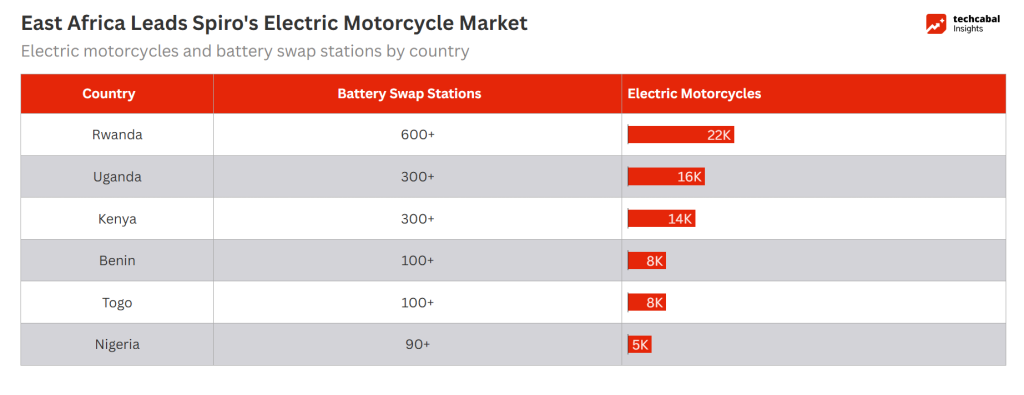
By the close of 2025, electric mobility company Spiro had deployed approximately 22,000 electric motorcycles and over 600 battery-swapping stations in Rwanda, according to its inaugural Sustainability Report. In Nigeria—Africa's most populous nation and one of its largest motorcycle markets—the company had deployed only about 5,000 electric motorcycles.
The gap is stark. Rwanda, with roughly 13 million people, hosts more than four times as many Spiro motorcycles as Nigeria, whose population exceeds 200 million. Rwanda also ranks as Spiro's largest operation across its six African markets, ahead of Uganda's 16,000 bikes, Kenya's 14,000, and Togo and Benin, which each have approximately 8,000.
These figures provide a rare window into how one of Africa's largest electric motorcycle companies determines where to allocate capital. While investors often assume the continent's biggest motorcycle markets will attract the largest electric vehicle (EV) fleets first, Spiro's footprint points to a different calculus—one that weighs government policy, infrastructure readiness, manufacturing capability, and the economics of battery swapping alongside raw demand. The contrast carries weight beyond corporate strategy: motorcycle taxis underpin urban transport and employment for millions across African cities, meaning the pace and geography of electrification will shape livelihoods, urban air quality, and fuel-import dependency for years to come.
In an interview with TechCabal on Tuesday, Group Chief Executive Anant Badjatya said Rwanda's lead stems from a combination of earlier market entry, supportive government policy, and years of infrastructure investment.
A Tale of Two Markets
Rwanda was among Spiro's earliest African markets, with operations launching in 2023. Nigeria followed a year later. In a business that depends on batteries, swap stations, and assembly plants, a year's head start can prove decisive.
"Rwanda has also benefited from one of Africa's most supportive policy environments for electric mobility, particularly in Kigali, where government measures have accelerated EV adoption," Badjatya told TechCabal. "Combined with the country's size, this allowed us to scale infrastructure rapidly."
Rwanda's government has embraced electric mobility more decisively than most African peers, backing EV adoption with import duty relief and coordinated urban policy in Kigali, where authorities have mandated that 30% of public fleets go electric. That alignment, Badjatya argued, enabled Spiro to compress years of infrastructure build-out into a comparatively short runway.
Nigeria has demanded a fundamentally different approach. Rather than attempting to match the pace of its Rwanda expansion, Spiro has concentrated on building the industrial backbone required to support a far larger market.
"Nigeria is a different opportunity," Badjatya said. "It is a much larger and more complex market, so our strategy has been to build progressively, not only deploying motorcycles and infrastructure, but also investing in local assembly, battery recycling and industrial capabilities that will support long-term growth."
The sustainability report also reveals how Spiro allocates resources across markets. In Nigeria, approximately 574 staff support a fleet of 5,000 motorcycles—roughly one employee for every nine motorcycles. Rwanda, by comparison, has close to 1,200 employees and workers supporting 22,000 motorcycles, or about one for every 18 bikes.
That ratio reflects the different developmental stages of Spiro's operations. While Rwanda has reached a more mature deployment phase, the company says Nigeria has required heavier upfront investment in local assembly, battery recycling, and other industrial capabilities alongside the rollout of motorcycles and battery swap stations. The emphasis on building local assembly and recycling capacity before scaling reflects a structural reality across many African EV markets, where reliance on imported vehicles and components has historically constrained both affordability and supply chain resilience.
Policy, Not Population
Badjatya was careful to frame Rwanda's advantage as a lesson in market conditions rather than a universally applicable model.
"I wouldn't describe it as what works or doesn't work," he said. "The fundamentals remain the same: reliable infrastructure, strong rider economics and a great customer experience. What Rwanda taught us is that when policy, infrastructure and economics align, adoption accelerates very quickly."
Nigeria has compelled Spiro to chart its own course. The company says differences in customer behaviour, riding patterns, and market dynamics made it impractical to transplant the model developed in Rwanda.
"Rather than exporting a Rwandan model, we are building a Nigerian one," Badjatya said. That has meant investing in local assembly, battery recycling, and second-life battery applications alongside motorcycles and swap stations, with the explicit goal of constructing industrial capacity before accelerating deployment.
Scaling What Comes Next
Rwanda, for now, remains Spiro's most mature market, and the company's next moves there suggest a shift from expanding coverage to expanding capacity. Spiro has introduced what it calls Mega Stations—high-throughput swap stations capable of serving more than 2,000 riders per day.
"As adoption grows, the focus is no longer just on adding stations, it's about increasing network capacity," Badjatya said.
Nigeria's next phase, he suggested, will follow a similar trajectory once its foundational work matures.
"Nigeria already has the fundamentals to become one of Spiro's largest markets," Badjatya said. "As we have done in Rwanda with our Mega Stations, we will continue investing in higher-capacity infrastructure alongside manufacturing and strategic partnerships."
Asked whether structural barriers were holding Nigeria back, he was direct: "I don't see structural barriers preventing Nigeria from reaching Rwanda's scale. Rather, it is following its own development path."
Spiro's ambitions extend well beyond its current six markets. Badjatya said Cameroon and Tanzania are already scaling, and the company is preparing to enter Ethiopia, Malawi, Mali, and the Democratic Republic of Congo—part of a plan to eventually operate in roughly 20 African markets. Site selection, he said, comes down to where "mobility demand, supportive policy, rider economics and infrastructure opportunities come together," alongside industrial potential and the ability to build a dense battery-swapping network.
Rwanda has demonstrated that market size alone does not determine where electric mobility scales fastest. Policy, infrastructure, rider economics, and long-term industrial investment may matter just as much.
