Shopify Q2 2026 Earnings: 34% Revenue Growth and AI Momentum Reshape the SHOP Stock Story
Key Takeaways
- •Shopify's Q2 2026 revenue grew 34% to $3.583 billion, surpassing the $3.45 billion analyst estimate cited by Reuters.
- •Gross merchandise volume increased 32% year over year to $115.567 billion, reflecting accelerated merchant sales across the platform.
- •AI-driven traffic and orders both tripled during the quarter, with daily active merchants using the Sidekick assistant rising 3.6 times year over year.
- •Operating income climbed 68% to $488 million, indicating strong operating leverage as expense growth remained well below revenue growth.
- •Shopify guided for Q3 revenue growth in the low-30% range, exceeding the 26.3% analyst consensus compiled by LSEG.
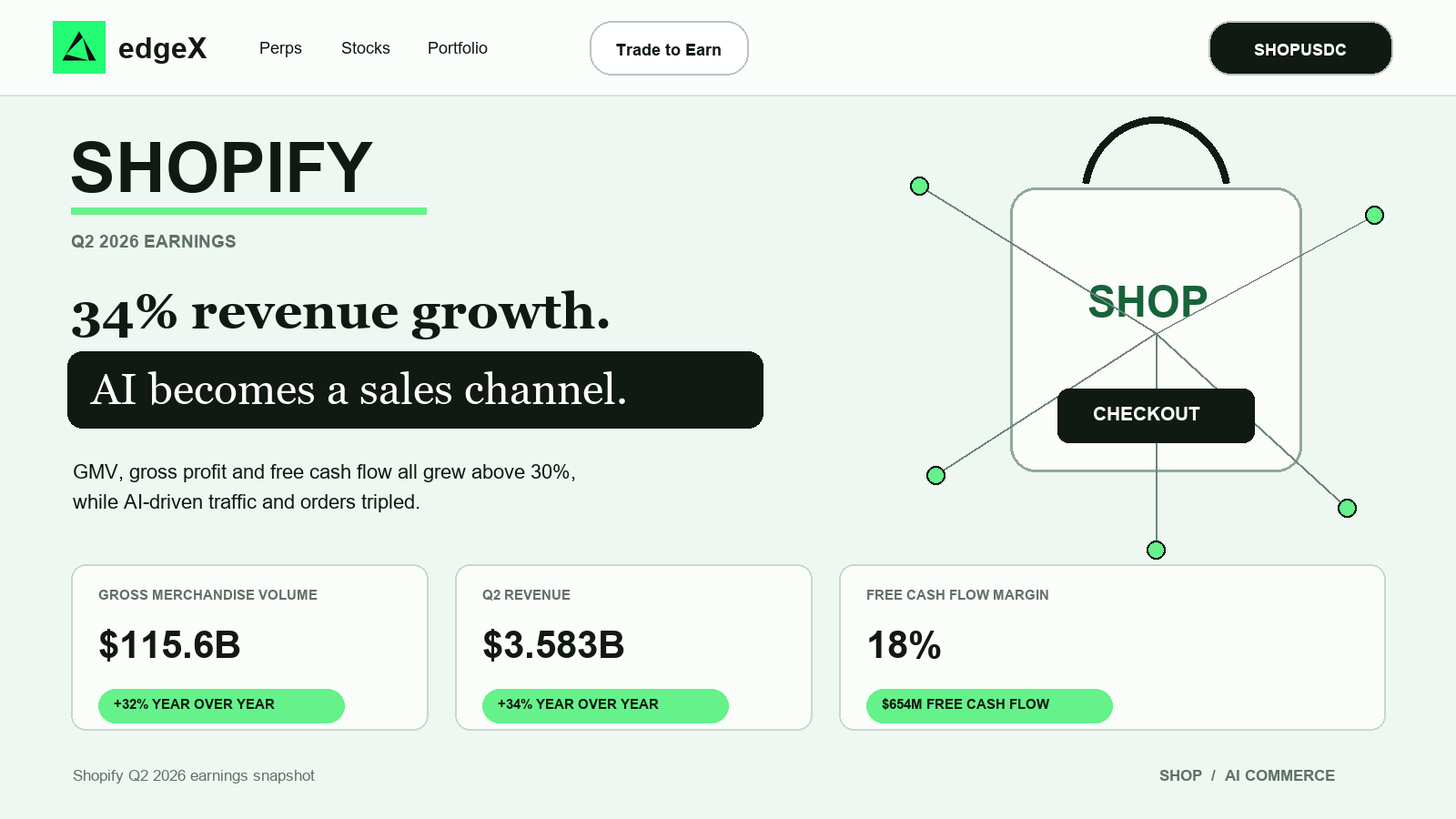
Shopify Q2 2026 Earnings at a Glance
The headline figures showed broad-based growth rather than a single product carrying the result. GMV accelerated across merchant sizes, channels and geographies, while both major revenue streams expanded by more than 20%.
| Metric | Q2 2026 | Investor Interpretation |
|---|---|---|
| Gross merchandise volume | $115.567B, up 32% | Merchant sales accelerated from an already strong comparison |
| Revenue | $3.583B, up 34% | Growth exceeded the $3.45B analyst estimate cited by Reuters |
| Subscription solutions revenue | $802M, up 22% | MRR and platform adoption supported recurring revenue |
| Merchant solutions revenue | $2.781B, up 37% | Payments and transaction-linked services drove the majority of growth |
| Gross profit | $1.708B, up 31% | Dollar growth remained strong despite a modest margin decline |
| Operating income | $488M, up 68% | Expense growth stayed well below revenue growth |
| Free cash flow | $654M; 18% margin | Cash generation improved alongside continued AI investment |
The year-over-year comparison is strong on its own, but the mix matters. Merchant solutions represented nearly 78% of revenue, tying more of Shopify's economics to payment volume, transaction activity and merchant success. That model can compound rapidly when GMV rises, but it also gives consumer demand and commerce cycles greater influence over results.
GMV and Merchant Solutions Remain the Economic Engine
GMV rose to $115.567 billion from $87.837 billion a year earlier. That 32% increase matters because it exceeded revenue growth in many mature commerce businesses and showed that Shopify was gaining activity at scale rather than relying only on price increases.
Merchant solutions grew faster than the platform
Merchant solutions revenue increased 37% to $2.781 billion. This category includes payment processing and other transaction-linked services, so its expansion reflects both merchant sales and Shopify's ability to attach more services to that activity.
The result strengthens Shopify's operating-system thesis. A merchant may begin with a storefront subscription, but the larger opportunity lies in checkout, payments, capital, shipping, cross-border tools, point of sale and other services used as the business grows. Each additional product can deepen the relationship and increase revenue without requiring Shopify to acquire the merchant again.
There is a trade-off. Merchant solutions generally carry a lower gross margin than subscription software because payment processing and fulfillment-related services have direct costs. Revenue can therefore grow faster than gross profit even when the business is healthy. That is exactly what happened in Q2: revenue rose 34%, while gross profit increased 31%.
Subscription growth supplied a recurring base
Subscription solutions revenue rose 22% to $802 million, while monthly recurring revenue increased to $221 million from $185 million. The subscription business is smaller than merchant solutions, but it remains strategically important because it captures the installed merchant base and provides a recurring foundation beneath transaction-sensitive revenue.
Investors should watch whether MRR growth continues to support the broader ecosystem as Shopify expands into larger merchants, business-to-business commerce and more international markets. Strong GMV without durable merchant retention would weaken the compounding argument. Q2 showed both transaction growth and a larger recurring base.
AI Shifted From Competitive Threat to Distribution Channel
The most important narrative change came from AI-assisted commerce. Reuters reported that traffic and orders attributed to AI both tripled during Q2. Daily active merchants using Sidekick, Shopify's AI assistant, increased 3.6 times year over year.
Agentic discovery can expand the merchant funnel
Shopify's partnerships with OpenAI and Google can help merchants surface products inside conversational search and chatbot experiences. That is especially relevant for smaller brands, which often lack the marketing budgets and data advantages of large retailers. If AI tools lower the cost of product discovery, Shopify's merchant base could receive incremental traffic that would otherwise be difficult to capture.
The strategic advantage is not merely owning a chatbot. Shopify already has product catalogs, merchant identities, inventory, checkout infrastructure, payment relationships and order data. Those components can make it an execution layer when an AI agent moves from recommending a product to completing a transaction.
That position is still being tested. Traffic and order growth do not reveal how much volume is incremental, how conversion compares with conventional search, or whether AI platforms will demand a larger share of transaction economics. The next phase requires Shopify to demonstrate that agentic commerce improves merchant outcomes while preserving its own take rate and customer relationship.
AI costs remain part of the margin equation
Reuters noted investor concern about AI-token and cloud-infrastructure costs. More use of Sidekick and agentic tools can increase demand, but it can also raise the cost of serving merchants. Shopify must turn AI engagement into enough GMV, retention or higher-value services to cover that infrastructure burden.
The quarter provided encouraging evidence without settling the issue. Gross-profit dollars rose 31%, operating income increased 68% and free cash flow expanded, indicating that AI investment did not prevent operating leverage. Gross margin, however, was approximately 47.7%, down from roughly 48.6% a year earlier as merchant solutions became a larger part of the mix.
Operating Leverage Improved the Quality of Growth
Operating income rose to $488 million from $291 million, substantially faster than revenue. Free cash flow increased to $654 million from $422 million, and the margin expanded two percentage points to 18%.
That combination is central to the SHOP stock case. High growth can command a premium when it produces cash rather than requiring continuously rising external investment. Q2 suggested Shopify can fund product development and AI infrastructure while still improving cash conversion.
Reported net income needs adjustment
GAAP net income was $1.502 billion, up from $906 million. That figure overstates the change in operating economics because Shopify recorded a $1.25 billion net gain on equity and other investments. Net income excluding the impact of equity investments was $439 million, compared with $338 million a year earlier.
Both figures are valid, but they answer different questions. GAAP income captures the full accounting result. The adjusted measure is more useful for judging the commerce platform's recurring earnings power because equity valuations can move independently of merchant demand, product execution or operating efficiency.
Q3 Guidance Raised the Growth Bar
Shopify expects Q3 revenue to increase at a low-30% year-over-year rate. Reuters said the outlook exceeded the 26.3% analyst estimate compiled by LSEG. Management also expects gross-profit dollars to grow in the mid-to-high 20% range, operating expenses to equal 33% to 34% of revenue and free-cash-flow margin to land in the high teens to low 20s.
The 18% rally reflected relief and higher expectations
Reuters reported that Shopify shares rose more than 18%, recovering most of their 2026 decline after the stock had been down 23.4% through the previous close. The reaction reflected more than a quarterly beat. Investors received evidence that AI was supporting demand, plus guidance implying that momentum could continue through the second half.
The same rally raises the burden of proof. SHOP now has to sustain fast growth while demonstrating that gross-profit expansion does not fall too far behind revenue. A company can deliver excellent operating results and still disappoint if valuation assumes an even stronger outcome.
This article does not state a live Shopify share price. Investors should verify the latest SHOP quote through Nasdaq, a broker or a real-time market-data service before making a decision.
The Bull Case, Bear Case and Middle Path for SHOP Stock
The bull case is that Shopify becomes the neutral commerce layer for websites, social platforms, physical stores and AI agents. Merchant growth, rising GMV and deeper payment penetration would reinforce one another, while AI lowers acquisition and operating costs for smaller brands. In that outcome, revenue can remain above 30% for longer than investors expect and cash margins can expand with scale.
The bear case is that the market extrapolates a powerful quarter too aggressively. Consumer spending can weaken, tariffs and cross-border friction can pressure merchants, AI platforms may capture more of the customer relationship, and infrastructure costs may limit margin expansion. A merchant-solutions-heavy mix also means gross profit may continue growing more slowly than revenue.
The middle path is a durable high-growth platform with uneven quarterly margins. Shopify can benefit from AI-assisted discovery and gain commerce share without becoming the sole infrastructure winner. Under that scenario, business execution remains strong, but shareholder returns depend heavily on valuation and the pace at which free cash flow catches up with expectations.
What Shopify Investors Should Watch Next
The next report should be judged against connected operating signals: revenue growth in the low 30s, gross-profit growth in the mid-to-high 20s, operating expenses at 33% to 34% of revenue and a high-teens to low-20s free-cash-flow margin.
Beyond guidance, investors should track AI-attributed traffic and orders, Sidekick adoption, merchant-solutions growth, MRR, payment penetration and international GMV. The strongest confirmation would be continued GMV acceleration alongside stable or improving gross margin. The clearest warning would be rising AI engagement without corresponding merchant sales or cash generation.
Q2 changed the SHOP debate because it connected AI usage with commerce outcomes. The next challenge is to prove that the connection can scale without surrendering economics to infrastructure providers or new distribution platforms.
Frequently Asked Questions
When did Shopify release its Q2 2026 earnings?
Shopify released its second-quarter results on August 5, 2026. The reported quarter ended June 30, 2026.
What was Shopify's Q2 2026 revenue?
Shopify reported revenue of $3.583 billion, up 34% from $2.680 billion a year earlier.
How much GMV did Shopify process?
Gross merchandise volume reached $115.567 billion, up 32% year over year from $87.837 billion.
How did Shopify's AI activity change during the quarter?
Reuters reported that AI-driven traffic and orders both tripled. Daily active merchants using Shopify's Sidekick assistant increased 3.6 times year over year.
What is Shopify's Q3 2026 outlook?
Management expects low-30% revenue growth, mid-to-high-20% gross-profit-dollar growth, operating expenses equal to 33% to 34% of revenue and a high-teens to low-20s free-cash-flow margin.
Why did Shopify stock rise after earnings?
Reuters reported that the shares gained more than 18% after Q2 revenue and profit exceeded expectations and Q3 guidance came in above the analyst forecast. Evidence that AI was generating traffic and orders also reduced concern that generative AI would disrupt Shopify's platform.
Is the SHOP share price in this article live?
No. Verify the latest SHOP quote through Nasdaq, a broker or a real-time market-data page before making a trading decision.

