SEC to Review 24-Hour Trading Proposals for U.S. Stock Markets
Key Takeaways
- •The SEC will hold a roundtable on September 17, 2026, to evaluate the operational and regulatory implications of adopting 24-hour U.S. stock trading.
- •NYSE Arca and Nasdaq are each targeting 23-hour weekday trading schedules, with Nasdaq planning a launch date of December 6, 2026.
- •Cboe has proposed near 24/5 trading but is still awaiting formal SEC approval to proceed.
- •Blue Ocean ATS has provided overnight U.S. stock trading since 2021, and Robinhood introduced 24/5 trading for select stocks in 2023.
- •The SEC's review will focus on critical areas such as overnight liquidity, clearing and settlement infrastructure adequacy, and investor protection measures.
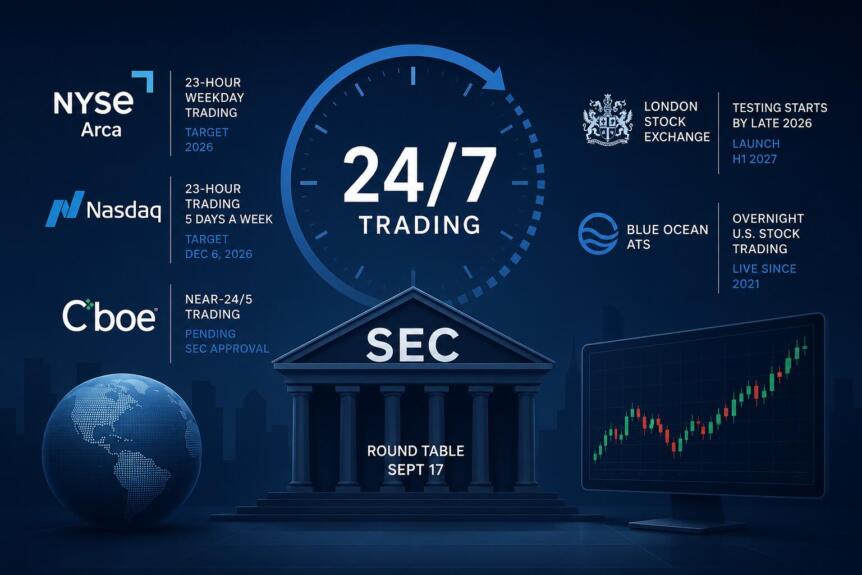
The U.S. Securities and Exchange Commission (SEC) is preparing to formally evaluate the future of extended stock market hours, a move prompted by multiple national exchanges advancing plans to implement near round-the-clock trading operations. According to a post shared by Coin Bureau on the social media platform X, the SEC will host a roundtable meeting on September 17, 2026, specifically dedicated to discussing the widespread implications of establishing 24-hour trading across American financial markets.
SEC Plans Roundtable on Extended Trading Hours
Citing Coin Bureau, reports indicate that the SEC intends to use the upcoming roundtable to deliberate on the potential adoption of continuous, 24-hour trading for U.S. stock exchanges. Scheduled for September 17, the event will center on the operational and infrastructural impacts such a massive transition would entail for the financial industry.
The regulator's decision to host this discussion stems from mounting interest among major exchanges to expand their daily operating hours. While the SEC has not yet green-lit a sweeping, nationwide conversion to 24-hour trading, the upcoming meeting clearly indicates that regulatory bodies are actively assessing the feasibility of various exchange proposals. Key areas of focus are expected to include liquidity conditions during overnight sessions, the adequacy of clearing and settlement infrastructure, and investor protection measures—concerns that have historically accompanied any expansion of trading windows. The U.S. transition to T+1 settlement, completed in May 2024, underscored the operational complexities involved in recalibrating core market plumbing.
Major Exchanges Advance Extended Trading Plans
Several prominent financial exchanges have already detailed their specific strategies for extended operations:
- NYSE Arca aims to implement 23-hour weekday trading, targeting a full rollout in 2026.
- Nasdaq is preparing to launch its own 23-hour trading schedule starting December 6, 2026.
- Cboe plans to introduce nearly 24/5 trading, an initiative that currently awaits formal approval from the Securities and Exchange Commission.
Beyond the United States, international markets are actively pursuing similar updates. The London Stock Exchange intends to begin trials for extended trading hours by the close of 2026, with plans for a broader, more comprehensive implementation during the first half of 2027.
Blue Ocean ATS Pioneers Overnight Trading
In contrast to the ongoing planning and proposal phases of traditional exchanges, Blue Ocean ATS has successfully offered overnight U.S. stock trading to its users since 2021. The firm's active platform demonstrates that extended trading systems are already operational, though they currently cater to a distinct category of market participants and brokerages. Retail-facing platforms have also moved in this direction—Robinhood launched 24/5 trading for select stocks in 2023, indicating that demand for nontraditional hours has already reached individual investors.
As a growing number of exchanges submit applications to prolong their trading sessions, market participants will gain increased flexibility to respond to global news and economic events outside of traditional hours. Nonetheless, any permanent, widespread implementation will depend entirely on regulatory outcomes stemming from the SEC's evaluation process.
Crypto Markets Highlight Demand for Continuous Trading
Since their inception, cryptocurrency markets have functioned on a 24/7 basis, operating entirely without conventional market hours, weekend closures, or trading halts. The current propositions from legacy financial exchanges point toward a broader industry aspiration to provide equity traders with similar around-the-clock flexibility.
For now, the SEC's upcoming September roundtable marks a pivotal step in deciding how extended trading hours can be seamlessly and safely integrated into the broader American financial framework. Any eventual modifications to official market hours will require formal regulatory authorization before taking effect.

