Ryder's Second-Quarter Earnings Lifted Again by Used Vehicle Sales
Key Takeaways
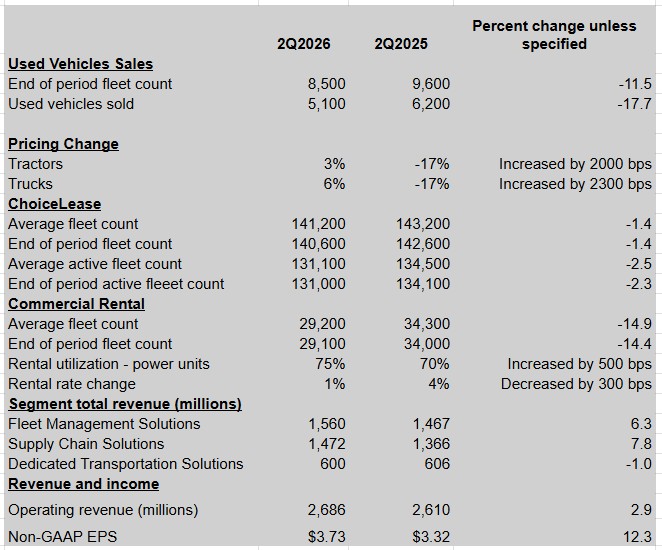
- •Ryder’s second-quarter non-GAAP EPS rose 12% from a year earlier to $3.73, modestly topping Wall Street consensus of $3.69.
- •The company lifted its 2026 non-GAAP EPS guidance to $14.40–$14.80 and raised its return on equity forecast to 18%.
- •Fleet Management Solutions operating revenue increased 1% sequentially to $1.303 billion, slightly above Citi’s consensus estimate.
- •Ryder now expects about $40 million in full-year gains from used vehicle sales, roughly $10 million higher than its prior forecast.
- •Commercial rental fleet size declined from a year earlier, but utilization improved by 5 percentage points to 75%.
Ryder System (NYSE: R) delivered a solid but unspectacular second-quarter performance, accompanied by enough optimism for the second half of 2026 that the company modestly raised its forecasts for several key financial metrics.
Earnings Beat Consensus Modestly
Non-GAAP earnings per share came in at $3.73, up 12% from a year earlier. Citi analyst Ariel Rosa noted that the firm's estimate was $3.71, slightly above Wall Street consensus of $3.69.
"It was a moderate quarter given the relatively in-line print and guides," Rosa said in a note published shortly after the earnings release but ahead of the company's conference call with analysts.
On a broad selloff day for U.S. equities, Ryder shares traded down approximately 3.55% — off $9.81 to $266.56 — as of about 2:40 p.m.
Ryder said in its earnings release that an unspecified but significant portion of the EPS improvement came from share repurchases. The company also pointed to higher earnings in its Fleet Management Solutions (FMS) segment, which houses its benchmark truck rental and leasing operations.
Fleet Management Solutions Performance
FMS operating revenue rose 1% sequentially to $1.303 billion, edging past Citi's consensus estimate of approximately $1.29 billion. The result was close enough to expectations that Citi described it as "in-line with our view that truck capacity reduction is providing some support."
However, Citi cautioned that a 15% reduction in average fleet size would constrain Ryder's ability to fully capitalize on a strengthening market. That makes utilization, pricing and fleet replacement decisions especially important for a business whose earnings can be affected both by rental demand and by the values realized when vehicles leave the fleet.
Raised 2026 Outlook
Ryder improved its full-year 2026 forecast across several metrics:
- Non-GAAP EPS guidance was tightened and raised to a range of $14.40–$14.80, compared with the prior range of $14.05–$14.80 issued in the first quarter.
- Return on equity is now projected at 18%, up from a previous range of 17% to 18%.
- Operating revenue growth remains projected at 3%, "primarily driven" by the Supply Chain Services (SCS) contract logistics segment.
- Net cash and free cash flow projections were unchanged at $2.7 billion and $700–$800 million, respectively.
The unchanged cash flow outlook keeps the emphasis on the quality of Ryder's earnings mix rather than only on the EPS guide, particularly because management cited share repurchases and used vehicle gains as contributors to the quarter's performance.
Used Vehicle Sales Remain a Key Profit Driver
Ryder has worked for years to diversify its business, in part to reduce its earnings dependence on used vehicle sales. Nevertheless, those sales remain a significant variable for profitability and were a clear tailwind in the second quarter, just as they were highlighted as a key driver in the first quarter.
Average tractor sale prices rose 3% year over year, while truck prices increased 6% year over year. On a sequential basis, used tractor sales prices were up 6% — matching the level recorded in the fourth quarter and making the first-quarter downturn appear to be an outlier.
The most important takeaway from the used tractor sales data in the $R quarterly earnings is that used tractor sales were up 6% sequentially. The first quarter downturn now looks like an outlier. The 6% sequential number is what was recorded in the fourth quarter also. — John Kingston (@JohnHKingston), July 23, 2026
The company sold 5,100 used vehicles in the second quarter, down from 6,200 in the same period a year earlier but up sequentially from 4,600 in the first quarter of 2026.
"In used vehicle sales, results outperformed our expectations as market conditions continued to strengthen," CEO John Diez said in the earnings report.
Selling Above Booked Residual Values
The financial impact of used vehicle sales is reported as a cost center in Ryder's financials. For the second quarter, the used vehicle sales net figure was negative $7 million — a positive outcome for the company's cost structure. That compared with plus $2 million in the year-ago quarter and negative $12 million in the first quarter of 2026.
Used vehicle pricing boosts Ryder's bottom line when vehicles sell above the residual value the company has booked for depreciation. CFO Cristina Gallo-Aquino told analysts on the conference call that this dynamic — pricing exceeding residual value estimates — continued to prevail.
Gains on used vehicle sales are now expected to total approximately $40 million for the full year, an increase of roughly $10 million from the prior forecast. Gallo-Aquino said Ryder anticipates about $500 million in proceeds from used vehicle sales for the year, which she described as "in line" with what the company collected in 2025.
Looking ahead, Diez said Ryder expects improvement in the second half, "and certainly going into 2027, we would expect year over year that pricing will continue to accelerate into that double digit range."
Operational Metrics Show Mixed Trends
Several operational indicators showed Ryder operating more efficiently on either a year-over-year or sequential basis, even as fleet counts declined.
For commercial rentals, the average fleet count stood at 29,200 units, down from 34,300 a year ago and from 30,500 in the first quarter. However, utilization improved by 5 percentage points year over year, reaching 75%.
In the SCS segment, the average number of customer vehicles under Select Care contracts rose to 44,300, up from 43,000 a year earlier and 43,900 in the prior quarter. The contrast between a smaller rental fleet and higher Select Care activity underscores the mixed operating backdrop: Ryder is seeing stronger utilization and service demand in some areas while still carrying less rental capacity than it did a year ago.
EPA Nitrogen Oxide Rules and OEM Pricing
Analysts questioned management about the upcoming 2027 Environmental Protection Agency emissions standards, which impose tighter limits on nitrogen oxide (NoX). The rule recently underwent revisions, though the changes were not as sweeping as some had anticipated.
The question of how these regulatory shifts affect capital expenditure planning has surfaced across the trucking industry, not only for Ryder. For Ryder, OEM pricing matters because higher equipment costs can influence lease pricing, customer discussions and the timing of fleet investment decisions.
Diez said Ryder is awaiting guidance from truck manufacturers before adjusting its plans. "I think we're still sitting on the fact that we're waiting for the OEMs to reveal what the price increases are going to be for the second half," he said. "Until we get that information from the OEMs, we won't be able to pass that along to our customers."
Diez indicated he does not expect dramatic changes. "I don't think it is going to be dramatically different than what we've been planning for, which is the fact that we're still expecting significant increases to not only deal with the EPA regulatory change, but also with some of the inflation and tariff-related activity that the OEMs are looking to pass on to the customers," he said. "We'll probably have more clarity in the third quarter."
Driver Capacity Tightening
When asked about securing drivers for Ryder's Dedicated Transportation Solutions segment, Diez pointed to signs of tightening.
"We are seeing evidence of tighter driver capacity," he said. "We are seeing the number of days that it takes to find drivers has ticked up a little bit."
That tightening is also reflected in the company's order pipeline. "Our pipeline shows that," Diez said. "Our sales activity shows that. So I would suspect we're going to continue to see good strong sales here for the balance of the year."

