Philippine Vehicle Sales Fall 8% in June Amid Weak Demand; EV Segment Surges
Key Takeaways
- •Philippine vehicle sales declined 8% year-on-year in June to 37,231 units, pulling first-half sales down 11.4% to 204,557 units.
- •Electric vehicle sales surged 132.7% in the first half to 31,381 units, with battery EV sales alone soaring 256.8% year-on-year.
- •Analysts attributed the year-on-year decline to high borrowing costs, consumer caution, and geopolitical uncertainty affecting big-ticket purchases.
- •Toyota Motor Philippines retained its market leadership through June with 100,909 units sold, despite a 9.3% sales decline.
- •Industry executives expect a modest sales recovery in the second half, driven by new EV and ICE model introductions alongside potential easing of interest rates.
By Beatriz Marie D. Cruz, Senior Reporter
Philippine vehicle sales declined 8% year on year in June, pulling first-half sales 11.4% lower as weak demand continued to weigh on the market, according to industry data.
A joint report by the Chamber of Automotive Manufacturers of the Philippines, Inc. (CAMPI) and the Truck Manufacturers Association (TMA) showed auto sales fell to 37,231 units in June, down from 40,483 units in the same month a year earlier. On a month-on-month basis, however, total sales rose 11% from 33,532 units in May. June's vehicle sales were the highest since December's 42,870 units, and the 8% annual decline was the smallest contraction since February's 6.6% drop.
Including other industry data, CAMPI said total vehicle sales reached 42,000 units in June, representing an 18.7% increase from the prior month.
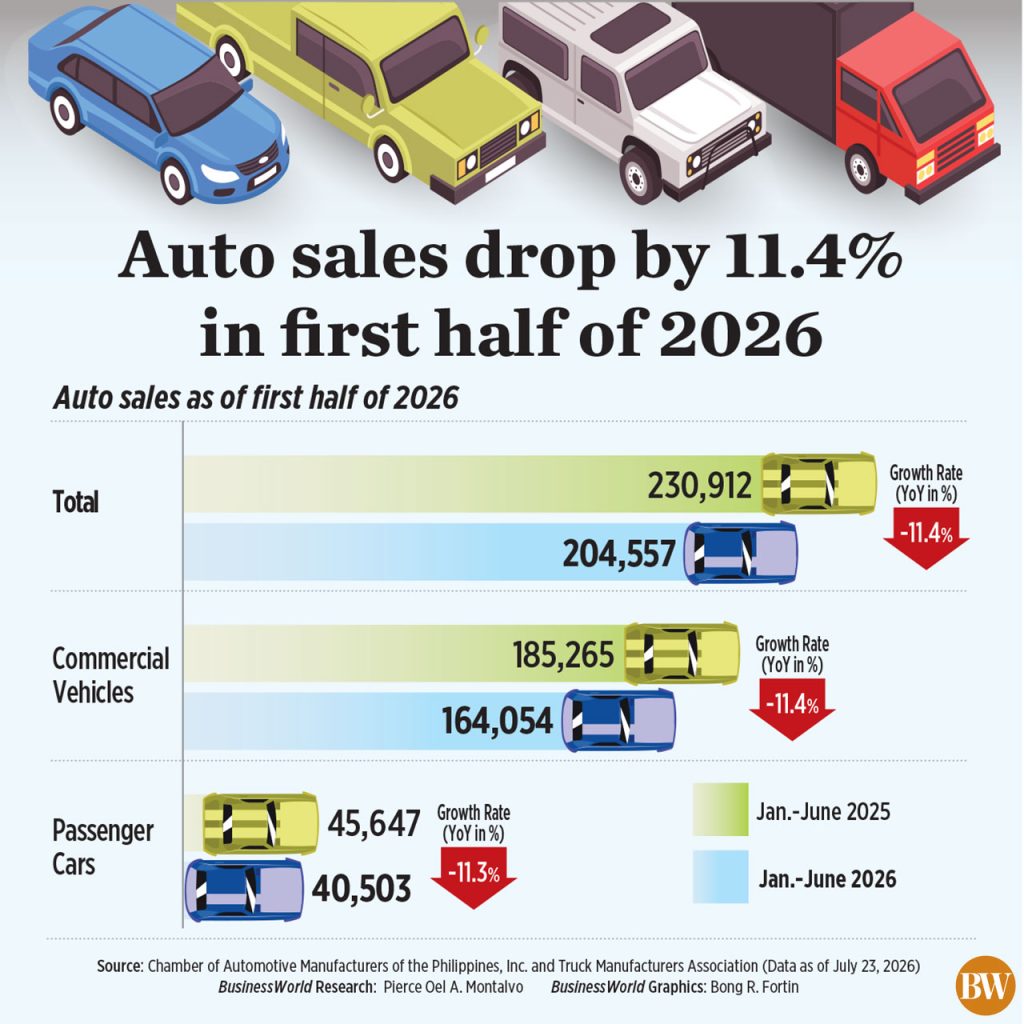
For the January-to-June period, combined vehicle sales fell 11.4% to 204,557 units from 230,912 units a year ago. Passenger car sales dropped 11.3% to 40,503 units, while commercial vehicle sales slipped 11.4% to 164,054 units, with declines across all segments. The Philippine auto market is one of Southeast Asia's smaller volumes compared with regional neighbors such as Indonesia and Thailand, which each see monthly sales in the tens of thousands, making the country's trajectory a useful gauge of consumer demand in a consumption-driven economy where household spending accounts for roughly 70% of GDP.
In a statement on Thursday, CAMPI President Jose Maria M. Atienza said he expects vehicle sales to improve in the second half of the year, citing the entry of new electric vehicle (EV) and internal combustion engine (ICE) models into the market.
In June, passenger car sales — which accounted for 21.65% of industry sales — rose 16.5% year on year to 8,061 units, up from 6,922 units a year earlier. Month on month, passenger car sales jumped 20.5% from 6,692 units.
Commercial vehicle sales, representing 78.35% of the total, fell 13.1% year on year to 29,170 units from 33,561 units. On a monthly basis, commercial vehicle sales rose 8.7% from 26,840 units.
Within the commercial vehicle segment, light commercial vehicle sales declined 14.9% year on year to 21,709 units, while Asian utility vehicle (AUV) sales slid 5.4% to 6,812 units. Light-duty truck sales fell 31.8% to 363 units, and medium-duty truck sales dropped 20.7% to 215 units. Heavy-duty truck sales, however, increased 22.4% to 71 units.
John Paolo R. Rivera, senior research fellow at the Philippine Institute for Development Studies, attributed the June year-on-year decline to high borrowing costs and geopolitical uncertainty, which have made households more cautious about discretionary spending. The Bangko Sentral ng Pilipinas held its benchmark interest rate at a multiyear high through the first half of the year following an aggressive tightening cycle to curb inflation, keeping auto financing costs elevated.
"The annual decline likely reflects a higher base last year, continued caution among consumers amid elevated borrowing costs and living expenses, and some uncertainty affecting big-ticket purchases," he said in a Viber message.
Rivera noted that the month-on-month improvement was likely driven by midyear promotions from car companies and improved vehicle availability. For the second half, he expects modest sales growth, though global uncertainties may continue to weigh on consumer confidence and financing conditions.
"For the rest of 2026, car sales are likely to post modest growth, supported by easing inflation, a gradually improving interest rate environment, and sustained economic activity," Mr. Rivera said.
Jonathan L. Ravelas, senior adviser at Reyes Tacandong & Co., said he anticipates a gradual recovery in auto sales for the remainder of the year.
"Looking ahead, lower inflation, easing interest rates, and steady remittances should support a gradual recovery in auto sales during the second half, although buyers will likely remain price-sensitive amid renewed geopolitical risks," he said in a Viber message. Remittances from overseas Filipinos, which typically total over $30 billion annually and are a pillar of household consumption, have remained resilient even amid global headwinds.
EV Sales Surge
Meanwhile, EV sales remained strong in June as supply grew more stable, Mr. Atienza said.
According to CAMPI and TMA data, total EV (xEV) sales more than doubled to 6,995 units in June from 3,057 units in the same month last year. The segment — which includes battery EVs (BEVs), plug-in hybrid EVs (PHEVs), and hybrid EVs (HEVs) — also posted a 16% month-on-month increase from 6,032 units sold in May. The growth comes as the Philippines continues to implement the Electric Vehicle Industry Development Act, enacted in 2022, which mandates EV procurement across government fleets and lays out fiscal and non-fiscal incentives for the sector.
For the January-to-June period, xEV sales surged 132.7% to 31,381 units from 13,488 units a year earlier.
BEVs accounted for nearly half of June xEV sales at 3,193 units, up 383.8% year on year. First-half BEV sales reached 8,702 units, soaring 256.8% from the year-ago period.
PHEV sales skyrocketed 3,902.4% to 1,681 units in June, bringing the six-month total to 5,531 units — a 3,356.9% year-on-year increase. HEV sales, by contrast, fell 9.9% in June to 2,121 units, though first-half HEV sales still rose 57.5% to 17,148 units.
Market Leaderboard
Toyota Motor Philippines Corp. retained its position as market leader as of end-June, even as sales declined 9.3% to 100,909 units. Mitsubishi Motors Philippines Corp. ranked second with a 17.5% sales drop to 36,321 units. Suzuki Phils., Inc. placed third despite a 13.7% decline to 9,262 units. Ford Motor Company Phils. Inc. took fourth, with sales down 32.1% to 7,435 units, followed by Nissan Philippines, Inc. in fifth, where sales fell 41.6% to 6,921 units.

