Marten Transport Reports Firmer Reefer Market in Second Quarter
Key Takeaways
- •Marten Transport reported second-quarter earnings per share of 7 cents on net income of $5.3 million, falling 1 cent below analyst consensus and 2 cents below the prior-year period.
- •Non-dedicated truckload revenue increased 9% year over year to $116 million, supported by a 9% rise in revenue per tractor and a 6% gain in revenue per loaded mile to $2.81.
- •The dedicated segment saw revenue excluding fuel decline 14% year over year, with its operating ratio deteriorating by 430 basis points to 95.4% as truck count fell 17%.
- •Companywide revenue of $224 million decreased 3% year over year and missed consensus estimates by $4 million, partly due to an $11.7 million revenue headwind from the 2025 sale of its intermodal unit to Hub Group.
- •Marten maintained a debt-free balance sheet during the quarter while generating $61 million in operating cash flow for the first half of the year.
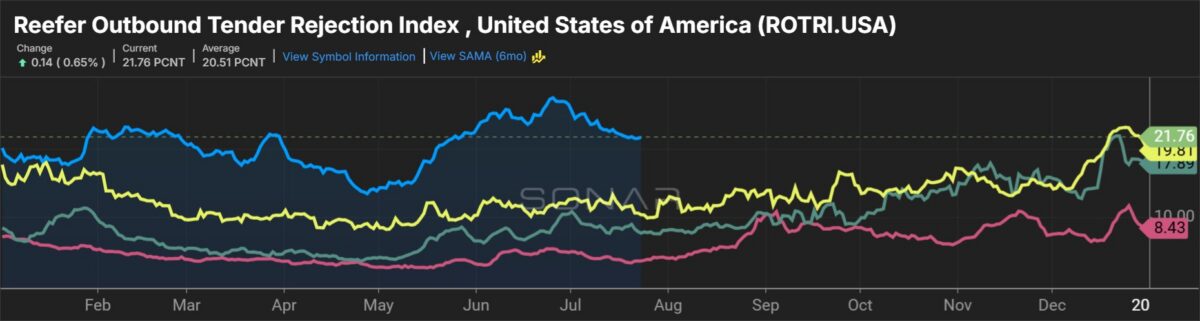
Refrigerated carrier Marten Transport said truckload fundamentals strengthened materially in the second quarter, pointing to a tighter capacity environment that is allowing the company to be more selective with freight and increase rates.
The company reported its second-quarter results Thursday after the market closed. Marten Transport, based in Mondovi, Wisconsin, does not hold a quarterly earnings call.
“The freight market has sharply tightened in recent months and is now breaking out from the longest freight market recession on record,” CEO Randy Marten said in a news release. That downturn, which began in 2023 following a pandemic-era surge in carrier capacity, pushed numerous small fleets out of the market and depressed rates industrywide. Marten said a regulatory crackdown is “contracting meaningful levels of freight capacity by removing noncompliant and unqualified drivers.”
Revenue from Marten’s (NASDAQ: MRTN) non-dedicated truckload fleet rose 9% year over year to $116 million. Excluding fuel surcharges, revenue was flat at $93 million. The company recorded an 8% decline in average tractors in service, which was offset by a 9% increase in revenue per tractor.
Like many large carriers, Marten has been managing truck counts in an effort to improve asset utilization. Revenue per loaded mile in the non-dedicated truckload unit increased 6% year over year to $2.81. The segment reported a 97.4% operating ratio, excluding fuel, an improvement of 10 basis points from the prior-year period. Operating ratio measures operating costs as a percentage of revenue, so lower figures indicate stronger profitability.
Marten’s smaller dedicated segment reported a 14% year-over-year decline in revenue, excluding fuel. A 17% reduction in truck count was only partly offset by a 3% increase in revenue per tractor. Revenue per loaded mile declined 5% year over year to $2.36. The unit posted a 95.4% operating ratio, excluding fuel, which was 430 basis points worse than a year earlier.
Brokerage revenue was unchanged year over year at $40 million. A 2% increase in loads was offset by a 2% decline in revenue per load. The brokerage segment’s operating ratio deteriorated 160 basis points to 94.8%, though that performance compares favorably with other similar brokerages. Third-party capacity buy rates, or purchased transportation costs, are much higher than existing sell rates on contractual business because of the rapid increase in the broader spot market. That mismatch typically compresses brokerage margins when contracts were priced before the tightening, while asset-based carriers stand to benefit as contractual rates reset higher on renewals.
Companywide revenue was $224 million, down 3% year over year and $4 million below the consensus estimate. Revenue excluding fuel surcharges declined 9% year over year. The 2025 sale of Marten’s intermodal unit to Hub Group (NASDAQ: HUBG) created an $11.7 million revenue headwind during the quarter.
Marten reported earnings per share of 7 cents, with net income of $5.3 million. Earnings per share were 2 cents lower than a year earlier and 1 cent below consensus. The result included a 3-cent headwind from a $3.5 million year-over-year decline in gains on equipment sales.
Cash flow from operations totaled $61 million for the first half of 2026, down 12% year over year. Marten maintained a debt-free balance sheet during the quarter, providing financial flexibility relative to leveraged peers.
The company’s tractor fleet had an average age of 2.5 years, compared with 2.1 years in the year-ago period.
Shares of MRTN were down 2% in early trading Friday, while the S&P 500 was down 0.1%.
Marten Transport is widely viewed as a refrigerated pure play. It is the only publicly traded carrier focused on the reefer market, making its quarterly results a bellwether for the industry. The company’s second-quarter results indicated improving fundamentals in refrigerated freight, which primarily serves food, grocery, and pharmaceutical supply chains that historically exhibit steadier demand patterns than dry van freight.

