Why young women, once Lee's strongest base, are turning away
Key Takeaways
- •President Lee Jae Myung's approval rating among women in their 20s fell from 61 percent to 45 percent and among women in their 30s from 69 percent to 47 percent between July 2025 and July 2026, a steeper decline than his overall rating.
- •The government's decision to halve the mortgage loan cap from 600 million won to 300 million won has effectively priced many salaried first-time homebuyers out of neighborhoods they had been saving toward.
- •Critics have questioned President Lee's use of a seller-financing arrangement for his own Seongnam apartment sale, valued at 1.77 billion won, while simultaneously pushing policies that tighten mortgage access for ordinary buyers.
- •The DPK-led prosecution reform eliminated prosecutors' ability to conduct supplementary investigations of police cases, a power previously used to secure convictions in high-profile violent crimes such as the Busan roundhouse kick attempted rape-murder case.
- •Former supporters report a complete absence of policies addressing women's issues, which they attribute to the administration's fear of alienating young male voters in their 20s and 30s.
South Korea
Politics
Why young women, once Lee's strongest base, are turning away
Published Aug. 7, 2026, 7:00 a.m. KST
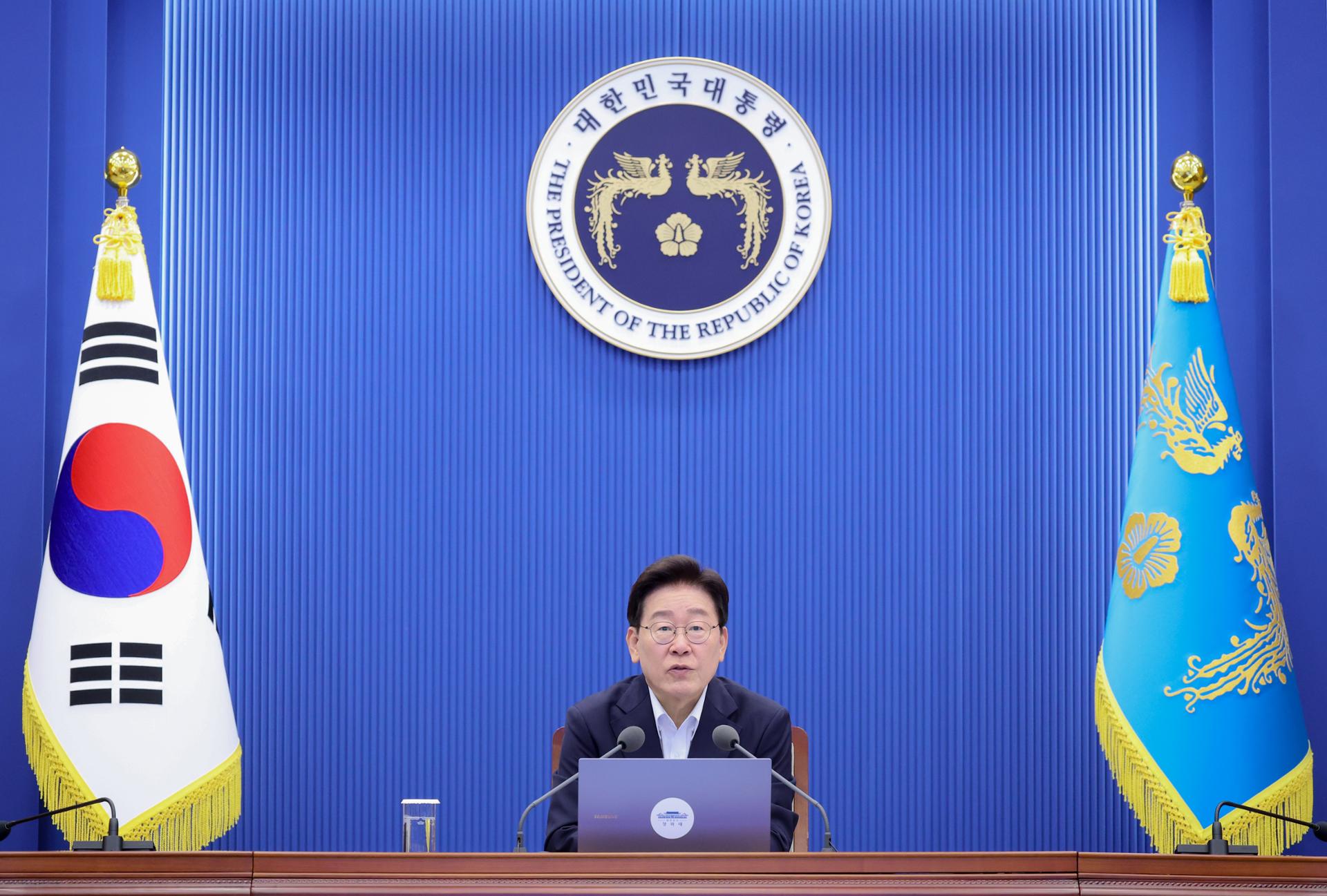
President Lee Jae Myung speaks during a senior presidential secretaries' meeting at Cheong Wa Dae in Seoul on Thursday. Joint Press Corps
Lee, a 32-year-old office worker in Seoul, spent years working and saving for one goal: buying her own apartment with a mortgage. She had finally reached that point when the government halved the loan cap from 600 million won to 300 million won.
"I've been working hard and saving up money and now that I was finally about to buy my own home with a mortgage, getting the loan cap cut in half is a huge blow to me," she said.
She had voted for President Lee Jae Myung, drawn by his hands-on administrative background as mayor of Seongnam, Gyeonggi Province, and later governor of Gyeonggi Province.
"I had high hopes for President Lee Jae Myung because he became president with hands-on administrative experience, unlike past leaders with a judiciary or legislative background," she said. "Watching the news about how he sold his own apartment in Seongnam makes it feel like double standards."
She no longer supports him.
Her case is not isolated. Many women in their 20s and 30s, a demographic that played a pivotal role in electing Lee, are withdrawing support for him and the ruling Democratic Party of Korea (DPK). Their frustration centers on housing policy, prosecution reform, the lack of policies on women's issues and internal party infighting.
In Seoul, where average apartment prices have long outpaced wage growth, mortgage loan ceilings are a lifeline for first-time buyers. Cutting the cap in half effectively prices many salaried workers out of neighborhoods they had been saving toward for years, making the policy's impact intensely personal for the demographic it hits hardest.
Sense of betrayal
For voters like the 32-year-old office worker, the mortgage cap cut felt like a personal betrayal from a president they had trusted because of his practical, ground-level experience.
The perception of double standards has been reinforced by scrutiny over the sale of Lee's Seongnam apartment, which was structured through a seller-financing arrangement. Under that deal, ownership was transferred to the buyer before the final payment was made in full, with a 1.77 billion won mortgage registered in the buyer's name to cover the remaining balance.
Critics have questioned why the president, who has pushed to tighten mortgage access for ordinary buyers, used a financing structure of his own to complete the sale. That criticism has become a recurring theme among former supporters who say real estate policy was their breaking point.
Other former supporters say the administration's push to strip prosecutors of supplementary investigative powers shows Lee is reforming the justice system to serve himself. The reform, long championed by the DPK as a check on an outsized prosecution service that previous conservative and progressive administrations alike had sought to rein in, eliminated prosecutors' ability to reopen and supplement police investigations — a power that had been used in several high-profile violent-crime cases.
"Public trust in the police is dropping, yet he's removing prosecutors from power just to evade his own legal punishment," said a 38-year-old office worker, a former dues-paying DPK member.
She cited the Busan roundhouse kick case, in which a supplementary prosecutorial investigation helped secure a 20-year sentence for attempted rape-murder, as an example of what could be lost.
"I feel so sorry for the potential victims who would not get a chance to get justice through supplementary prosecutorial investigation ... If things keep going like this, private vigilante justice is only going to surge," she said.
A 38-year-old office worker surnamed Yu pointed to a similar recent case, the Gwangju schoolgirl murder case, in which the suspect, the son of an active-duty police officer, allegedly attempted to cover up the crime.
"The DPK just got rid of [prosecutors' supplementary investigative authority] as if it doesn't care about the victim, by using its majority power at the Assembly," she said, adding that the party she once viewed as a champion of decency "is long gone."
Several former supporters also said the administration has largely avoided addressing gender-based violence and discrimination, a gap they attribute to political calculation. Gender policy has become one of the most polarizing fault lines in South Korean politics, with both major parties wary of alienating either young men or young women — groups that have diverged sharply in their policy priorities in recent election cycles.
"There is a complete absence of policies on women's issues. Women's issues were never brought to the forefront of their governance philosophy out of fear of losing young male voters in their 20s and 30s," said a 31-year-old office worker surnamed Lee.
"Beyond structural gender discrimination, violent crimes targeting women continue to occur, yet there is no visible determination to strengthen victim protection or crack down harder on offenders."
Warning sign
According to Gallup Korea polls, Lee's approval rating among women in their 20s stood at 61 percent in July 2025 and among women in their 30s at 69 percent. By July 2026, those figures had fallen to 45 percent and 47 percent, respectively, a steeper decline than Lee's overall approval rating, which dropped from 64 percent to 53 percent over the same period.
The DPK shows a similar trend. While the party's overall approval rating remained above 40 percent throughout the year, reaching 42 percent last month, down 3 percentage points from July 2025, support fell more sharply among women, dropping from 37 percent to 29 percent among those in their 20s and from 48 percent to 39 percent among those in their 30s.
The survey was conducted weekly among about 1,000 voters aged 18 and older nationwide, with results aggregated monthly. The margin of error was plus or minus 1.5 percentage points at a 95 percent confidence level.
Political commentator Lee Jong-hoon said the withdrawal of support from young women, once a key base for Lee, reflects long-simmering frustration that has intensified since the local elections.
"Since the Lee administration came to power — and particularly after the June 3 local elections — they've started pulling back or withholding their support ... Lately, it's been the internal party feuding — the rising conflict between the so-called pro-Lee faction and opposing factions," the commentator said.
"There is growing disappointment over the Lee administration driving through hardline policies without compromise; the Criminal Procedure Act amendment or real estate policy. I consider them the absolute core of the 'New Lee Jae Myung' supporter, so losing the primary base is a serious warning sign for the DPK."
