Korea Partners with U.S. to Train Shipbuilding Workforce Amid Severe Labor Shortage
Key Takeaways
- •Hanwha Ocean signed an MOU with Delaware County Community College to establish a shipbuilding instructor training program supported by $8 million in U.S. federal subsidies over four years, targeting up to 500 apprentices by next year.
- •Samsung Heavy Industries will partner with Vigor Marine Group to build a workforce development center equipped with VR/AR welding and painting training facilities near Vigor's shipyard.
- •The KUSPC plans to dispatch approximately 30 professional instructors from Korea to support U.S. shipbuilding workforce education programs through 2028.
- •Only four U.S. institutions offer naval architecture and ocean engineering departments, compared to Korea's sustained university pipeline that feeds engineering talent into its domestic industry.
- •Seoul National University is negotiating a credit recognition exchange program with San Diego State University that could send SDSU mechanical engineering students to study naval architecture in Korea as early as the fall semester next year.
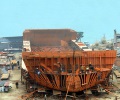
Korean shipbuilders and universities have launched initiatives to train shipbuilding workers in the United States, following the opening of the Korea-U.S. Shipbuilding Partnership Center (KUSPC) in support of the bilateral shipbuilding cooperation project known as MASGA. South Korea is one of the world's largest shipbuilding nations by order volume, and these partnerships represent an effort to transplant decades of accumulated Korean shipbuilding expertise into a U.S. industrial base that has atrophied since its mid-20th-century peak. The United States currently faces shortages of both shipyard production workers and research and development (R&D) personnel.
According to the shipbuilding industry on August 4, Korean shipbuilders announced a series of workforce training plans on March 23, coinciding with the opening of the KUSPC. The U.S. government had previously released the Maritime Administration's comprehensive strategy, the Maritime Action Plan (MAP), in February, designating shipbuilding as a core national security industry and identifying workforce development as one of its four key pillars. The strategy reflects broader U.S. concerns about the erosion of domestic maritime manufacturing capacity and the growing dominance of rival nations in global commercial shipbuilding.
Hanwha Ocean's Instructor Training Program
Hanwha Ocean will train instructors who will, in turn, directly teach future trainees. The company signed a memorandum of understanding (MOU) with Delaware County Community College (DCCC), located near Hanwha Philly Shipyard Inc. in Pennsylvania, to develop a shipbuilding instructor training program.
A Hanwha Ocean official stated: "We proceeded to develop an instructor training program based on the judgment that instructors must first be trained for the Korean shipbuilding technologies to be introduced going forward."
Hanwha Philly Shipyard Inc. and DCCC have been constructing a shipbuilding workforce training model since January of this year, supported by U.S. federal government subsidies totaling $8 million over four years. The initiative aims to train up to 500 apprentices by next year. A system linking trainees' on-site practicums with hiring is also under development.
Samsung Heavy Industries and Vigor Marine Partnership
Samsung Heavy Industries will jointly establish a workforce development center with advanced infrastructure alongside U.S. maintenance, repair, and overhaul (MRO) specialist shipbuilder Vigor Marine Group. Samsung Heavy Industries plans to build a training center near Vigor Marine Group's shipyard and will support virtual reality/augmented reality (VR/AR) welding and painting training programs.
The KUSPC also plans to operate and identify U.S. shipbuilding workforce education programs through 2028 and dispatch approximately 30 professional instructors from Korea.
U.S. Labor Shortage and Academic Gaps
The U.S. shipbuilding industry faces a severe labor shortage. According to consulting firm McKinsey & Company, major U.S. shipyards are struggling to secure sufficient skilled workers such as welders and electricians. There is also a shortage of graduates in related fields capable of conducting design research or building automation systems.
According to the National Center for Education Statistics (NCES) under the U.S. Department of Education, only four two-year and four-year institutions in the United States have naval architecture and ocean engineering departments: the University of New Orleans, the University of Michigan, the Naval Academy, and Webb Institute, a specialized college of naval architecture and ocean engineering. By contrast, Korean universities such as Seoul National University have maintained continuous naval architecture programs that feed a robust pipeline of engineering talent into the domestic industry.
Korean Universities Join the Effort
Korean universities will also participate in cultivating future talent in naval architecture and ocean engineering in the United States. The Seoul National University Department of Naval Architecture and Ocean Engineering is in discussions to establish a credit recognition exchange program with San Diego State University (SDSU) starting next year.
As early as the fall semester next year, SDSU mechanical engineering students will enroll at Seoul National University as exchange students. Seoul National University plans to offer core courses in naval architecture and ocean engineering, including fluid mechanics, structural mechanics, and production mechanics.
At SDSU, Professor Patrick Kwon, who became chair of the mechanical engineering department in 2024, is pursuing the establishment of a new naval architecture and ocean engineering program as well as cooperation with Korean corporations. Since March, SDSU has operated a joint research center with Samsung Heavy Industries, known as the SHI-SDSU Advanced Maritime Center.
Woo Jong-hun, a professor in the Seoul National University Department of Naval Architecture and Ocean Engineering, said: "Actually designing ships and building them is most important, but the United States has virtually no workforce, universities, or research institutions in this field."
Woo added: "For an industry to develop, undergraduate output and various research and development systems must be maintained. In Korea, diverse research is conducted up to shipbuilding production and design, and professional workers are produced, sustaining the industry. But in the United States, as universities declined, undergraduate output did not occur properly for a long period, and this has reduced the U.S. shipbuilding workforce."
Source: ChosunBiz

