South Korea's Industry Minister Warns Against Redistributing Chipmakers' Profits, Urges Reinvestment as China Narrows Tech Gap
Key Takeaways
- •Industry Minister Kim Jung-kwan stated that the government's claim on semiconductor profits should end with taxes and that record earnings should be reinvested into fabs and R&D rather than redistributed.
- •Kim warned that South Korea could lose its competitive edge in the global memory chip market within a year if chipmakers fail to accelerate investment.
- •China was identified as the most immediate competitive threat, with its reported development of a domestic DUV lithography system signaling a faster-than-expected narrowing of the technology gap with Korea.
- •Kim indicated that Seoul's priority in US trade negotiations is ensuring Korean companies are not placed at a competitive disadvantage relative to rivals, rather than simply securing a 15 percent tariff rate.
- •The minister dismissed concerns that Korea's regulatory response to the Coupang data breach could damage bilateral ties with the United States.
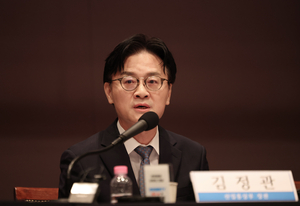
South Korea should not seek to redistribute the record profits earned by Samsung Electronics and SK hynix beyond the taxes they already pay, Industry Minister Kim Jung-kwan said Thursday, cautioning that the country risks losing its competitive hold on the global memory chip market within a year if investment does not accelerate.
Semiconductors are South Korea's largest export, and Samsung and SK hynix together account for a dominant share of the worldwide memory chip market, making the sector's competitiveness central to the country's trade-driven economy.
Speaking at a debate hosted by the Kwanhun Club, a senior journalists' association, in Seoul, Kim was direct: "The government's share should end with taxes. Semiconductors are the only strategic asset Korea has. This is not the time to divide the profits."
Kim emphasized that chipmakers must urgently reinvest their earnings into new fabrication plants, advanced manufacturing equipment, and next-generation research and development. He argued that even substantially greater government support would fall short given the scale and pace of global semiconductor competition.
"People say semiconductor companies are making a lot of money, but that can disappear in an instant," Kim said. "A single fab requires 150 trillion won ($105.8 billion) to 200 trillion won. The 800 trillion won project planned for the Honam region is essentially the cost of building four fabs, with that capital tied up for years."
The memory chip industry has historically been highly cyclical, with periods of oversupply erasing margins as quickly as boom cycles generate them, a pattern that underscores Kim's urgency.
The minister expressed concern over mounting competition from both the United States and China, each channeling enormous resources into semiconductors and artificial intelligence. The United States has committed tens of billions of dollars through the CHIPS and Science Act to expand domestic manufacturing, while China continues to direct state-backed funding toward achieving technological self-sufficiency. Kim identified China as the more immediate competitive threat.
While Chinese chipmakers still trail their Korean counterparts, state-backed investment and the reported development of a domestic immersion deep-ultraviolet (DUV) lithography system indicate the technology gap is closing more rapidly than anticipated, Kim said.
"The DUV development was shocking," he remarked. "My sense is that China is steadily advancing across semiconductor materials, components and equipment, step by step."
On trade negotiations with Washington, Kim said Seoul's objective extends beyond securing a headline tariff rate of 15 percent. The priority, he stressed, is ensuring Korean companies are not placed at a competitive disadvantage relative to major rivals, including Japanese firms. Japan has recently intensified its own semiconductor revival efforts, including support for domestic foundry ventures and tighter alignment with U.S. technology supply chain policy. He noted that the actual tariff burden also hinges on product coverage, exemptions, and other negotiated conditions.
Kim also addressed concerns raised in the United States regarding Korea's response to Coupang after the e-commerce company suffered a personal data breach. While acknowledging differences in tone between U.S. political circles and trade officials, he dismissed the notion that the dispute could strain bilateral ties.
"It is not an issue serious enough to shake the Korea-U.S. alliance," Kim said.
During the forum, the minister additionally discussed nuclear power, electricity grids, labor policy, and industrial restructuring.
The Kwanhun Club, an association of senior journalists founded in Seoul in 1957, regularly hosts debates featuring prominent government, political, and business leaders. Kim's appearance marked the first by an industry minister at the forum in 28 years, the last being then-Industry and Resources Minister Park Tae-young during the 1998 Asian financial crisis.
Source: Korea Herald Business
