Kaspa (KAS) Eyes Key Resistance as Toccata Upgrade Settles, Volume Weakens
Key Takeaways
- •The Toccata hard fork went live on Kaspa's mainnet on June 30, introducing KIP-16, KIP-17, KIP-20, and KIP-21, which add zero-knowledge verification and covenant programming capabilities to the network.
- •Kaspa's trading volume has declined 15.56% to $4.54 million, signaling limited fresh capital inflows despite the project's prominence among proof-of-work Layer-1 networks.
- •Broader market sentiment sits at 36 on the Fear & Greed Index, reflecting cautious conditions that make it difficult for Kaspa to mount an independent rally without a clear catalyst.
- •Kaspa is holding above its major support zone of $0.0270–$0.0275, with $0.0300 serving as the critical psychological resistance level that could determine whether the token breaks out or continues consolidating.
- •DAGKnight, Kaspa's next major consensus upgrade designed to improve upon GHOSTDAG by reducing confirmation times, remains in the research phase and could emerge as a future catalyst once implementation timelines become clearer.
Kaspa (KAS), the proof-of-work cryptocurrency built on the GHOSTDAG protocol that enables parallel block processing through its blockDAG architecture, is trading with a modest gain over the past 24 hours, slightly outperforming the broader cryptocurrency market, which rose 0.47% over the same period. Bitcoin's minor uptick provided the primary upward pressure on KAS and other altcoins, though Kaspa currently lacks a strong coin-specific catalyst. Traders are weighing whether the coming week will bring a breakout or continued consolidation.
Ecosystem Developments: Toccata Hard Fork and Beyond
Kaspa's price action remains closely correlated with Bitcoin's movements, a pattern that has persisted throughout July. The broader market sentiment sits at 36 on the Fear & Greed Index, reflecting cautious trading conditions and making it difficult for Kaspa to mount an independent rally without a clear catalyst.
Social sentiment around Kaspa registers as neutral-bullish with a net score of 5.09. Community discussions continue to focus on long-term accumulation and the project's underlying technology. However, trading volume has declined 15.56% to $4.54 million, indicating limited fresh capital inflows for a project that ranks among the more prominent proof-of-work Layer-1 networks by market capitalization.
The most significant recent network development is the Toccata hard fork, which went live on mainnet on June 30. Following activation, attention has shifted to builder tooling, covenant programming, and zero-knowledge (ZK) application infrastructure. The ecosystem is now monitoring for early application activity on the upgraded mainnet, particularly ZK-based and covenant-driven projects. These capabilities are notable because programmability and ZK primitives have historically been associated with account-based smart contract platforms rather than UTXO-based proof-of-work chains, positioning Toccata as Kaspa's entry into a more competitive Layer-1 landscape.
The Toccata upgrade introduced KIP-16, KIP-17, KIP-20, and KIP-21 as its core technical components. These cover ZK verification, expanded script and covenant opcodes, covenant IDs, and partitioned sequencing commitments. With the upgrade now a live mainnet feature, the network's technical fundamentals have been strengthened.
Ongoing specification work centers on script pricing, with KIP-17 still being refined within the broader Toccata framework. Developers are focused on making the new covenant surface more accessible through SilverScript-style workflows and improved documentation.
DAGKnight remains Kaspa's longer-horizon consensus upgrade track. Still in the research phase, it represents the next major milestone in the protocol's development roadmap. DAGKnight is designed as an improvement to the existing GHOSTDAG consensus, aiming to reduce confirmation times further. Progress on DAGKnight could emerge as a future catalyst once implementation timelines become clearer.
Technical Analysis: Support and Resistance Levels
On the daily chart, Kaspa is holding above the major support zone between $0.0270 and $0.0275, an area that has prevented multiple breakdowns since June. However, the price has been forming lower highs over recent months, indicating that sellers still control the broader trend.
Downside momentum has weakened considerably, with volatility compressing near support. The Ultimate Oscillator has recovered to 54.27, showing improving buying momentum but remaining below levels typically associated with strong breakouts. The Stochastic RSI has begun turning lower after a brief entry into overbought territory, signaling that short-term bullish momentum has cooled.
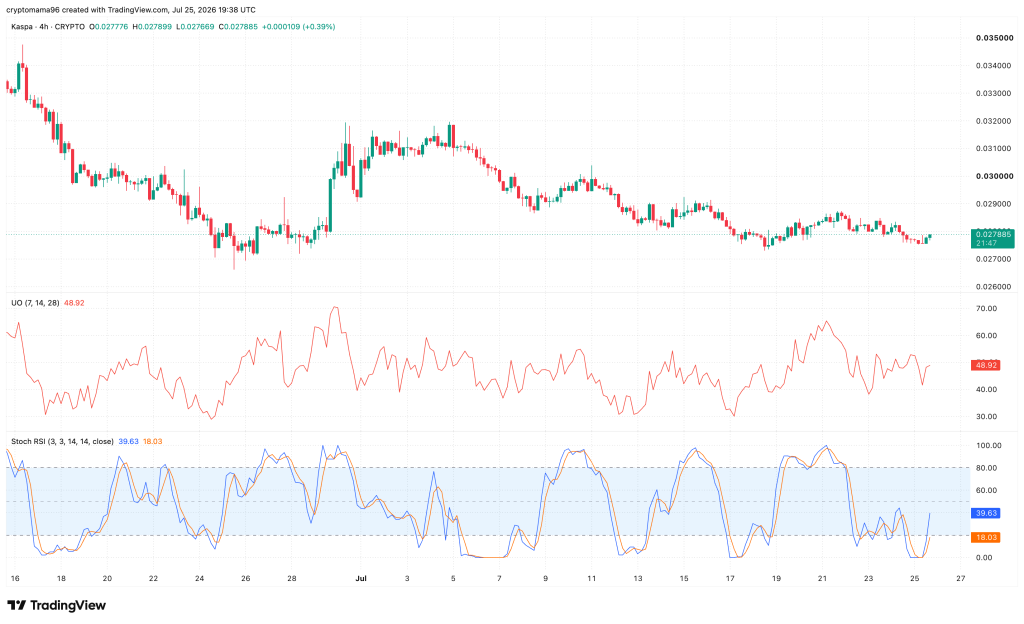
The 4-hour chart reveals Kaspa trading in a narrow range between $0.0275 and $0.0288 over recent sessions. The Ultimate Oscillator sits near 49, indicating balanced momentum with neither buyers nor sellers in control. The Stochastic RSI recently bounced from oversold territory, suggesting buyers are attempting to regain short-term momentum.
Key support levels:
- $0.0270–$0.0275 (major support)
- $0.0255 (next downside support)
Key resistance levels:
- $0.0300 (psychological resistance)
- $0.0325–$0.0330
- $0.0350 (major breakout level)
Price Scenarios for the Week Ahead
The technical structure indicates Kaspa could remain range-bound unless buyers generate sufficient volume to breach resistance. A decisive move above $0.0290–$0.0300 would likely attract additional buying interest.
Bullish scenario: If Kaspa maintains support above $0.0275 and reclaims $0.0300, the next upside targets are $0.0325 and $0.0350. A breakout above $0.035 would invalidate the recent lower-high pattern and could trigger a stronger recovery. If broader crypto sentiment improves alongside post-upgrade optimism, Kaspa may experience increased buying pressure.
Bearish scenario: A failure to defend $0.0270 would expose $0.0255 and subsequently $0.0240.
Outlook: Fundamentals and Technicals Converge
Kaspa currently sits at a notable juncture. The Toccata upgrade has strengthened the network's technical capabilities, but the market has not yet fully priced in the potential of these developments. The ecosystem is in a building phase, with developer tooling and early application activity representing the next milestones to monitor.
The technical picture remains cautious. Kaspa has successfully defended the $0.0270 support zone, yet sellers have maintained control of the broader trend. Consolidation near support often precedes a larger directional move, though the direction remains uncertain without a clear catalyst.
For this week, $0.0300 is the critical level to monitor. A breakout above it could open a path toward $0.0325–$0.0350, while losing $0.0270 would likely shift momentum back in favor of sellers. Volume confirmation will be essential for any sustained directional move.

