Intel Q2 2026 Earnings: $16.1 Billion Revenue Rebound Meets an $11 Billion GAAP Loss
Key Takeaways
- •Intel’s revenue increased 25% year over year to $16.1 billion, its fastest growth in more than 15 years.
- •The company reported an $11.0 billion net loss, but the main driver was a non-cash mark-to-market loss on escrowed shares rather than an operating collapse.
- •Data Center and AI revenue rose 59% to $6.3 billion, while Client Computing and Physical AI Group revenue increased 13% to $8.9 billion.
- •Intel Foundry revenue reached $5.8 billion, but $5.5 billion of intersegment eliminations show that much of the volume came from internal business.
- •Intel forecast third-quarter revenue of $15.8 billion to $16.8 billion and projected GAAP gross margin of 41.0%.
Intel's Quarter Had Two Very Different Headlines
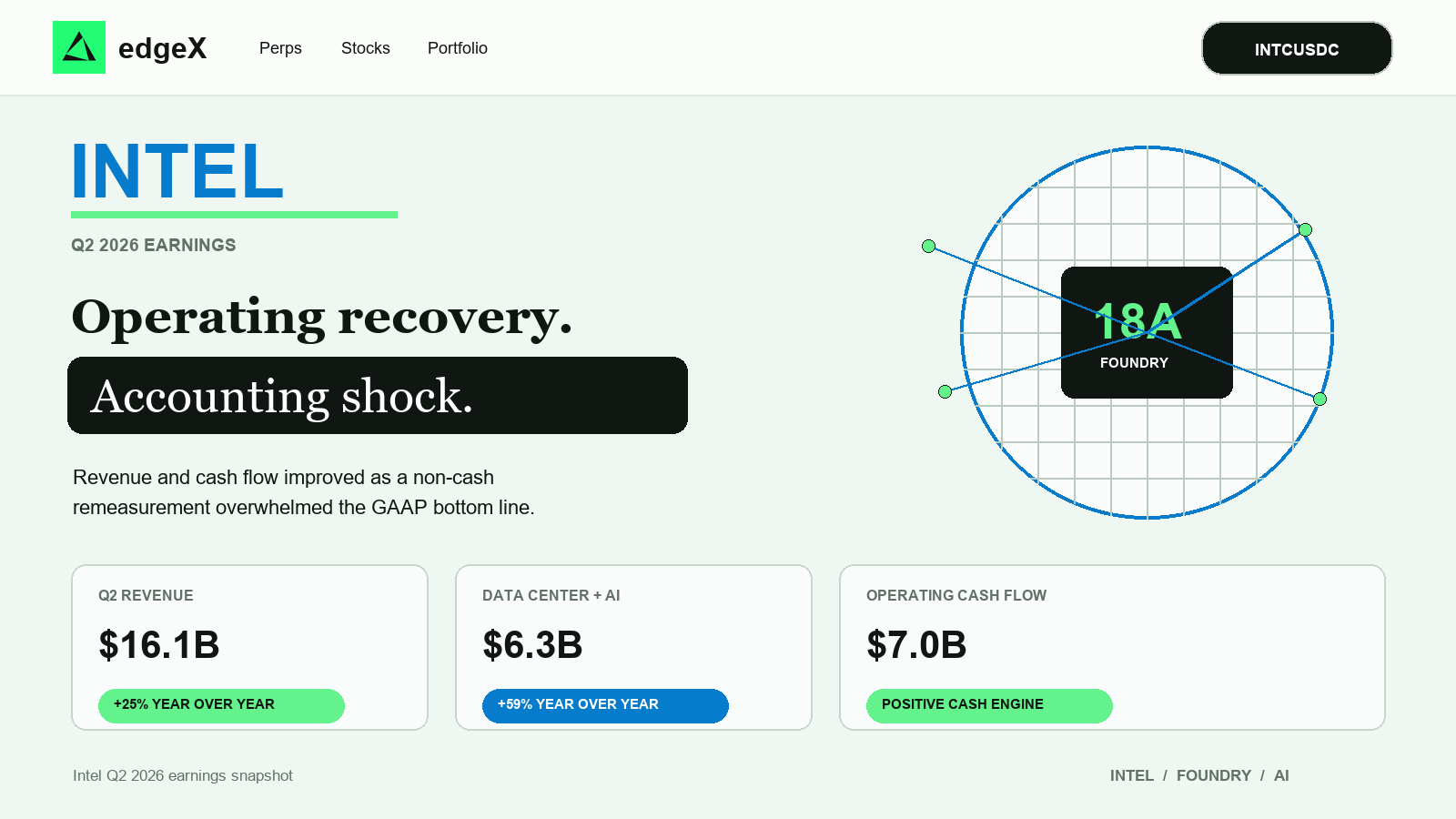
Intel's July 23 report presented investors with an unusual split screen. One side showed the most convincing operating progress the company has delivered in years: revenue grew 25%, GAAP gross margin reached 40.4%, GAAP operating margin returned to 11.1%, and operating cash flow climbed to $7.0 billion. The other side showed a $11.0 billion net loss attributable to Intel and a diluted loss of $2.16 per share.
Both statements are true, but they describe different parts of the quarter. Intel's core business generated positive operating income. The net result was overwhelmed below the operating line by a large mark-to-market loss associated with escrowed shares. That distinction matters because a reader who stops at the bottom-line loss could mistake an accounting remeasurement for an equivalent operating cash burn.
The cleaner investor question is therefore not whether Intel lost $11 billion in its factories and product businesses. It did not. The question is whether the underlying recovery is strong enough to absorb heavy capital requirements, sustain margin improvement and build a foundry business that can win customers outside Intel itself.
The Numbers Behind Intel's Q2 2026 Earnings
Intel's fiscal second quarter ended June 27, 2026. The company reported stronger growth across products and foundry operations, while the gap between GAAP and non-GAAP earnings became unusually wide.
| Metric | Q2 2026 Result | Investor Read |
|---|---|---|
| Revenue | $16.1 billion | Up 25% year over year; strongest growth in more than 15 years |
| GAAP gross margin | 40.4% | Up 12.9 percentage points year over year |
| GAAP operating income | About $1.8 billion | Positive operating result despite the headline net loss |
| GAAP net loss attributable to Intel | $11.0 billion | Dominated by a non-operating mark-to-market loss |
| Non-GAAP net income | $2.2 billion | Shows the scale of the accounting reconciliation |
| Operating cash flow | $7.0 billion | Strong cash generation from operations during the quarter |
| Data Center and AI revenue | $6.3 billion | Up 59% year over year |
| Intel Foundry revenue | $5.8 billion | Up 31%, with substantial internal sales eliminated in consolidation |
| Q3 revenue guidance | $15.8 billion-$16.8 billion | Midpoint of $16.3 billion |
The comparison also needs a portfolio caveat. Intel sold a 51% interest in Altera in September 2025 and deconsolidated the business, so year-over-year totals are not perfectly like for like. Even with that complication, the product-group growth and margin recovery point to a substantially healthier operating quarter.
Why an $11 Billion Loss Did Not Mean an $11 Billion Operating Collapse
Intel reported approximately $1.8 billion of GAAP operating income, then recorded $12.576 billion of expense within “interest and other, net.” Its cash-flow reconciliation separately identified $13.619 billion of mark-to-market losses on escrowed shares. That non-cash remeasurement was the main reason the income statement moved from positive operating income to a huge net loss.
GAAP and non-GAAP answer different questions
GAAP captures the accounting effect that shareholders are entitled to see, including changes in the value of financial instruments. Non-GAAP results remove selected items to show how management views continuing operations. Neither presentation should be read alone. The GAAP loss matters because it affects reported equity and reflects a real economic exposure, even when the quarterly charge is non-cash. The non-GAAP result matters because it helps isolate the performance of processors, foundry operations and corporate costs.
The $2.2 billion non-GAAP net income figure should not be treated as a replacement for GAAP. It is a bridge to understanding why the quarter's operating direction differed so sharply from the statutory bottom line.
Cash flow provides the strongest reality check
Operating cash flow of $7.0 billion makes the same point from a different angle. Intel did not consume $11 billion of operating cash during the quarter. Still, cash generation is not the same as free cash flow. Semiconductor manufacturing requires substantial spending on fabrication plants, advanced tools and process development, and investors must compare operating cash inflows with capital expenditure and funding commitments over time.
For Intel, this is especially important. A foundry turnaround can create strategic value, but it can also absorb cash well before external customer revenue reaches scale.
Data Center and AI Growth Strengthened the Product Story
Data Center and AI revenue reached $6.3 billion, up 59% from the prior year. The result shows Intel benefiting from the AI infrastructure buildout, though its exposure differs from the accelerator-led stories associated with Nvidia and AMD.
Xeon remains Intel's route into AI infrastructure
Intel's opportunity is centered on server CPUs, host processing, inference and integrated rack systems. During the quarter, the company highlighted rack-scale AI infrastructure and disaggregated inference solutions using Xeon. Intel, SambaNova and Foxconn also demonstrated production-ready rack-scale infrastructure.
That positioning can be valuable as AI spending broadens from training clusters toward inference and enterprise deployment. Accelerators attract the largest headlines, but servers still need CPUs, memory access, networking and orchestration. Intel can participate without winning the leading share of the merchant AI accelerator market.
The risk is that strong data-center growth may not automatically translate into the valuation premium attached to specialized AI compute. Investors need evidence that Xeon demand is durable, product competitiveness is improving and system-level partnerships create attractive margins rather than merely higher volume.
Client Computing Is Recovering, but It Cannot Carry the Thesis Alone
Client Computing and Physical AI Group revenue rose 13% to $8.9 billion. That remains Intel's largest product business and gives the company scale across notebooks, desktops, edge systems and emerging robotics applications.
Intel said more than 130 customers were adopting or testing Core Ultra Series 3 and Core Series 3 for edge AI and robotics. This widens the addressable market beyond conventional PC replacement cycles. Yet AI-PC branding alone will not settle the investment case. The measurable questions are unit demand, average selling prices, channel inventory and whether new platforms improve gross margin.
The client business can stabilize revenue and fund development, but it is still exposed to replacement cycles and competition. A durable Intel rerating requires client execution to work alongside data-center growth and foundry progress, not substitute for them.
Intel Foundry Grew, but External Validation Remains the Test
Intel Foundry reported $5.8 billion of revenue, up 31%. That number looks large beside total company revenue, but it cannot be interpreted like an independent contract manufacturer's sales. Intel recorded $5.5 billion of intersegment eliminations because much of the foundry output was sold to Intel's own product groups.
Internal production proves capability, not market demand
Manufacturing Intel products on Intel processes can improve utilization and demonstrate technical progress. It does not by itself prove that external chip designers will commit leading-edge programs. Outside customers evaluate yield, cost, design tools, intellectual-property libraries, packaging, delivery reliability and the risk of depending on a supplier that also sells competing processors.
That is why external foundry wins matter more than the segment's headline revenue. Investors should look for named customer commitments, tape-outs, volume schedules and evidence that external business can improve the economics of Intel's manufacturing network.
Intel 18A is moving from promise toward production
Intel said Xeon 6+ is its first server-class product on Intel 18A. Intel 18A-P entered risk production, and a subset of Panther Lake entered high-volume manufacturing using ASML EXE High-NA EUV equipment. These milestones move the process story closer to commercial reality.
Execution risk remains high. Leading-edge manufacturing is judged by yield, performance, power, cost and repeatability, not by milestone language alone. Intel's announced €5 billion investment to expand manufacturing and Xeon capacity also reinforces the capital intensity of the strategy. The more Intel invests, the more important utilization and customer commitments become.
Q3 Guidance Keeps the Recovery on Trial
Intel guided for third-quarter revenue between $15.8 billion and $16.8 billion. At the $16.3 billion midpoint, revenue would be slightly higher than Q2. Management also projected GAAP gross margin of 41.0%, non-GAAP gross margin of 42.0%, GAAP diluted earnings of $0.31 per share and non-GAAP diluted earnings of $0.38.
The guide suggests stability rather than another dramatic step-up. That can still support the recovery if margins hold and product demand remains broad. It also raises the bar for execution: after a 25% revenue increase, investors will want proof that the rebound is not simply a favorable comparison or a short restocking cycle.
Three signals matter most. First, Data Center and AI should continue to outgrow the company without sacrificing profitability. Second, gross margin should advance as product mix and manufacturing efficiency improve. Third, foundry disclosures should show more evidence of external adoption, not only higher internal volume.
The Bull Case, Bear Case and Most Plausible Middle Path
The bull case is that Intel has reached the point where product recovery and manufacturing recovery reinforce each other. Xeon gains from AI inference and server refresh demand, client platforms defend scale, Intel 18A improves competitiveness, and external foundry customers raise utilization. In that scenario, revenue growth and margin expansion turn heavy investment into stronger cash returns.
The bear case is that the quarter's growth proves cyclical recovery but not structural advantage. Foundry revenue remains largely internal, advanced-node costs stay high, and competitors preserve stronger positions in accelerators, server CPUs or manufacturing. Intel could then grow revenue while still struggling to earn an adequate return on its capital base.
The middle path is a gradual operating repair. Intel does not need to displace the AI leaders to improve, but it does need consistent product delivery and credible foundry milestones. The stock's outcome would then depend less on one quarter's accounting shock and more on whether margins, cash generation and external customer commitments improve over several reporting periods.
What Intel Investors Should Watch Next
The next Intel report should be read through a connected dashboard: revenue against the $16.3 billion Q3 midpoint, gross margin against the 41% GAAP guide, Data Center and AI growth, client demand, operating cash flow, capital spending, 18A yields and external foundry commitments.
Investors should also separate recurring economics from unusual accounting movements. The escrowed-share remeasurement may remain volatile, while operating income and cash flow provide a clearer view of semiconductor execution. Conversely, adjusted earnings should never be used to ignore the cost and risk of Intel's capital structure and strategic commitments.
Q2 showed that Intel's operating recovery is becoming visible. It did not prove that the turnaround is complete. The decisive evidence will come from repeatable margins, customer-backed foundry volume and cash returns that justify the scale of the manufacturing bet.
Trade Intel Perpetual Futures on edgeX
Intel earnings, product announcements and semiconductor policy can move expectations outside regular U.S. market hours. edgeX offers eligible traders self-custodial access to crypto, commodity and stock-linked perpetual markets through an on-chain trading platform.
Access the INTCUSDC market
The INTCUSDC perpetual market provides a dedicated Intel-linked contract for expressing long or short views. Traders should verify the market's current leverage, funding rate, fees, liquidity, order availability and contract specifications on the product page before entering a position.
Understand the instrument before trading
Perpetual futures are derivatives, not Intel common stock. They do not provide ownership, voting rights, dividends or other shareholder rights. Leverage magnifies gains and losses and can result in liquidation. Product availability may vary by jurisdiction, and self-custody does not remove market, smart-contract, liquidity or execution risk.
Frequently Asked Questions
When did Intel release its Q2 2026 earnings?
Intel released its second-quarter results on July 23, 2026. The fiscal quarter ended June 27, 2026.
What was Intel's Q2 2026 revenue?
Intel reported revenue of $16.1 billion, up 25% year over year.
Why did Intel report an $11 billion GAAP net loss?
The quarter included a large non-operating mark-to-market loss tied to escrowed shares. Intel still reported approximately $1.8 billion of GAAP operating income and $7.0 billion of operating cash flow.
How fast did Intel's Data Center and AI business grow?
Data Center and AI revenue reached $6.3 billion, an increase of 59% from the prior-year quarter.
Is Intel Foundry's $5.8 billion revenue mostly external?
No. A substantial portion came from Intel's own product groups, which is why the consolidated results included $5.5 billion of intersegment eliminations. External customer adoption remains the more important validation test.
What did Intel guide for Q3 2026?
Intel expects revenue of $15.8 billion to $16.8 billion, GAAP gross margin of 41.0% and non-GAAP diluted earnings of $0.38 per share.
Is the Intel share price in this article live?
No. Verify the latest Intel quote through Nasdaq, a broker or a real-time market-data service before making a trading decision.

