Hedera (HBAR) Starts Week Near $0.0699 as RWA Activity, EVM Compatibility and Token Unlock Draw Attention
Key Takeaways
- •HBAR traded at $0.0699 after a 0.12% daily decline, with volume falling more than 33%.
- •Santiment ranked Hedera first in real-world asset development activity over the past 30 days with a score of 278.17.
- •Hedera reported $3.5 million in distributed value in tokenized non-U.S. government debt after 102% growth.
- •The network added full Ethereum Virtual Machine compatibility to its Smart Contract Service for Solidity developers.
- •HBAR’s near-term price range centers on support around $0.069 and resistance near $0.0715–$0.0720.
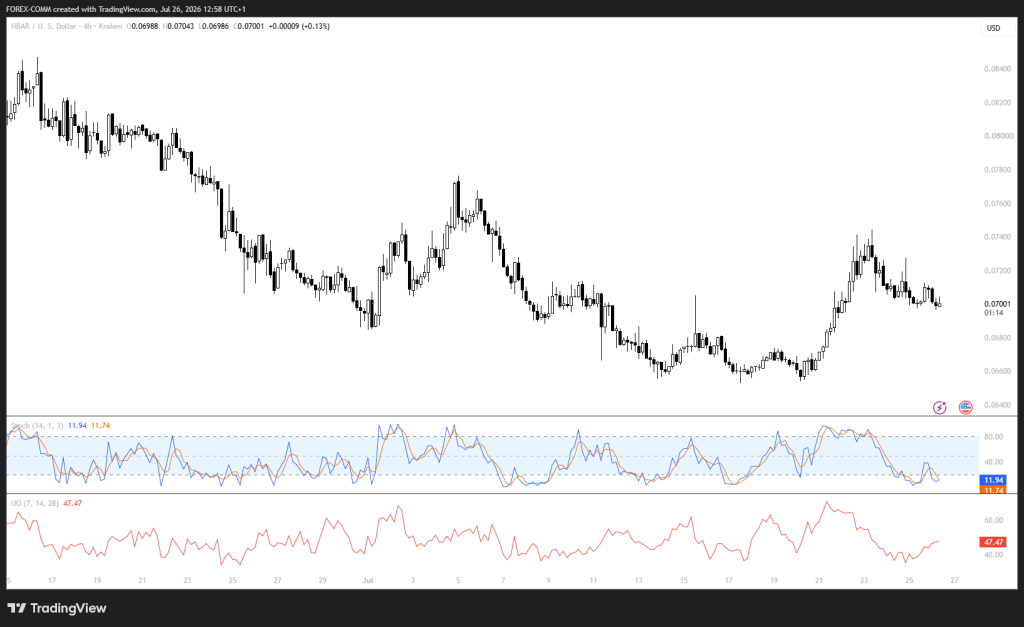
Hedera’s HBAR token began the week with limited price movement, trading at $0.0699 after a 0.12% decline over the previous 24 hours. Trading volume fell 33%, indicating weaker short-term market activity as traders watched whether the token would hold nearby support or continue moving sideways.
Several developments around the Hedera network remain in focus. Hedera has entered the tokenized non-U.S. government debt market, reaching $3.5 million in distributed value after 102% growth. The network is also facing continued discussion over the planned release of more than 4 billion HBAR this quarter. Token unlocks are closely watched because they increase the amount of circulating supply according to a preset schedule, though their market impact depends on factors such as recipient behavior, liquidity and broader demand. Some market participants have expressed concern about the size of the unlock, while many community members have said the schedule is already known and that the release is intended to support ecosystem growth rather than create immediate selling pressure.
Hedera Developments This Week
Hedera continues to rank highly in one of the cryptocurrency sector’s fastest-growing areas: real-world assets, or RWAs. Santiment ranked Hedera first in RWA development activity over the past 30 days with a score of 278.17, placing it ahead of other blockchain networks tracked in the category.
RWAs refer to blockchain-based representations of off-chain assets such as debt instruments, funds or other financial products. The category has drawn attention because it connects public and enterprise blockchain infrastructure with traditional financial markets, where settlement, transparency and compliance requirements are central considerations. The ranking reflects strong GitHub activity and ongoing protocol development, which may be relevant as institutions explore blockchain-based asset tokenization. Hedera’s move into tokenized non-U.S. government debt adds to that activity, with the network reporting $3.5 million in distributed value and 102% growth.
Hedera has also expanded support for Ethereum developers. The network added full Ethereum Virtual Machine compatibility to its Smart Contract Service, allowing Solidity developers to deploy applications using existing Ethereum tooling without rewriting applications from the ground up. EVM compatibility matters because Ethereum’s developer stack remains one of the most widely used in crypto, and support for familiar tools can reduce friction for teams evaluating multiple chains. Lower migration complexity and familiar developer tools could make Hedera more accessible to builders already working in the Ethereum ecosystem.
Infrastructure upgrades are another major area of attention. Cheeky Crypto pointed to Hedera’s v0.74 mainnet upgrade, which was designed after the network processed more than 72 billion transactions. The upgrade separates live consensus from historical data storage through dedicated block nodes, reducing pressure on consensus nodes and supporting long-term scalability as activity on the network grows.
This HBAR Data Just Forced a Major Upgrade HBAR’s 72 billion transactions created a problem most holders never see: the network’s history was becoming too heavy to ignore. This video explains why Hedera’s v0.74 mainnet upgrade separates live consensus from historical storage,… pic.twitter.com/TvAdQOr2D1 — Cheeky Crypto (@CheekyCrypto) July 26, 2026
https://x.com/CheekyCrypto/status/2081303762447065182?ref_src=twsrc%5Etfw
HBAR Price Chart Levels
On the chart, buyers have been attempting to stabilize HBAR after last week’s move from $0.066. That advance reached approximately $0.073 before sellers appeared, and the token has since moved back toward the $0.070 support area. In recent sessions, price action has narrowed, suggesting neither buyers nor sellers have established clear short-term control.
Technical indicators remain mixed. The Stochastic reading is 11.94, placing it deep in oversold territory. A reading below 20 is often associated with potential short-term rebound conditions, but confirmation typically requires price to move back above nearby resistance. The Ultimate Oscillator is at 47.47, near the middle of its range, indicating that buying pressure has eased but has not disappeared.
The broader short-term structure remains above last week’s low near $0.066. As long as buyers continue to defend the $0.069–$0.070 area, the recovery from July’s lows remains intact. The first resistance zone to watch is $0.0715–$0.0720, where sellers halted the previous recovery attempt.
If HBAR moves above that range, the recent high near $0.0735 becomes the next reference level. A further move could bring $0.075–$0.076 into focus, but the source analysis said such a move would require stronger volume.
If sellers push HBAR below $0.069, the next downside level is $0.067. A break below that area would bring $0.065–$0.066 back into view, a zone described as one of the strongest demand areas during the month. For now, the chart points to continued sideways movement unless support or resistance breaks with meaningful volume.
Possible HBAR Scenarios This Week
For HBAR to strengthen, buyers would first need to reclaim $0.0715. A move through that level could put $0.0735 back in focus, followed by $0.0760 if buying volume increases. The source cited Hedera’s real-world asset activity, EVM compatibility and expanding ecosystem as fundamental factors supporting interest in the network.
If conditions remain unchanged, HBAR could continue trading between $0.069 and $0.072 during the week. Declining volume and mixed indicators suggest the token is waiting for a stronger catalyst before making a decisive move.
The weaker scenario would begin if $0.069 fails as support. That would expose $0.067, followed by the July swing low near $0.065. Concerns surrounding the upcoming HBAR unlock could also weigh on short-term sentiment if selling pressure increases.
HBAR remains under pressure after trading volume fell by more than 33%, reducing short-term buying activity. At the same time, Hedera’s RWA growth, full EVM compatibility and continued network development are helping keep attention on the asset while it trades near key support around $0.069.
A move toward higher levels would require buyers to regain the $0.0715–$0.0720 resistance area with stronger volume. If that happens, HBAR could retest $0.0735 before the $0.075–$0.076 zone becomes relevant later in the week. However, the token’s performance will still depend on broader cryptocurrency market conditions, liquidity and continued ecosystem adoption.

