Hashdex Revises NCIQ Staking Terms to Give Sponsor 100% of Initial Rewards
Key Takeaways
- •Hashdex amended NCIQ’s sponsor agreement to allow staking of the fund’s crypto assets and created a new Sponsor Share class.
- •The Sponsor Share receives 100% of Net Staking Income up to 25 basis points of net asset value attributable to common shares.
- •Common shareholders receive 60% of Net Staking Income generated above the initial 25-basis-point threshold.
- •NCIQ targets staking equal to 10% to 20% of the Trust’s total net asset value, so only part of eligible assets is expected to be staked.
- •Ethereum is NCIQ’s largest stakable holding, representing 11.75% of the fund as of July 24, 2026.
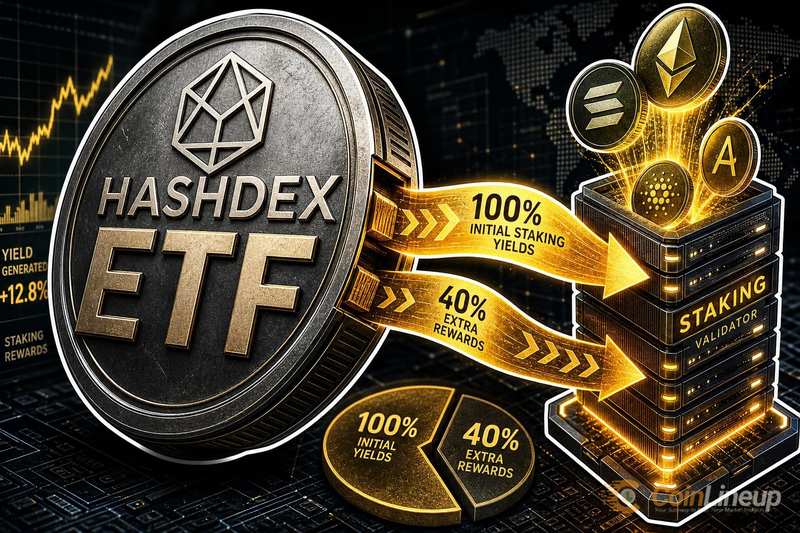
Hashdex has revised the staking economics of its Nasdaq CME Crypto Index ETF (NCIQ), creating a structure under which the fund’s Sponsor Share receives 100% of the initial staking yield and 40% of additional rewards above that level, according to SEC filings dated July 23, 2026.
The change establishes the staking-reward allocation that determines how on-chain income from the fund’s crypto assets is distributed between the Sponsor Share and the Trust’s common shareholders. In a multi-asset crypto fund, that allocation matters because staking income is generated only by proof-of-stake holdings that are actually staked, rather than by every asset in the portfolio.
How NCIQ’s Staking Rewards Are Allocated
The revised arrangement uses a tiered distribution model. Under the new terms, the Sponsor Share receives all Net Staking Income up to 25 basis points of net asset value attributable to NCIQ common shares before any staking income is allocated to the Trust.
In practical terms, the initial staking yield consists of the first portion of on-chain rewards, capped at 25 basis points. That entire amount goes to the sponsor. Any staking income generated above that threshold is treated as additional yield.
Once Net Staking Income exceeds the 25-basis-point level, the excess amount is divided between the Sponsor Share and the Trust. The Sponsor Share receives 40% of the additional Net Staking Income, while the remaining 60% is allocated to the Trust for common shareholders.
Hashdex disclosed the change in an 8-K filed on July 23, 2026, stating that the Trust amended its sponsor agreement to permit staking of the fund’s crypto assets. A Sixth Amended and Restated Trust Agreement created the new Sponsor Share class on the same day.
The Sponsor Share’s staking return is separate from, and not netted against, NCIQ’s 0.25% management fee. As a result, the staking allocation is added on top of the fund’s existing expense charge rather than offsetting it.
Implications of the Structure for Common Shareholders
The design directs the full base layer of staking rewards to the sponsor while allowing common shareholders to participate in most of the staking income generated above the initial threshold. Common shareholders receive no allocation from the first 25 basis points of Net Staking Income, then receive 60% of any excess amount above that level.
The amount of income the fund can generate depends in part on how much of its assets are staked. Hashdex’s NCIQ product page lists a target staking range of 10% to 20% of the Trust’s total net asset value, meaning only a portion of eligible assets is expected to be staked at any given time.
Validator and staking-service costs also reduce the gross reward amount before the income is distributed under the waterfall. Staking service provider fees are 8% of gross rewards for Ethereum, 8% for Solana, and 5% for Cardano. The Net Staking Income subject to the 100% and 40% allocation formula is therefore already net of those provider charges.
The prospectus supplement also states that common shareholders bear market risk on accrued staking rewards until an in-kind distribution occurs. That disclosure addresses the timing risk associated with passing staking rewards through to shareholders in a fund structure, where rewards may accrue before they are delivered to holders.
Ethereum Is the Largest Stakable Holding
Ethereum is currently the largest stakable asset in NCIQ. As of July 24, 2026, Ethereum accounted for 11.75% of the fund’s holdings, followed by Solana at 3.17% and Cardano at 0.49%. Because of that weighting, ETH staking economics are the primary driver of the fund’s potential on-chain income from stakable assets.
Ether traded at $1,935.44 at press time, up 3.26% over 24 hours, according to market data from CoinGecko. The Crypto Fear & Greed Index from Alternative.me read 26, categorized as “Fear.”
The tiered staking-income policy gives NCIQ an explicit framework for allocating validator-generated rewards within a crypto index ETF structure. It also reflects ongoing experimentation by issuers that have added staking mechanics to exchange-traded products holding proof-of-stake assets, while disclosing how rewards, service-provider fees, and sponsor economics interact.
Hashdex’s NCIQ page notes that the product is not registered under the Investment Company Act of 1940. That structural detail is part of the fund’s stated framework alongside the sponsor-first staking allocation and the separate 0.25% management fee.

