EU Expands Belarus Crypto Ownership Ban to All MiCA-Regulated Firms Starting August 25
Key Takeaways
- •The new EU restriction applies to Belarusian nationals and residents connected to EU-regulated crypto businesses under the MiCA framework.
- •Council Decision (CFSP) 2026/1847 broadens an earlier Belarus sanctions rule that had focused only on wallet, account, and custody services.
- •MiCA-covered services include trading platforms, exchange services, client order execution and transmission, transfers, advisory, and portfolio management.
- •The expanded crypto-specific restriction will become applicable on August 25, although the decision entered into force upon adoption.
- •EU crypto firms may need to assess shareholder registers, controlling persons, management roles, and board appointments for Belarusian nationality or residency links.
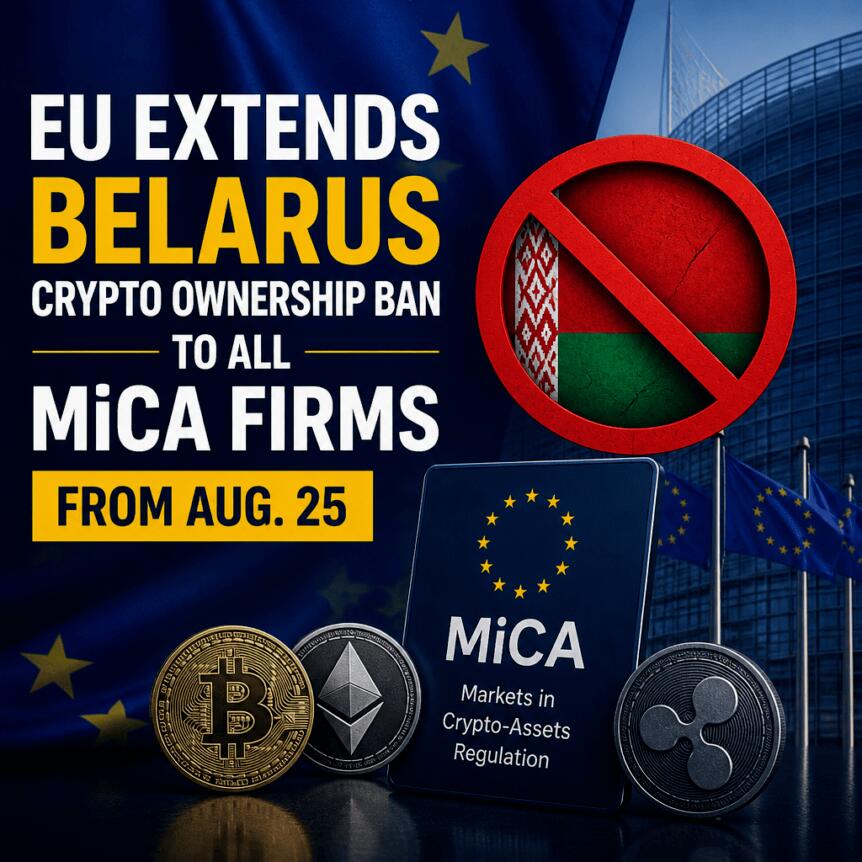
The European Union is tightening crypto-related sanctions linked to Belarus, effectively barring Belarusian nationals and residents from holding ownership or controlling roles in a broad range of EU-regulated crypto businesses. The new restriction will apply to crypto exchange and custody providers operating under the EU's Markets in Crypto-Assets (MiCA) framework, taking effect August 25.
The amendment is contained in Council Decision (CFSP) 2026/1847, adopted Thursday. It modifies the EU's existing sanctions regime targeting Belarus for its role in Russia's war against Ukraine, significantly broadening an earlier limitation that applied only to wallet, account, and custody services. Belarus has served as a staging ground for Russian military operations and has faced EU sanctions since 2022 alongside Russia.
Scope of the Expanded Sanctions
Under the Council Decision, Belarusian nationals and residents are prohibited from owning or controlling any EU-based entity that provides "any other crypto-asset services" as defined under MiCA. They are also barred from holding positions on such entities' governing bodies, meaning the restrictions target both governance influence and economic control.
The practical relevance of this measure is underscored by Belarus's own history with crypto regulation. In 2017, Belarus legalized crypto-related business activities through a decree establishing the High Technologies Park, creating a favorable environment that attracted crypto exchanges, mining operations, and blockchain firms. Belarusian nationals and entities have since been active participants in the global crypto sector, including in EU jurisdictions.
MiCA defines "crypto-asset services" broadly, encompassing the operation of trading platforms, crypto-asset exchange services, execution and transmission of client orders, placement of crypto assets, and transfer services. The framework also covers advisory and portfolio management activities, allowing the expanded sanctions to reach multiple business lines well beyond custody.
While the decision entered into force immediately upon adoption, the expanded crypto-specific restriction does not take effect until August 25, giving regulated firms a narrow window to evaluate whether their current ownership, management, or board structures could be affected.
Post-Transition MiCA Landscape
The EU's move follows the conclusion of MiCA's transition period on July 1, after which crypto companies lacking the required authorizations were instructed to cease operations or face enforcement. Against that backdrop, the new sanctions measure introduces an additional compliance layer for firms navigating the post-transition MiCA environment.
Rather than addressing licensing and operational rules alone, the EU is now intertwining MiCA market regulation with sanctions screening, particularly regarding personnel and governance structures. Compliance teams must review ownership stakes, board seats, and day-to-day control arrangements through both the MiCA and sanctions lenses.
This creates a dual-gate system: a firm may hold MiCA authorization yet still be compelled to restructure if it falls within the sanctions framework's constraints. MiCA licensing standardizes crypto services across the bloc, but sanctions can independently restrict who is permitted to participate in certain roles, regardless of regulatory approval.
Broader EU Sanctions Strategy on Crypto
The Belarus amendment aligns with a wider series of EU actions targeting crypto platforms and financial networks allegedly used to circumvent sanctions related to Russia's war in Ukraine. The EU has progressively expanded its approach through successive sanctions packages and transaction bans covering crypto-related entities. These measures complement parallel efforts by the United States, where the Treasury Department's Office of Foreign Assets Control has designated numerous Russia-linked crypto addresses and entities under its own sanctions authority.
Earlier in the week, as part of its 21st sanctions package against Russia, the EU extended a transaction ban to 14 crypto-related service platforms located outside the bloc. It also introduced a mechanism enabling the EU to prohibit dealings with any foreign crypto provider identified as being used by Russia for sanctions evasion. That package built on a June 11 proposal that had targeted 11 crypto platforms.
The sanctions tightening has also been shaped by allied measures. The proposal reportedly followed the United Kingdom's May 26 sanctions against Huobi Global S.A., the Panamanian company behind HTX, over alleged support for Russia-linked financial networks involving the sanctioned entities A7 and Garantex. HTX denied the allegations, telling Cointelegraph that regulatory compliance remains a priority and that it adheres to regulatory frameworks in all jurisdictions where it operates.
Implications for EU Crypto Firms and Boards
Because the amendment explicitly addresses governance, EU-facing crypto firms cannot treat sanctions compliance solely as a customer-onboarding or screening obligation. The provision targets who may own, control, manage, or serve on governing bodies—placing internal corporate structure squarely within sanctions risk management.
For businesses offering MiCA-listed services, from trading and exchange operations to transfers and portfolio management, the change likely necessitates a review of shareholder registers, controlling persons, executive roles, and board appointments connected to Belarusian nationality or residency.
The measure also broadens an existing Belarus-related restriction. By extending coverage from wallet, account, and custody services into "any other crypto-asset services" under MiCA, the EU signals that it regards the crypto sector as an interconnected set of services rather than isolated product lines. Companies that previously considered themselves outside the sanctions perimeter based on their service type may need to reassess their exposure.
Enforcement of EU sanctions falls to individual member states, each of which maintains its own penalty framework for violations, meaning firms should consult both EU-level guidance and national implementing legislation.
For investors and counterparties, the restrictions carry implications for operational continuity and due diligence. Business partners may increasingly incorporate sanctions-driven corporate eligibility into their counterparty risk assessments, particularly where controlling persons or board members could become subject to future amendments.
The key dates going forward are the August 25 applicability deadline and the concrete steps firms take to ensure compliance, especially any adjustments to ownership structures or governance appointments. The EU's pattern of expanding crypto sanctions indicates that additional service categories, jurisdictions, or transaction rules may follow, even as MiCA continues to implement its licensing and enforcement regime across member states.

