EU Expands HTX Enforcement as Russia-Linked Crypto Network Shifts Financial Rails
Key Takeaways
- •The EU has intensified sanctions enforcement against HTX, formerly known as Huobi, as part of a broader initiative targeting Russia-linked digital asset activity.
- •The EU's latest Russia sanctions package extends official designations to cryptocurrency platforms directly, moving beyond earlier measures focused on traditional financial institutions and specific individuals.
- •A network associated with the targeted activity has already begun shifting its financial infrastructure to alternative platforms and settlement paths in response to heightened sanctions scrutiny.
- •Rail-shifting by sanctioned networks complicates compliance monitoring because existing transaction screening protocols are calibrated to known infrastructure and lag behind when activity migrates.
- •The UK has similarly designated cryptoasset exchanges in its own sanctions expansion, reinforcing a coordinated cross-jurisdictional approach to regulating digital asset platforms.
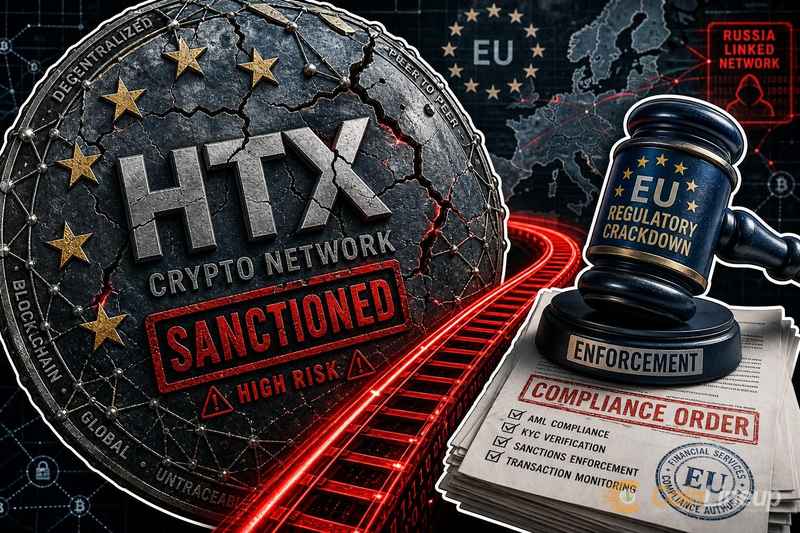
The European Union has intensified its enforcement pressure on the HTX cryptocurrency exchange—formerly known as Huobi, one of the larger global trading platforms by volume—as part of a broader sanctions initiative aimed at Russia-linked digital asset activity. According to recent reporting, a network associated with the targeted activity has already begun shifting the financial infrastructure it relies on to transfer value.
The EU's action against HTX aligns with a wider pattern of European and allied measures directed at crypto platforms accused of facilitating sanctioned transactions. Since Russia's 2022 invasion of Ukraine, the EU has progressively expanded its sanctions framework, with digital assets drawing particular regulatory focus because they can move cross-border without traditional banking intermediaries.
Scope of the EU's Expanded Action
The enforcement push builds on the EU's most recent Russia sanctions package, which extended official designations to cryptocurrency platforms themselves, rather than limiting measures to traditional banks and named individuals. This expansion was highlighted in a Chainalysis analysis of the package.
By naming exchanges directly in its designations, the EU has gone beyond earlier measures that focused primarily on financial institutions and specific persons. For a platform such as HTX, being brought within that scope creates immediate reputational exposure and places pressure on banking relationships, custody arrangements, and counterparty connections, even where formal restrictions have yet to be fully defined.
Official designations and their scope are published through the European Council's press releases.
How the Russia-Linked Network Shifted Its Rails
In this context, "financial rails" refers to the underlying channels, tokens, exchanges, and counterparties that a network depends on to send, receive, and liquidate value. Changing rails means rerouting activity through different infrastructure to reduce detection and sanctions exposure.
Reporting indicates that the associated network began moving away from channels now subject to heightened scrutiny, redirecting activity toward alternative platforms and settlement paths. Analysts describe this as a pattern of adaptation under enforcement pressure rather than routine operational adjustment. The shift is being interpreted as a direct response to designation risk.
This behavior mirrors what allied regulators have observed elsewhere. The UK moved to designate cryptoasset exchanges as part of its own sanctions expansion, as documented by Elliptic, reinforcing that rail-shifting tends to follow coordinated cross-jurisdictional designations.
Implications for Crypto Compliance and Market Surveillance
Exchanges and service providers operating in or near sanctioned corridors face the greatest likelihood of similar scrutiny, especially those handling flows connected to newly designated platforms.
Rail-shifting creates significant complications for compliance monitoring. Transaction screening protocols, onboarding checks, and address-based controls are calibrated to known infrastructure. When a network migrates to new channels, existing detection models lag behind until they are updated to reflect the changes. This dynamic has driven demand for blockchain analytics tools that can trace funds across successive layers of intermediary wallets and swapping services.
Enforcement activity has accelerated across the digital asset sector, ranging from the EU's platform-level designations to U.S. actions such as the SEC's lawsuit against Mining Automatic over alleged fraud. The emerging trend points toward regulators naming platforms directly rather than pursuing only individual actors.
The compliance landscape is also reshaping exchange governance. Firms have begun adding regulatory and enforcement experience to their leadership teams, exemplified by Andrew Cuomo joining the OKX board as the exchange expands its U.S. operations.
Observers should monitor for the formal publication of EU designations, any explicit naming of HTX in official texts, and whether additional jurisdictions introduce parallel measures.

